Actor Fatigue vs Crowd Flow: Fundamentals of the Link
By 10 PM, Your Best Actor Is Already Done
A haunt operator described the pattern in the third weekend of October: "Our Clown Alley performer was the best we'd ever had. Preview weekend, flawless. First peak Saturday, excellent. Second peak Saturday, they started missing beats around 9:30. By third weekend they'd left the role."
Nothing had changed in the design or the script. What had changed was the cumulative fatigue load from operating under compressed flow conditions — back-to-back groups without adequate reset time, repeated physical exertions without recovery gaps, voice used at full intensity for 4-hour shifts without the 40-60 second rest between groups that the dispatch interval was supposed to provide.
When groups pile up and dispatch intervals collapse, the actor's rest-between-scares disappears. Not just the physical rest — the cognitive reset, the vocal recovery, the postural return to starting position. The fatigue and human performance framework identifies two compounding fatigue types: performance fatigability (the measurable decline in scare output — missed beats, reduced physical intensity, voice loss) and perceived fatigability (the subjective experience of exhaustion that affects motivation and execution quality). Both accelerate dramatically under compressed-flow conditions.
By peak weekend three, actors in compressed-flow conditions show vocal cord inflammation, reduced reaction-time precision, and diminished physicality. These are not signs of poor conditioning — they are physiological responses to a workload that crowd flow conditions made impossible to sustain.
The Mechanical Link Between Flow Compression and Fatigue Rate
The pressurized-water-in-pipes model clarifies why crowd flow compression directly accelerates actor fatigue. Think of each actor as a pump node in the pressure system — they deliver output (the scare) at each group arrival and then require a pressurization recovery period before delivering the next output. When flow is healthy and dispatch intervals are appropriate, the recovery period exists. When the pipe system backs up and groups arrive compressed, the pump node is running without recovery cycles.
A standard 90-second dispatch interval provides approximately 60 seconds of reset time after a 30-second scare execution. That 60 seconds allows for: physical return to starting position (10 seconds), vocal recovery (20 seconds), breathing reset (15 seconds), and mental framing reset for the next group (15 seconds). Under normal flow, this cycle sustains actor performance across a 4-hour shift with manageable fatigue accumulation.
When dispatch interval compresses to 60 seconds under peak-night pressure — a 33% reduction — the reset window shrinks to 30 seconds. Physical return still happens. Vocal recovery is partial. Breathing reset is partial. Mental framing barely occurs. Over 4 hours at this compressed rate, the cumulative deficit is approximately 2 hours of recovery time that the actor never received. By hour 3, performance fatigability is measurable. By hour 4, the scare is a shell of the rehearsed version.
NIOSH Center for Work and Fatigue Research documents the specific mechanisms: rotating shifts, long duty periods, and insufficient recovery are the primary fatigue drivers in high-demand roles. Haunt schedules match all three criteria, and compressed-flow conditions remove the one built-in recovery mechanism the dispatch interval provides. OSHA worker fatigue hazard guidance confirms that irregular-schedule, high-demand roles carry disproportionate fatigue risk — with accident rates 30% higher on night shifts — which is precisely the haunt actor role profile.
Actor fatigue and the actor timing basics in flow-constrained haunts are deeply intertwined: actors in compressed-flow conditions who cannot maintain reset windows begin using shorter timing windows, less precise execution, and abbreviated physical sequences — all of which are adaptive responses to cumulative fatigue that further degrade scare quality in a self-reinforcing loop.
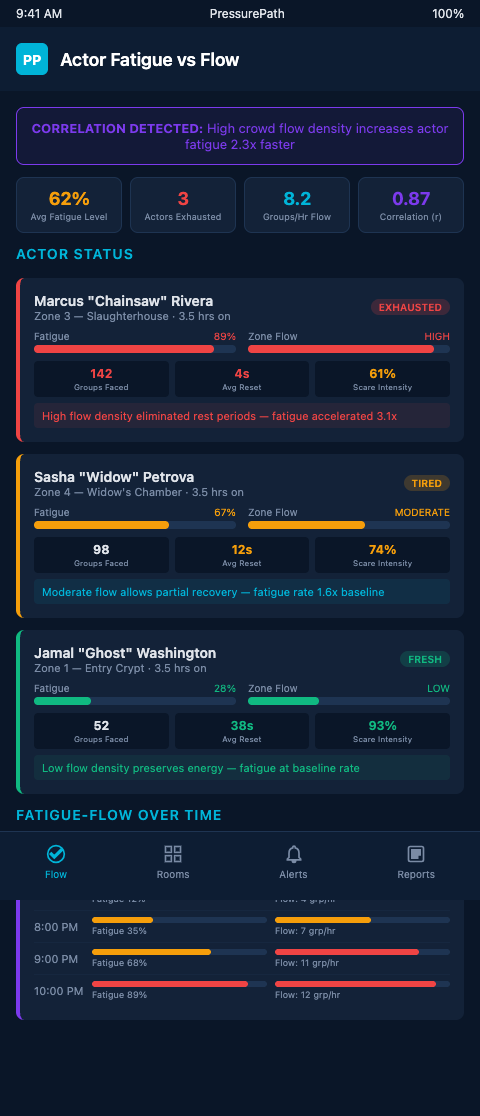
PressurePath models actor fatigue accumulation as a function of crowd flow. The simulation calculates reset-window compression for each actor position across your peak-night schedule, producing a fatigue-accumulation index per position per hour. You see which positions will exceed a sustainable fatigue threshold at which point during the night — not as a general estimate but as a specific, timestamped forecast derived from your actual dispatch interval and ticketing data.
Vocal cord damage from sustained screaming is a concrete physical outcome of inadequate recovery windows. When reset time between groups drops below 45 seconds, vocal cord inflammation rates increase significantly — Researchers tracking vocal cord damage from screaming document the progressive inflammation that follows repeated high-intensity vocal output without adequate recovery. Actors themselves confirm that fatigue causes missed cues, voice loss, and reduced physicality before the end of peak weekends. A flow model that preserves dispatch intervals protects actor voices, not just scare quality.
Industry surveys of growing attendance mean increasing actor workload per shift without proportional staffing increases. The link between crowding and actor fatigue is not theoretical — it is a documented occupational health risk that crowd flow management directly mitigates.
The 20-actor scare workflow must account for fatigue accumulation as an operational planning variable, not just as an actor welfare concern. When actor 7 in the chain is operating at 60% scare effectiveness because their reset window has been compressed for 3 hours, the downstream actors' timing is also affected — the group arrives with altered arousal state, and the cascade affects every position from the fatigue point forward.
Advanced Tactics: Protecting Actor Stamina Through Flow Management
The most effective actor fatigue management strategy is not a physical conditioning program — it is a crowd flow design that preserves the reset window. These tactics work in concert.
Fatigue-aware rotation scheduling. Map your actor rotation schedule against your flow model's reset-window compression forecast. Positions that your model shows will experience sustained reset-window compression of more than 20% during peak windows should have rotation cycles shortened by 30-40 minutes. Position actors with the highest physical demand requirements during the early window (7:30 PM to 9:00 PM), when flow conditions are healthiest, and rotate to less physically intensive positions or off-stage recovery during the peak compression window (9:00 PM to 10:30 PM).
Double-dispatch-cycle gap insertion. Schedule one intentional empty dispatch cycle every 20 minutes during peak windows at your highest-demand actor positions. This creates a 2-minute gap in the group sequence — invisible to the queue, which continues moving — that gives actors at those positions an extended recovery window without any operational change in guest experience. For a Clown Alley position under compressed flow, this single tactic can reduce hourly fatigue accumulation by 25-30%.
Vocal protection protocols. Haunt actors who rely on vocal scare delivery — screaming, shouting, character vocalizations — need enforced hydration and vocal rest protocols tied to the flow model's recovery window data. When the model shows a 90-minute sustained compression window, brief the actor beforehand: reduced vocal intensity during the first 60 minutes, full intensity during the final 30 when arousal-building has had time to accumulate, then a mandatory off-stage recovery afterward. This preserves voice quality through the season.
Post-peak recovery audit. After each peak-night shift, collect actor feedback on reset-window adequacy for each position. Actors who consistently report "no reset time" at specific positions are confirming your flow model's compression forecast. That feedback, correlated with your dispatch data, validates the model and identifies the specific dispatch interval adjustments that would relieve the pressure.
The parallel with sightline clustering in performance environments is instructive: in both haunted attractions and immersive theater, the performer's ability to execute depends on spatial conditions — adequate separation from the audience/group — that crowd density can eliminate. When those conditions fail, performer output degrades in ways that post-hoc coaching cannot fix, because the constraint is not performance quality but physical circumstance.
Model the Flow to Protect the Actor
Actor retention across a 3-week October run is an operational challenge that most haunted attraction designers underestimate. The standard explanation is "people get tired" — which is true but unhelpful. The specific explanation is that crowd flow compression eliminates the recovery windows that make sustained scare delivery physiologically possible, and that problem has a specific, measurable, preventable cause.
The operational consequences of actor fatigue extend beyond individual scare quality. When your Clown Alley performer starts missing beats at 9:30 PM on peak Saturday, every group that passes through that chamber gets a diminished experience. If that actor exits the role mid-season from fatigue-related injury — vocal cord inflammation, muscle strain, or burnout — you are recruiting and briefing a replacement actor during the busiest weeks of your run. Replacement actors learn fast but do not have the timing precision of your original cast. Your scares from Week 3 onward are consistently softer than Week 1.
That downstream cast degradation is a crowd flow consequence, not just a staffing challenge. Every hour of reset-window compression that your flow model could have prevented is an hour of fatigue loading that your actor carried instead. The flow model is as much a cast retention tool as it is a scare quality tool.
PressurePath gives haunted attraction designers the reset-window compression forecast that turns actor fatigue from an inevitability into a managed variable. You see which positions need rotation adjustments, which dispatch windows need gap insertions, and which peak hours will push your highest-demand actors past sustainable workload thresholds.
Your actors are the product. Protect the product with the flow model, and they will still be delivering clean scares on the last Saturday of October that your opening-night crowd would recognize as the same show.