Fundamentals of Sightline Protection When Audiences Cluster
The Scene That Plays to the Back of a Head
The actor is 40 seconds into the interrogation scene. The director watched this beat in rehearsal forty times: the actor moves stage right on the third line, and the 18 viewers in the room have clear sightlines to the confession that follows. Tonight there are 33 viewers in the room. Eleven of them are watching the back of someone's head. The blocking arc the director rehearsed is being delivered to a room where a third of the audience cannot see it.
Sightline failure in immersive theater is not a lighting problem or an actor problem. It is a density problem. Peer-reviewed C-value sightline calculations establish precise relationships between audience height, row depth, and the vertical angle required for unobstructed sight. Those calculations assume a known, stable audience arrangement — which promenade theater cannot guarantee. When audiences cluster, the standing configuration becomes unpredictable, bodies stack in layers, and the C-value conditions the director designed for cease to exist within seconds of the scene opening.
Research documented at GSA RADAR on Sleep No More audience behavior shows exactly how this plays out: dense crowd formation blocks actor visibility in immersive rooms, and the response — viewers jumping or leaning to see past obstructions — creates a cascade that worsens sightlines for the viewers behind them. The HowlRound accessibility analysis frames it as a structural issue: dense immersive environments systematically destroy sightlines for audience members at the spatial periphery of clusters. The magnet scene relief strategy establishes the upstream intervention model that this sightline protection work depends on.
Sightline Density Ceilings and Pressure Modeling
Sightline protection starts with defining density ceilings before a single viewer enters the space. A sightline density ceiling is the maximum number of standing audience members that can occupy a scene room while preserving acceptable C-value sightlines to the primary blocking zone. For a room with a 25-foot acting width and viewers distributed at standing density, this ceiling is calculable from the room's dimensions and the actor's maximum blocking range.
The pressure-pipe model that PressurePath uses treats each scene room as a chamber with a defined capacity ceiling. The ceiling is not a fire-code number — it is a sightline-derived number specific to each scene's blocking arc. The ballroom scene may have a physical capacity of 60 but a sightline ceiling of 28 because the blocking arc requires the actor to use the full room depth. The library scene may have a physical capacity of 35 but a sightline ceiling of 20 because the confession happens in a specific corner with restricted visibility angles.
When the simulation shows a scene approaching its sightline ceiling, PressurePath flags the transition as a pressure relief opportunity. The upstream scene's cue-exit timing, the corridor friction level, and the adjacent rooms' relative pull values are all adjustable variables that the platform models simultaneously to find the intervention that relieves density pressure before the sightline ceiling is breached.
De Gruyter research on watching, attending, and sense-making demonstrates that sense-making collapses when audiences cannot see actors in crowded immersive scenes — the narrative reception failure is not gradual, it is a threshold event. Viewers blocked from a sightline for more than approximately 20 seconds disengage and begin spatial repositioning behaviors, which worsen the cluster and push more viewers below the sightline threshold. Managing density to stay below that threshold is not cosmetic — it is the prerequisite for narrative reception.
Sightline ceilings also vary by scene phase. The opening 90 seconds of a scene — before viewers have settled into their positions — has a lower effective sightline ceiling than the middle of the scene when the audience has self-organized. Viewers entering the room during the opening phase are more likely to cluster at the entry point, creating a temporary density spike near the door that resolves as the scene develops. The sightline ceiling model for scene entry should therefore account for entry-phase clustering by setting the inlet metering rate below the average scene density to prevent the transient spike from exceeding the sightline threshold during the first 90 seconds.
The SBLM architectural analysis of immersive theater venue design identifies spatial flow design as the primary protective mechanism for performer visibility when audiences freely cluster. Architectural interventions — room shape, doorway placement, and internal layout — determine how clustering distributes across the room's surface area. A long, narrow room forces viewers into a single cluster centered on the actor's most common position. A wider room with multiple approach angles distributes the cluster and gives more viewers a reasonable sightline angle. When the director has no control over room shape, the blocking arc must be adjusted to move the actor's performance zone to where the room's natural cluster geometry creates the widest sightline spread.
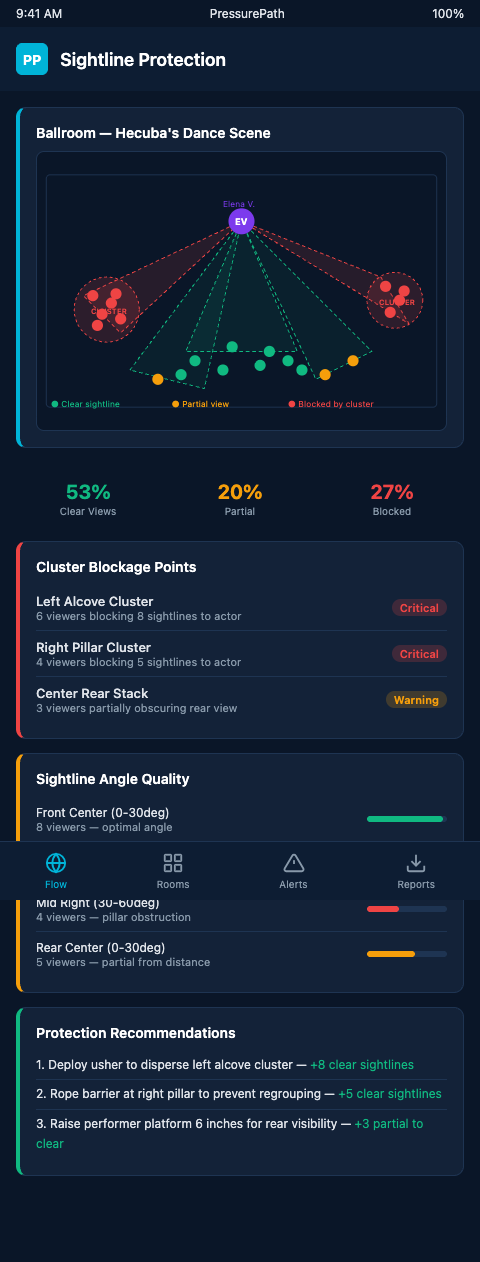
Three practical mechanisms protect sightlines under clustering pressure:
Staged entrance sequencing. Rather than allowing free-flow entry into a scene room as soon as the previous scene ends, stage the entry: release viewers in cohorts of 6–8 with a 45-second gap between cohorts. The first cohort takes positions near the blocking zone; subsequent cohorts fill the perimeter. This produces a layered distribution that preserves sightlines for all viewers rather than a cluster that forms at whatever point in the room viewers stopped moving.
Blocking zone elevation. Scenes with high projected density benefit from blocking the actor's primary performance zone on a raised platform of 18–24 inches. The C-value calculations for elevated blocking show that a modest elevation increase extends the sightline range to nearly twice as many standing viewers before obstruction occurs. The actor's performance range contracts slightly but the sightline count increases substantially.
Magnet scene pressure diversion. When Scene 6 consistently exceeds its sightline ceiling, the most reliable intervention is installing or enhancing a competing attraction in the adjacent corridor. A shorter, high-interest performance beat — 2 minutes, one actor — creates a magnet that draws a portion of the Scene 6 cluster away before they reach the blocking zone. This is the same logic behind the broader magnet scene strategy used in multi-room blocking design.
The Sightline Commercial flexible staging analysis documents how staging configurations that account for audience density variation consistently outperform fixed configurations that assume a stable crowd geometry. In immersive work, this means designing the actor's blocking arc for the maximum projected density, not the average.
When density spikes exceed sightline ceilings across multiple scenes simultaneously, the production crosses into density-driven arc failure territory where individual scene fixes are insufficient — the entire pressure network requires rebalancing. The same principle applies in haunted attraction design: pacing gaps in scare delivery exist precisely because density overloads the delivery mechanism, and the fix is a pressure relief gap before the peak moment, not an intervention at the peak itself.
Sightline Integrity as a Production Standard
A practical way to set sightline ceilings before rehearsal is the standing density test: place one performer at the primary blocking zone and fill the room with production staff at various densities. At each density increment, evaluate from multiple positions in the room whether the primary blocking zone is visible. The count at which more than 20% of positions lose sightline access is the scene's soft ceiling; the count at which more than 40% lose access is the hard ceiling. The target density range in the flow model should sit between 60% and 80% of the hard ceiling, leaving a buffer for natural clustering variance.
Productions that maintain sightline integrity across their run treat density ceilings as hard constraints in the flow model, not soft guidelines. Every scene has a defined ceiling. Every cue-exit is timed to prevent that ceiling from being breached. Every corridor between scenes has friction calibrated to meter the flow rate into the downstream room.
Actor fatigue is a secondary sightline concern that the density ceiling model should address. Actors performing in consistently overcrowded scenes develop compensatory behaviors — raising volume, reducing blocking range, abandoning planned movements — that alter the scene over time. These compensations are invisible to an audience that never saw the original blocking, but they represent a degradation of the director's arc that accumulates across the run. Monitoring sightline ceiling adherence is therefore not just an audience experience metric — it is a performer health and blocking integrity metric that stage managers can track when the flow model provides scene-by-scene density records.
The Design Collaborative analysis of spectator behavior when sightlines are blocked identifies the jumping-and-leaning cascade as the most common sightline failure mode in standing audiences. Each viewer who jumps or leans to see past an obstruction creates a new obstruction for the viewer behind them, triggering a wave of sightline failures that moves through the cluster. Preventing the cascade requires keeping density below the threshold where the first viewer is blocked — once the cascade begins, it is self-reinforcing and cannot be stopped without physically redistributing the audience.
PressurePath's blocking arc integrity scoring measures whether your show's flow model keeps each scene within its sightline ceiling across the full performance duration. A score of 100 means every scene stays within its sightline ceiling for every performance in the model. A score below 80 means at least one scene regularly exceeds its ceiling — and the platform identifies which scene, which transition, and which cue-exit adjustment resolves the breach.
Immersive theater directors who have built sightline ceilings into their production planning before tech week know what it costs to discover a density problem at dress rehearsal. If you're beginning rehearsals for a promenade or non-proscenium production, join the PressurePath waitlist for immersive theater companies and build your sightline density model before the blocking is locked.