Designing Magnet Scenes to Pull Audiences Out of Packed Spaces
The Overcrowded Scene Nobody Designed
Act 2, Scene 6: the Poisoning Monologue. The actor delivers it alone in the study, and the director blocked it for 20 viewers positioned on three sides. On opening night, 58 viewers are in the study. The back wall is solid people. The actor cannot maintain the blocking arc — the sightline positions are occupied by a crowd that extends into the hallway. In the drawing room adjacent, a paired scene with a cast of four plays to nine viewers.
The study was not supposed to be a magnet. The director did not designate it as the narrative peak. But the accumulated word-of-mouth from Act 1 — whispered recommendations between masked audience members in corridors — turned it into one. Once it became a magnet, no amount of usher presence reversed the clustering. The drawing room's four actors performed at diminished capacity for the remainder of the run.
The problem with undesigned magnets is that they are invisible during pre-production. The production team does not know which scene will become the emergent overcrowding point until the first week of performances, by which time the venue geometry, acoustic treatment, and corridor adjacencies are fixed. The choice at that point is between operational management — harder usher holds, more aggressive redirects — and structural redesign of the scene or its pull environment. Both are reactive. A production that models magnet dynamics with PressurePath before opening identifies potential emergent overcrowding points and installs counter-attraction mechanisms before the show opens, rather than after the problem has become visible.
What Audiences Want from Immersive (The Space) found that scenes perceived as high-value narrative moments generate disproportionate clustering — and that the perception of value precedes actual experience. Audiences route toward scenes that other audience members are moving toward, creating self-reinforcing density. A scene that attracts a crowd becomes more attractive, not less.
Behind the Scenes: Promenade Theatre (A Younger Theatre) documented anti-clustering design efforts in The Drowned Man, where the production team discovered that passive scene quality alone was insufficient to prevent collapse in high-value rooms. Magnet scenes require engineered spacing mechanisms to prevent density beyond the sightline ceiling.
The immersive entertainment market at $20.7 billion in 2024 with 26.9% CAGR (Grand View) reflects an industry where audience experience quality is the primary differentiator. A production where half the scenes play to fractured, over-dense crowds while the other half play to empty rooms is competing at a structural disadvantage.
Engineering Magnet Scenes as Pressure-Relief Mechanisms
A magnet scene designed for pressure relief operates on a different principle than a scene designed for narrative importance. Narrative importance makes a scene worth visiting. Magnetic pull makes a scene impossible to ignore from outside the room — before the audience has decided to enter.
Think of the over-packed scene as a node under excessive pressure in a pipe network. The standard intervention is to force flow reduction at the inlet — usher holds, headcount limits. The magnet approach instead opens a competing outlet: a high-pressure adjacent node that draws flow away from the overloaded scene through its own attractive force. Rather than blocking the overcrowded pipe, the magnet scene lowers relative pressure in the over-occupied node by making the adjacent node more desirable.
Punchdrunk's forensic sensory layering (ResearchGate) identifies how they use multi-sensory focal-point design as intentional attention-draw mechanisms — smell, sound spill, and light quality visible from corridors signal scene value to audiences before they enter. Technology-Mediated Theatre Experiences (ACM) confirms that multi-sensory focal-point design guides audience movement; sound and lighting function as pre-entry pull cues.
The magnet scene's relationship to the overcrowded node is a pressure-differential question, not an artistic one. The overcrowded node is a high-pressure region in the flow network. The magnet scene is a low-resistance outlet that the pressurized flow can enter. For the magnet to work, the differential between the two nodes — in perceived value, accessibility, and discoverability — must be large enough that a viewer standing in the overcrowded node's approach corridor chooses the magnet rather than waiting. The practical design elements of a magnet scene intended for pressure relief are:
Audio overspill calibrated to the corridor. The scene's soundscape should be audible at the entrance to the over-occupied adjacent room at roughly 40% of its in-room intensity. Not loud enough to distract viewers in the adjacent scene, but loud enough to signal that something is happening nearby. This is an acoustic design decision made with specific corridor geometries in mind.
A high-luminance threshold marker. Viewers scanning a corridor make entry decisions based on visible light levels. A slightly brighter entry threshold on the magnet scene — not a spotlight, but a deliberate warm spill from inside — functions as a low-resistance entry signal. Viewers moving in a corridor toward the overoccupied scene perceive the magnet scene entry as the lower-friction option.
An actor whose physical performance is partially visible from the corridor. If any part of the actor's movement is legible through a doorway or partial wall, corridor viewers allocate attention before committing to entry. Together Here: Immersive Theatre (Trinity) found that spatial cues like light, sound, and scent can redirect audience attention as effectively as actor presence itself. The partially visible actor is the highest-fidelity version of that principle.
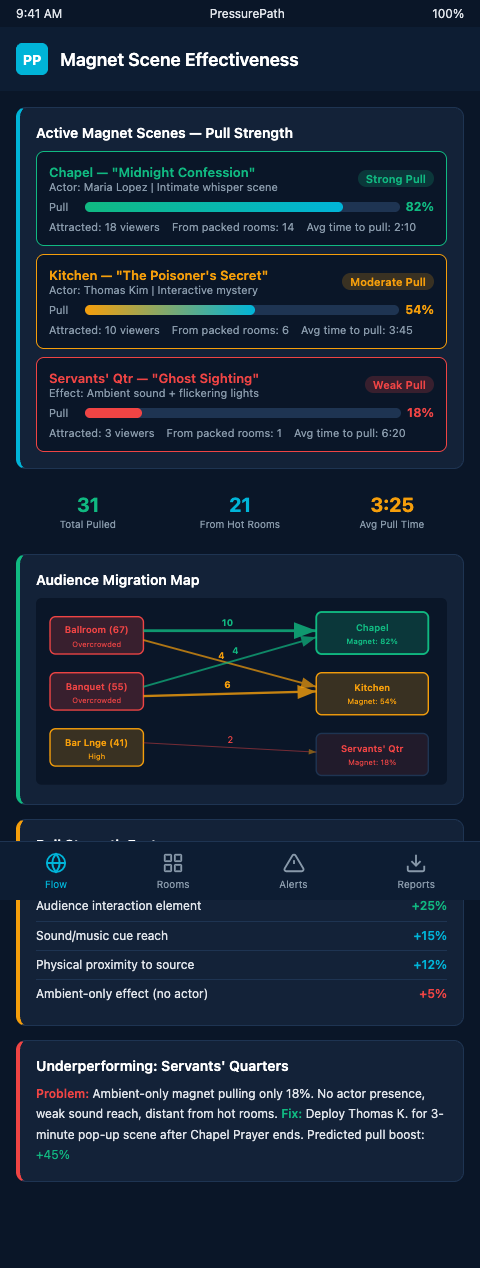
PressurePath models magnet pull strength for each scene based on corridor geometry, audio spill radius, and historical headcount data. The scene transition flow analysis tools can identify which scene transitions produce the heaviest drift toward over-occupied nodes; magnet scenes are then positioned in the adjacent flow path.
Advanced Tactics: Timing and Scheduling Magnet Activation
A magnet scene that fires at the wrong moment in the show's arc competes with the narrative rather than supporting it. The design question is not just which scenes can function as magnets, but when in the show their magnetic pull should be at maximum.
Effective magnet activation also requires monitoring whether the magnet is working. PressurePath tracks both the origin scene's density and the magnet scene's density simultaneously, measuring whether the magnet pull is drawing viewers from the overcrowded node or attracting new viewers from elsewhere without affecting the overloaded scene. A magnet that attracts viewers from unrelated corridors rather than from the target overcrowded scene has not solved the pressure problem — it has created a second over-occupied node.
The monitoring feedback allows the production to distinguish between two failure modes: a magnet that is not strong enough (its pull signal is insufficient to overcome the target scene's magnetic force) and a magnet that is correctly sized but positioned in the wrong corridor relative to the overcrowded scene's exit flow. The first failure requires increasing the magnet's pull signal strength — more audio overspill, brighter threshold, more visible actor movement. The second failure requires repositioning the magnet scene relative to the flow path from the overcrowded node's exits.
Flow modeling enables magnet scheduling. PressurePath's simulation identifies the minute marks where the target overcrowded scene hits its pressure peak — typically 8 to 12 minutes into each act. The magnet scene should reach its highest pull-signal intensity 3 to 5 minutes before that peak: audio overspill rises, the actor's most kinetically visible sequences fall in this window, and the corridor lighting threshold brightens subtly.
Design Methodologies for Attraction Queue (Falcon's Creative) describes theme park zone design using narrative payoff and sensory escalation to pull crowds through spaces in sequence — the same temporal logic applied to magnet scene activation. The magnet does not pull continuously; it escalates to peak pull precisely when the overcrowded node needs relief.
Museum magnet stations use dwell-time engineering to slow visitor exit from high-value stations, creating a similar downstream pressure relief effect. The sightline clustering analysis provides the upstream reading: once sightline counts in the overcrowded scene exceed the ceiling, the magnet needs to have already been firing for several minutes to begin pulling viewers out.
After calibration across ten to fifteen performances, magnet scenes become a reliable pressure-relief mechanism that the director can schedule into the blocking arc — not an emergency fix, but a designed element of the spatial score.
Design the Magnet Before the Problem Appears
Productions that attempt to create magnet scenes after an overcrowding problem has been identified face an uphill design constraint: the adjacent scene's blocking, soundscape, and corridor geometry are already fixed. Magnet scenes designed during pre-production have maximum flexibility in placement, acoustic treatment, and actor choreography.
The pre-production design sequence for magnet scenes runs in parallel to the primary blocking work rather than after it. As the director identifies the high-pull scenes in the show's arc — the scenes that will become overcrowding candidates — the production designer simultaneously sketches the adjacent magnet options: which adjacent rooms could be repurposed as pressure-relief magnets, which corridor geometries allow the necessary audio overspill, which actor schedules permit the partial visibility positioning. By the time the primary blocking is locked, the magnet scene inventory is ready to be tested against the flow simulation. This parallel workflow adds minimal time to pre-production because it reuses the venue analysis already being done for the primary scenes.
Directors who run this workflow describe the magnet scenes as the production's pressure insurance: every high-pull scene has a designed relief mechanism that activates automatically when density approaches the sightline ceiling. The insurance is cheap to build during pre-production and catastrophically expensive to retrofit during a running show. Productions that understand this sequence treat magnet scenes as a design category equivalent to lighting design or sound design — not as an operational patch applied when things go wrong.
Immersive theater production designers and directors building multi-room promenade work need pressure-relief mechanisms that are as carefully engineered as the scenes they protect. Join the PressurePath waitlist for magnet scene pull-strength modeling built for immersive venue configurations.