How to Design Magnet Stations That Slow the Pass-Through
The Water Table That Nobody Built to Be a Magnet
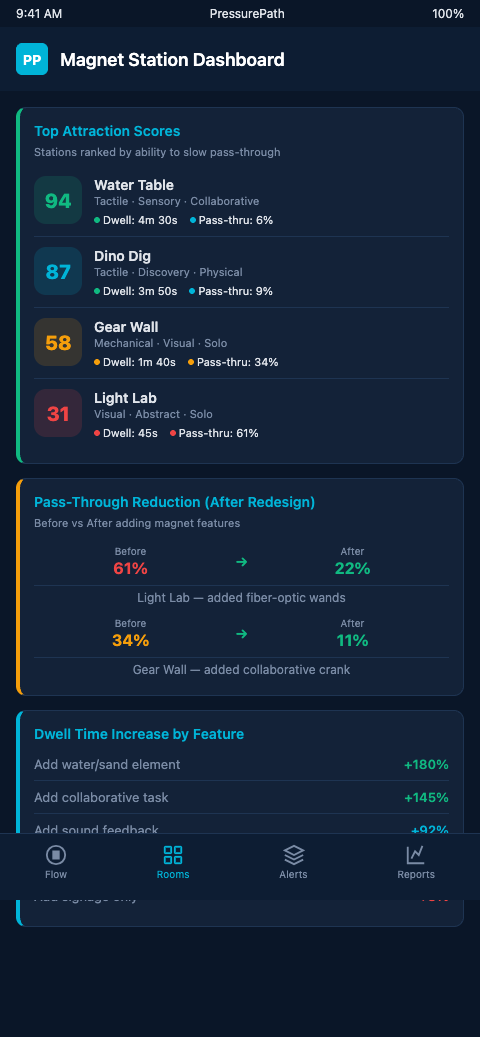
A children's museum in the mid-Atlantic region installed a water table near the cafeteria exit as an afterthought—something to slow families on their way to lunch. Within six months, it was the most-stopped exhibit in the building for school groups. Field trip waves that bypassed the NSF-funded Water Cycle puzzle in the science wing reliably stopped at the water table for 6–8 minutes.
The water table wasn't designed as a magnet. It had four magnet attributes by accident: immediate tactile feedback, physical immersion of hands, no reading required to begin, and peer-visible results. Any child who entered the zone and pushed a paddle wheel created a visible water movement that attracted adjacent children within seconds. Behavioral contagion—the peer cascade that drives 30-kid wave dynamics—worked in favor of the station rather than against it.
That accidental outcome is reproducible by design. Magnet stations can be engineered into a floor plan to create controlled back-pressure that slows the wave at strategic points, protecting downstream learning exhibits from bypass. The key is understanding why the water table worked and building those same properties into the exhibits that carry the most educational weight.
The irony of many children's museum floor plans is that the accidental magnets—water tables, construction zones, ball runs—are positioned near exits or secondary spaces, while the grant-funded learning exhibits are positioned in primary zones but designed with none of the magnet attributes. The solution isn't to move the water table to the center of the floor. It's to give your learning exhibits the properties that made the water table so effective.
The Four Attributes of a Functional Magnet Station
Immediate response. The single most important magnet attribute is that the first touch produces an observable result within two seconds. Water moves. A lever activates a mechanism. A sound plays. Light changes. The two-second rule exists because peer contagion needs a signal to propagate: children near a station who see a peer receive an immediate response are pulled toward the exhibit by social imitation. Play-based exhibit design research documents that play-based elements extend dwell times from minutes to hours—the enabling factor is this immediate, repeatable feedback loop.
Social scale. A magnet station for a 30-kid school wave needs to accommodate 8–12 simultaneous participants without generating exclusion pressure. A station designed for 2–3 children creates a queue that the remaining 27 bypass. A station with a 10-foot activation surface—like a large-format interactive wall, a multi-player build zone, or a wide water table—absorbs a meaningful fraction of the wave at once. AAM guidelines on designing exhibitions for children explicitly identify multi-sensory, open-ended, participatory exhibits as the documented design pattern for slowing pass-through. The social scale requirement is specific to school group contexts—a station designed to the same standard for family visitors may accommodate 3–4 at a time, which is sufficient for families but creates exclusion dynamics under wave conditions.
Narrative restarting. Research on narrative-framed exhibit design shows that narrative framing measurably increases dwell time versus static equivalents. A magnet station that resets its narrative after each group—a puzzle that can be re-solved, a mechanism that returns to neutral position, a water table that continuously replenishes its challenge—invites repetition rather than completion. The station doesn't end; it restarts. This is the distinction between an exhibit children spend 90 seconds with and one they spend 6 minutes with.
Convergence placement. Quinn Evans' pedestrian flow analysis identifies strategic exhibit placement at path convergence points as the mechanism for converting pass-through into engagement. A magnet station placed at a convergence point—where two circulation paths meet, or where the wave is naturally decelerating—captures groups that a mid-corridor placement would miss entirely. Position matters as much as design. A perfectly designed magnet station off the primary flow path will underperform an adequately designed station at the main convergence node. The same convergence-point logic operates in immersive theater audience flow, where magnet scenes in packed spaces demonstrates how placement at natural convergence nodes and immediate engagement cues drive capture rates in ways that transfer directly to children's museum exhibit design.
PressurePath's Pressure Mapping for Magnet Placement
PressurePath models 30-kid school waves as pressurized fluid bursts through your floor plan. The pressure map identifies nodes where the fluid is moving fastest (high bypass risk) and nodes where natural deceleration occurs (high magnet placement opportunity). Positioning a magnet station at a natural deceleration node amplifies the station's capture rate dramatically—the fluid slows, the back-pressure of the magnet station holds it, and downstream exhibits receive the group at lower velocity.
This is the pipe-and-valve model applied to museum design. In a pressurized pipe system, you place flow regulators at the points of highest pressure to protect downstream components. In a children's museum floor plan, you place magnet stations at the points of highest wave velocity to protect downstream learning exhibits. The magnet doesn't just capture children for itself—it reduces the wave's momentum so that the next three exhibits receive the group at a speed where stops are possible.
Augmented exhibit research found that augmented interactive elements increased visitor capture rate by 9.54 times and improved holding time significantly. That multiplier isn't uniformly distributed across floor plans—it's concentrated at convergence and deceleration nodes. A magnet station placed at the wrong position on the floor receives a fraction of that capture improvement.
The IMLS data on achievement outcomes establishes that museum visit benefits are contingent on actual engagement. Magnet stations that slow the wave at the right nodes don't just increase that station's dwell time—they protect the engagement of adjacent exhibits that would otherwise sit in bypass shadow. A well-placed magnet station produces a halo effect: 2–3 surrounding exhibits see higher contact rates because the wave arrives at reduced velocity.
Where Magnet Design Goes Wrong
The most common magnet station failure mode is over-concentration: a single high-energy exhibit that absorbs 80% of the wave and leaves the rest of the floor plan empty. This creates the "water table problem"—one station succeeds brilliantly while the grant-funded puzzle in the adjacent wing receives zero contact.
A well-designed magnet network distributes back-pressure across the floor plan rather than concentrating it at one node. PressurePath models the cascade effect of a magnet station: not just how many children it captures, but where the captured group goes next, and whether that exit path routes them through or past the downstream learning exhibits. A magnet station that captures 25 children and exits them toward the bathroom rather than the science wing has done nothing to improve science wing engagement—and may have actively reduced it by pulling a large fraction of the wave out of the primary learning sequence.
The second common failure mode is magnet decay: a station that functions as a magnet at the start of the school year but loses capture effectiveness as children habituate to it over repeated visits. Rotating exhibits, seasonal updates, and complexity scaling—where the station's challenge level increases over time—extend the magnet's effective lifespan. Nina Simon's participatory museum framework addresses this directly: social objects and participatory design that generate novel peer interactions on each visit resist habituation more effectively than fixed-outcome exhibits.
A third failure mode is exit misdirection: a magnet that captures the wave but exits it in the wrong direction. A well-designed magnet creates a capture zone and a directed exit that routes the wave toward the next priority learning exhibit. A magnet that's positioned at a junction, with exits pointing toward the bathrooms, the café, or the gift shop, captures the wave and then funnels it out of the learning sequence entirely. Exit direction from a magnet station should be modeled as carefully as entry capture.
The same distributed-pressure logic appears in how puzzle station bypass propagates through a floor plan—a bypass at one station increases pressure on subsequent stations as the unreduced wave accelerates. And for stations that have already become bypass-heavy due to design or positioning issues, the approaches in refreshing bypass-heavy stations address the redesign path.
Commissioning Your First Magnet Station Redesign
For children's museum exhibit designers who have identified a specific bypass problem—a mid-floor learning station that consistently misses school waves—a magnet station redesign is often the fastest intervention. Rather than repositioning the bypassed station (expensive, potentially disruptive to adjacent exhibits), you position a new or redesigned exhibit upstream to slow the wave before it reaches the critical zone.
The upstream magnet captures the wave at peak velocity, extracts 4–6 minutes of engagement, and exits the group onto a path that leads directly to the learning station. The learning station, now receiving a group at low velocity with depleted momentum, has dramatically higher contact rates—PressurePath's models show a 40–65% improvement in downstream station contact for groups that passed through a well-designed upstream magnet.
The design criteria for the upstream magnet don't require the station to carry significant educational weight itself. It needs the four magnet attributes—immediate response, social scale, narrative restart, convergence placement—not a deep learning sequence. This separation of pacing function from educational content is the key design principle: magnets do pacing work; learning stations do educational work. They should be positioned and designed for their respective roles.
Children's museum designers ready to model their first magnet placement can join the PressurePath waitlist and request a bypass analysis for their current floor plan.