Best Practices for Refreshing Bypass-Heavy Stations Mid-Visit
The 15-Minute Bypass Window
At 10:28 AM, Group 2 from Jefferson Elementary — 31 third-graders — is 13 minutes into its visit. The Water Cycle puzzle, a centerpiece of a $180K NSF grant, has logged 3 visitor stops. The Electricity wall has logged 24. Those numbers are not unusual; they match the bypass pattern that has persisted across every Tuesday group for the past six weeks.
In a museum without real-time tracking, that pattern is invisible until the post-visit data review — by which time the session is over and Group 3 is already booked. In a museum with a pacing dashboard, the pattern flags as an alert by the 12-minute mark: stop rate at the Water Cycle puzzle is below threshold, and the current group is tracking toward the same bypass outcome as the six preceding groups.
That 12-minute alert creates a 15-minute window before the group transitions toward the exit corridor. Fifteen minutes is enough to execute one meaningful intervention: a docent reposition with an engagement cue, a chaperone redirect, a prop addition, or a digital signage change pointing to the under-occupied station. Often the bypass pattern traces back to a magnet station drawing excessive wave pressure upstream that pulls the group away from the target exhibit. Fifteen minutes is not enough to redesign the exhibit. But it is enough to recover a portion of the bypass loss for the current group while the structural redesign waits for the end-of-season review.
Informalscience.org research on attracting and holding power establishes that low attracting power can be remediated through placement, lighting, and novelty — factors that are adjustable mid-session, not just at installation. The theoretical basis for mid-visit refresh is that a station's effective attracting power is not fixed; it's partly a function of contextual signals that the floor team can modify in real time.
The intervention window is the critical constraint. A 60-minute field trip session has roughly three phases: the first 15 minutes (atrium arrival and initial wave dispersal), the middle 30 minutes (active station engagement), and the final 15 minutes (transition toward exit corridor and summary activities). A bypass alert that fires at the 12-minute mark leaves the entire 30-minute active phase as intervention opportunity. An alert that fires at the 40-minute mark has a narrow window before the group begins transitioning out. PressurePath is designed to surface bypass alerts early enough to allow meaningful intervention rather than documentation.
The Five Mid-Visit Refresh Tactics
The pressurized-water model clarifies the intervention logic. A bypassed station is a pipe junction the wave pressure is routing around — not because the pipe is blocked but because the routing signals (visual salience, perceived access, peer behavior cues) are directing pressure toward other junctions. Mid-visit refresh tactics change those routing signals mid-session.
Docent reposition with engagement cue. A docent stationed at the Water Cycle puzzle — actively demonstrating the lever mechanism, speaking to passing kids in a curious rather than directive tone — changes the visual signal from "empty exhibit" to "exhibit where an adult is doing something interesting." Third-graders are drawn toward adult-directed activity when the adult is engaged rather than supervisory. Visitor Studies foundational research on attracting power (VSA) documents that facilitator presence at a station measurably increases approach rate. The decision tree for whether to reposition, redirect, or accept a bypass for the current session mirrors reset station routing in multi-room venues, where the same triage logic applies at room scale rather than exhibit scale. Execution time: two minutes from alert to position.
Chaperone redirect with a sub-group. Using the chaperone script system, redirect one chaperone sub-group (8-10 kids) to the bypassed station with a specific opening prompt. This does not require changing the chaperone's full routing assignment — it's a single detour that seeds the station with active users. Once kids are at the station engaging with the mechanism, peer-behavior cues attract additional visitors from the passing wave. Execution time: four minutes from alert to sub-group arrival.
Digital signage redirect. Wavetec's research on queue-display signage documents that signage directing visitors to under-occupied stations is a proven rebalancing tactic. Seen Labs museum digital signage research shows engagement increases up to 55% when digital signage directs visitors to less-crowded exhibits. For museums with dynamic digital signage systems, a template update takes 90 seconds and reaches every visitor in the corridor simultaneously. Execution time: 90 seconds if the signage system is accessible.
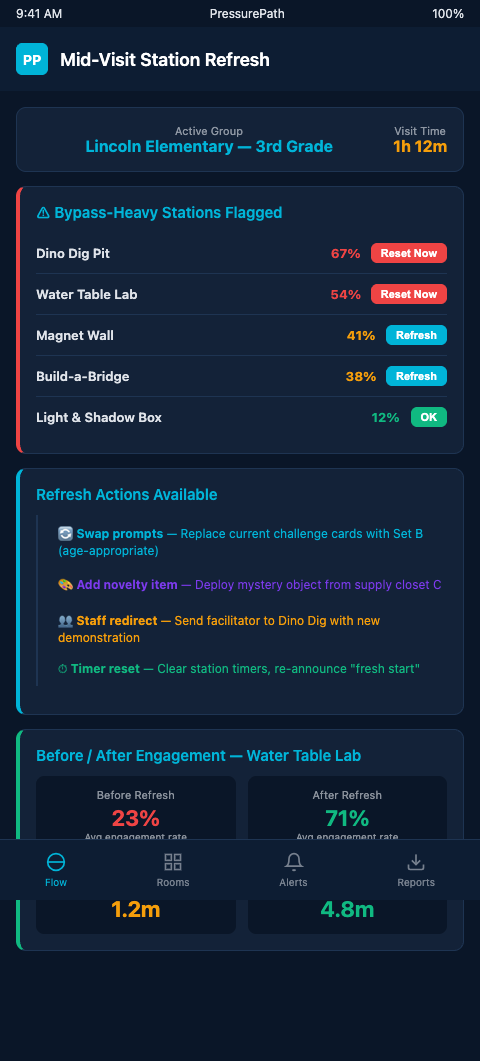
Prop addition. Physical novelty triggers re-attention at a bypassed station. A tray of colored water added to the Water Cycle puzzle, an unfamiliar rock sample placed at the geology table — these are low-cost additions that change the visual composition of the station without altering the exhibit structure. Eight Ways to Engage Visitors research (Engaging Places) recommends dynamic in-visit content rotation as a standard engagement tactic. Execution time: three minutes from alert to prop placement.
Station lighting adjustment. If your exhibit floor has adjustable lighting zones, increasing brightness at a bypassed station by even one stop changes its visual weight in the room. PressurePath flags the bypass; the facilities team makes a 30-second adjustment. This is the lowest-effort intervention and the most frequently underused because it requires cross-team coordination (floor team to facilities). Building a lighting-adjustment protocol into the bypass alert workflow removes that coordination friction.
PressurePath connects these tactics to the alert system by recommending the highest-probability intervention based on current floor state: if a docent is already within 20 feet of the bypassed station, the recommendation is a docent reposition; if a chaperone sub-group is mid-transition, the recommendation is a redirect; if both options are unavailable, the recommendation is a signage update.
Advanced Refresh Configurations
The first advanced layer is multi-session refresh patterns. If the Water Cycle puzzle is showing bypass across six consecutive Tuesday groups, single-session interventions are treating a symptom rather than the condition. Visitor Studies benchmark data identifies stations below SRI thresholds as structural refresh candidates — their baseline attracting or holding power is too low to recover with single-session tactics. Structural candidates need exhibit redesign, not repeated docent repositioning.
PressurePath distinguishes structural bypass from session-specific bypass by comparing stop rates across multiple groups on the same day and across multiple days. A station with 12% stop rate from all six Tuesday groups for four consecutive weeks is a structural problem. A station with 12% stop rate from only the 10:15 AM slot is a scheduling problem — something specific to that time window (light angle, competing activity, arrival fatigue) rather than the station itself.
For advanced seasonal simulation configurations, mid-visit refresh logic connects to seasonal exhibit rotation: stations that are persistently bypassed in fall (when third-grade cohorts dominate bookings) may perform well in spring (when fifth-grade cohorts dominate). Knowing which bypass patterns are grade-cohort-specific versus structural determines whether the response is a seasonal refresh or a permanent redesign.
Tracking Refresh Effectiveness
Mid-visit refresh tactics are only worth executing if they work often enough to justify the staff attention they require. Tracking their effectiveness — comparing stop rates before and after an intervention — closes the feedback loop and identifies which tactics produce the most reliable recovery.
A docent reposition at the Water Cycle puzzle that raises the stop rate from 11% to 28% for the remainder of the session is a highly effective intervention worth documenting as a standard protocol. The same reposition that raises the stop rate from 11% to 14% is marginal — barely above noise — and suggests the bypass problem is structural rather than correctable through facilitation.
PressurePath records pre-intervention and post-intervention stop rates automatically, linking each intervention type (docent reposition, chaperone redirect, signage update, prop addition, lighting change) to its measured effect. Across 20 or 30 field trip sessions, the effectiveness data produces a ranked intervention protocol: at this specific station, with this grade level, the most effective first-response intervention is docent reposition; if that fails to raise the stop rate above threshold within eight minutes, the second-response is a chaperone redirect.
That ranked protocol is more valuable than any single intervention decision, because it converts ad-hoc floor judgment into a systematic response framework that any trained staff member can execute — not just the senior docent with four years of experience.
Prioritizing Which Stations to Refresh
Not every bypassed station warrants a mid-visit refresh intervention. A station with 15% stop rate against a baseline of 18% is marginally underperforming — within normal variation range, not worth pulling a docent from their current zone. A station with 9% stop rate against a baseline of 38% is severely underperforming — a three-way gap that justifies immediate intervention.
PressurePath applies a threshold filter to bypass alerts: only stations deviating by more than a configurable percentage from their grade-level baseline generate actionable alerts. The threshold prevents alert fatigue — if every minor underperformance triggers an alert, floor staff begin ignoring them. By setting the threshold at, for example, 40% below baseline, alerts indicate stations that are genuinely failing the current group rather than stations performing at the low end of normal variation.
The threshold is configurable by station category. Grant-funded stations with explicit learning objectives warrant a lower alert threshold — a 25% deviation from baseline triggers an alert at those stations because their learning-goal accountability makes any meaningful bypass worth addressing. High-magnet stations with consistently high baseline performance can tolerate a wider deviation before triggering an alert, because their baseline is high enough that even a 40% deviation still leaves them performing at acceptable engagement levels.
Act in the Window, Not After the Bus
Mid-visit refresh is the difference between recovering 30% of a bypassed station's potential engagement and writing that session off. The 15-minute window is real and actionable for children's museum exhibit designers who have the alert system to see it and the intervention toolkit to use it.
The cumulative effect across a field trip season is significant. A museum that successfully executes a mid-visit refresh on even one of every three bypass events over a hundred school group visits recovers engagement at its priority stations that would otherwise have been lost entirely. That recovery shows up in grant evaluation data as documented engagement rather than in post-visit survey notes as "the group seemed rushed." The distinction matters for renewal applications and for the floor team's institutional credibility with program officers and board members.
The operational requirement is modest. Most mid-visit refresh tactics — docent reposition, chaperone redirect, prop addition — take two to four minutes of staff attention and require no additional budget. The binding constraint is not resources but timing: the alert has to reach the right staff member with enough lead time to execute before the group has moved past the recovery window. That timing requirement is what pacing infrastructure delivers.
PressurePath surfaces bypass alerts with enough lead time for floor teams to act within the session rather than review after it. If you manage field trip programming and want to stop discovering bypass patterns in post-visit reports, join the PressurePath waitlist for children's museum exhibit designers.