Reset Station Routing: Best Practices for High-Volume Weekends
Why Reset Stations Break Down Under High-Volume Pressure
Labor costs consume approximately 48% of gross revenue at escape room facilities, according to data from Financial Models Lab. On peak weekends, that cost concentration is most exposed at reset stations, where the same two-person team may be turning over 12 or more rooms across a 6-hour window with no buffer between cycles.
The compounding problem: reset timing isn't constant. Room 4 (a puzzle-heavy room) might require 18 minutes for a full reset. Room 8 (a prop-light room) clears in 9 minutes. When your booking grid schedules both rooms to receive new groups at the same time, the reset team faces a routing conflict — and if no one has defined which room gets priority, the slower reset cascades into a late start for the next group, which cascades into a briefing room queue delay, which cascades into the photo wall backing up.
Room Escape Artist's 2024 industry report identifies labor costs and reset-cycle pressure as the top operational stressors for US escape room owners. The stressor isn't headcount — it's the absence of a routing protocol that makes the existing headcount efficient.
Picture the high-volume weekend as pressurized water entering a two-outlet pipe with a single pump. Each reset staff member is an outlet drain, and each room needing reset is upstream pressure building in its own segment. When two rooms exit within a 4-minute window — a common pattern at 70%+ Saturday utilization — the pump is briefly overloaded beyond its drainage capacity. Without a protocol that pre-assigns which outlet drains first, the team defaults to physical proximity, which is almost never the optimal routing decision. A 10-room franchise running 4 peak Saturdays per month typically sees 12-18 such overlap windows monthly, each costing 3-6 minutes of downstream latency when routed by proximity rather than by next-start urgency. That's 45-100 minutes of recoverable reset-cycle time per month baked into the physical layout of the venue — not in the staffing budget.
Engineering Your Reset Routing Protocol
The industrial engineering framework that applies here is SMED — Single-Minute Exchange of Die. Originally developed for manufacturing changeovers, SMED's core insight is that any setup process has internal steps (must happen while the prior session is still active) and external steps (can happen in advance). Lean Production's SMED guide documents 60–90% changeover time reductions when teams systematically convert internal steps to external ones.
For escape room reset stations, the equivalent separation is: what can the reset team prepare while the current group is still in the room versus what requires the room to be empty? Prop restocking, costume staging, and clue-reset pre-staging are all external steps. Physical room reset — repositioning furniture, resetting electronic puzzles — is internal. A franchise that routes external steps to happen during the last 10 minutes of a session rather than after exit cuts its effective reset window significantly.
Think of the reset pipeline as a pressurized network with a fixed throughput ceiling. Each room is a demand node drawing from the reset team's capacity. When multiple rooms exit simultaneously on a Saturday afternoon, the pressure at the reset station spikes — more demand than the two-person team can meet simultaneously. The routing protocol is the pressure regulator: it determines which rooms get serviced first, which get pre-staged externally, and which can safely queue without cascading into briefing room delays.
WIP (work-in-process) limits from lean manufacturing offer the second structural principle. Veryable's guide to WIP management establishes that limiting WIP improves throughput and makes bottlenecks visible sooner. For reset stations, the equivalent WIP limit is the number of rooms the team actively resets simultaneously — typically one room per reset staff member. When a third room exit hits before the first two are cleared, it enters a queue rather than being pulled into active reset, keeping the team focused and preventing cross-contamination between partially reset rooms.
PressurePath models your reset station as a constrained service node. Load your room count, per-room reset duration estimates, and booking grid, and the simulator surfaces every Saturday window where reset demand exceeds team capacity. That output isn't a warning — it's a routing brief. The GM knows by Friday morning which rooms need priority sequencing and which slots have enough gap for a relaxed reset.
A 12-room franchise running two-person reset on a peak Saturday typically faces 6-10 overlap windows across an 8-hour day where two or more rooms exit within a 4-minute span. Each window creates roughly 180 seconds of routing pressure at the reset pipe — time during which the team must choose which room to service first and which to queue. Without a protocol, that choice defaults to physical proximity; with a simulation-driven brief, it defaults to next-start urgency and complexity tier, which is a measurably different decision in roughly 40% of overlap windows. Across 4 peak Saturdays per month, that's 24-40 routing decisions the simulation pre-computes, each saving 2-4 minutes of downstream cascade latency. The pressurized pipe model calls this protocol pressure regulation: the valve sequence determines which branch drains first when the junction hits its capacity ceiling.
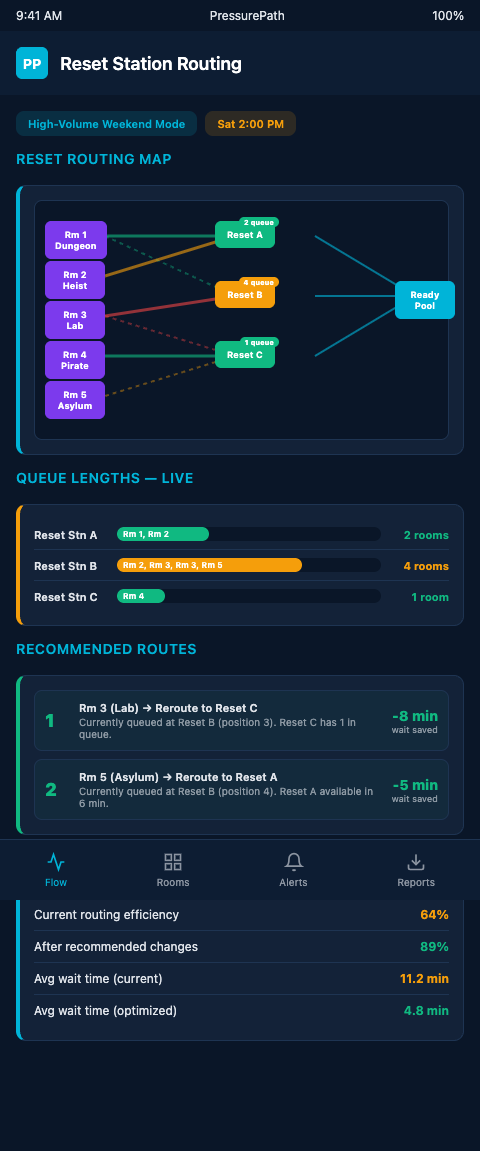
For operators dealing with accumulated reset station backlog, the routing protocol described here is the structural fix — SMED separation plus WIP limits address the root cause rather than adding staff to absorb the overload.
The connection to briefing queue engineering is direct: a reset routing delay of 4 minutes in room 6 pushes the next group's entry back, which pushes their briefing back, which creates the briefing room collision that was invisible in the booking calendar.
Advanced Routing Tactics for High-Volume Weekends
At franchises running 12+ rooms on peak Saturdays, the routing protocol needs a triage tier. Rooms are classified by reset complexity and downstream pressure sensitivity:
Tier 1 (Priority): Rooms whose late reset immediately cascades into a shared-asset collision — typically rooms feeding directly into a single shared briefing room or photo wall. These get reset team priority and external pre-staging.
Tier 2 (Buffer-eligible): Rooms with a downstream gap in the booking grid. If the next booked group isn't arriving for 22 minutes, a 15-minute reset has buffer. These can safely queue while the team handles Tier 1.
Tier 3 (Pre-staged): Rooms with consistent short reset times and light prop loads. These benefit most from the SMED external-prep approach — reset is completed 80% before the prior session even ends.
Lean management principles for high-mix, low-volume operations from LEI address the exact challenge escape room franchises face: each room is different (high-mix), but volumes are high on peak days (high-volume). The lean approach is to standardize the process envelope, not the props — define the sequence of reset tasks, not just the list of tasks.
How other venue types handle high-density transitions is also instructive. Bypass-heavy station strategies tackle the parallel problem of refreshing high-traffic exhibit stations without blocking visitor flow — the same principle of routing service around peak demand rather than through it.
Visiontron's research on peak demand at stadium venues confirms that dedicated routing lanes with timed release — assigning specific staff to specific zones with pre-defined handoff moments — reduce bottlenecks at high-volume transition points by up to 35%.
Reset Routing Is the Operational Foundation for Sustainable Peak Days
Multi-room escape room franchise operators who run without a documented reset routing protocol are relying on GM intuition to manage a system-level problem. That reliance works when the experienced Saturday GM is on shift, but it breaks the first weekend a less experienced team member runs the floor — because the routing knowledge lives in one person's head rather than in a repeatable protocol. The gap between an intuitive router and a protocol-driven router shows up most clearly during the 2:00–4:00 PM peak window, where reset overlap density is highest and the margin for ad-hoc decisions is thinnest.
PressurePath surfaces the Saturday pressure map for your reset stations before the week begins — which rooms are collision risks, which slots have genuine buffer, and where a two-person team can run efficiently versus where a third staff member is actually warranted. If your current peak Saturdays involve GMs making real-time reset priority calls without data, the routing protocol and simulation layer together are the fix. Join the waitlist and bring your room configuration; the reset pressure analysis takes less than five minutes to run.