Why Your 8-Room Franchise Back-Logs at Reset Stations (And How to Fix It)
Why Reset Stations Break on Saturdays
At 3:00 PM on a peak Saturday, your two-person reset team has just finished "Reactor Core" and has 12 minutes before "Arctic Passage" needs to be ready for the next group. Under normal conditions, 12 minutes is tight but workable. But "Arctic Passage" is a high-prop room — 23 items to reset, 4 clue cards to replace, lighting sequence to restore. The group that just finished it solved half the room in the wrong order and left props scattered outside their designated zones.
Your reset team is now running 6 minutes behind. The next booking can't start. The host extends the lobby briefing. A cascade begins.
Escape room success rate data shows completion time variance is inherent to the product: success rates run 20-40%, meaning a meaningful portion of groups either exit early (escaped) or run the full clock. Both patterns generate unpredictable reset pressure. A room cleared by a successful group in 42 minutes creates different reset urgency than the same room cleared after a 60-minute full-clock run — and your booking grid was built assuming a consistent pattern.
The problem compounds at 8 rooms because reset demand doesn't arrive sequentially. Multiple rooms exit in overlapping windows during peak Saturday hours, and your reset capacity — typically two or three staff — cannot cover simultaneous demand. The result is a reset station backlog that grows through the afternoon, shifting every subsequent start time by 2-5 minutes per slot.
Applying SMED and Flow Constraints to Room Resets
Manufacturing has solved this problem repeatedly. The SMED methodology from Lean Production demonstrates that changeover time can be reduced by an average of 94% by separating internal tasks (those that require the previous run to be complete) from external tasks (those that can be prepared in advance). Applied to escape rooms: reset tasks that require the group to have exited are internal; pre-staging of replacement props and clue cards can begin while the group is still in the final minutes of their session. That's an external task, and it doesn't require the room to be empty.
The Lean Enterprise Institute's framework on changeover formalizes this into a two-phase model. In escape room terms: phase one is external prep (have clue card replacements, cleaned props, and lighting presets staged at the door before exit). Phase two is internal reset (enter room, place props, restore set pieces, test clues). When you load the external phase while the room is still occupied, you cut your effective reset window by 30-50%.
The Theory of Constraints frames the reset station as your system's binding constraint whenever it dictates start times downstream. That's exactly what's happening in your 8-room franchise on Saturday afternoons: not every room's reset is the bottleneck, but one or two high-complexity rooms reliably become the constraint that prevents subsequent bookings from starting on schedule. The fix is not to add staff uniformly — it's to identify which specific rooms are the binding constraint and target additional reset capacity to those rooms during peak windows.
Think of your reset workflow as pressure flowing through a pipe network. When a high-complexity room generates a long reset cycle, it creates backpressure against the next booking. The group waiting in the briefing room for that room to clear is pressure accumulating at the junction. The Game Master monitoring the transition is watching the pressure gauge climb without the tools to release it.
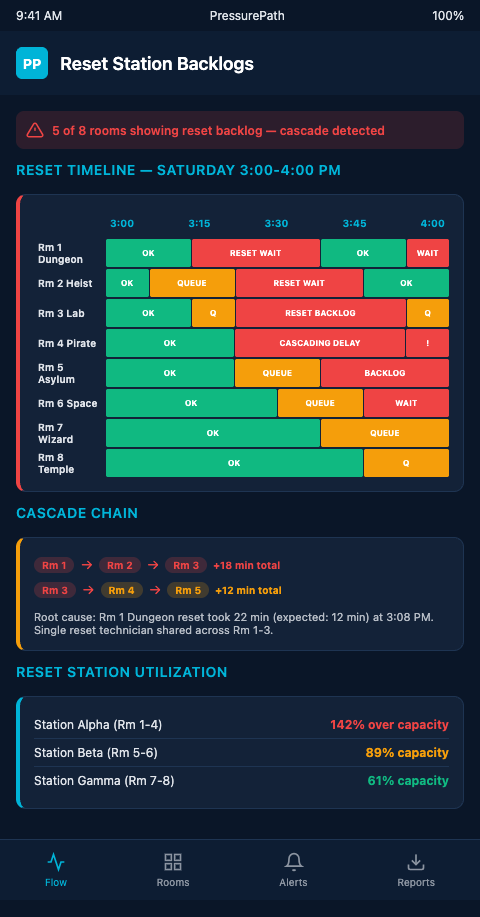
PressurePath models this by treating each room's reset cycle as a pipe segment with a defined throughput rate. When you load your 8-room Saturday grid, the simulator identifies every window where reset demand from multiple rooms overlaps, calculates whether your reset staff capacity covers that demand, and flags the windows where backlog is structurally guaranteed given current staffing and booking spacing.
The reset station routing best practices for high-volume weekends extend this into the routing decisions: which rooms should your reset team prioritize first when two overlap, and what sequencing reduces cascade risk most effectively.
Airport gate turnaround analysis from Assaia's 2024 benchmark report documents a 6% delay reduction through analytics applied to the same structural problem: multiple concurrent turnarounds competing for shared ground crew capacity. The discipline transfers directly. Just as gate turnarounds are sequenced by priority aircraft, room resets must be sequenced by next-start urgency and room complexity.
Think of an 8-room Saturday as eight pressurized segments draining into a single reset pipe. When Room 4 and Room 6 both exit within a 3-minute window and your two-person reset team has only 14 minutes until the next group enters Room 4, that pipe is briefly overloaded beyond its drainage capacity. Pressure builds for 6-8 minutes, groups wait in the briefing room, and the rest of the afternoon inherits a 4-5 minute latency that never fully clears before closing. Routing protocol is the valve that determines which pressure wave releases first and which can safely hold upstream without triggering a downstream cascade into the 4:30 PM wave.
Three Structural Fixes for Persistent Reset Backlog
The first fix is complexity tiering. Classify every room into three tiers: low (under 15 items to reset, no prop dependence), medium (15-25 items, some fragile props), and high (25+ items or elaborate set pieces). High-complexity rooms get a 20-minute minimum buffer between bookings. If your booking platform doesn't allow per-room buffer configuration, build the buffer in by blocking the slot immediately after high-complexity rooms and selling it only if the prior slot goes unrebooked at 48 hours.
The second fix is split-team routing. When two or more rooms need reset simultaneously, assign the second reset team member to the highest-complexity room with the nearest next start, rather than having both team members clear a lower-complexity room together. Parallel reset coverage is more efficient than sequential.
The third fix is pre-exit staging. Thirty seconds before your room timer hits zero, your reset team should be at the door with replacement materials staged. This isn't about rushing the experience — it's about eliminating the dead time between group exit and reset start. Setup time reduction frameworks from TXM Lean Solutions confirm that the gap between "machine stopped" and "setup started" is often the largest recoverable time in any changeover process.
The puzzle station bypass patterns offer a parallel insight: when reset workflows allow groups to encounter partially-reset assets, they route around them — creating additional recovery work. Pre-exit staging eliminates the partial-reset exposure entirely.
For an 8-room franchise running three back-to-back booking waves on a peak Saturday, these three changes alone can recover 40-60 minutes of reset backlog across the shift — time that currently shows up as staff overtime and guest wait extensions at the briefing room.
That recovered time directly reduces the staff hour hemorrhage from firefighting that most 8-room operators absorb as an invisible weekly cost. Reset backlog compounds into afternoon chaos; afternoon chaos compounds into overtime. Breaking the first link in the chain is what makes the staffing model sustainable.
Reserve Your Spot on the Waitlist
PressurePath is currently onboarding multi-room escape room operators who want to model their exact reset station constraints before their next peak weekend. If you run 8 rooms and your Saturday reset team is regularly firefighting the 3 PM wave, we'll load your booking grid and show you the specific slots creating structural backlog — before you spend another Saturday firefighting it.
The reset station analysis begins with your room complexity tiers, reset team size, and three recent peak-day booking grids. PressurePath maps every overlapping reset window, calculates whether your current staffing covers simultaneous demand at each point, and generates a reset routing protocol tailored to your specific room layout. Operators who have completed the analysis typically discover that 60-70% of their reset backlog traces back to 2-3 specific booking slot combinations that recur every Saturday — and that adjusting those slots by 4-8 minutes eliminates the cascade before it starts.