Staff Hour Hemorrhage: Spotting the Firefighting Pattern
The Firefighting Pattern Looks Like Good Operations
Your GM repositioned a host from Room 7 to cover the briefing room overflow at 2:15 PM. The host who was originally scheduled for the briefing room was handling the photo wall backup. A third staff member covered the late group exit from "Cryogenic Breach" because the reset team was already in "Arctic Passage." Everyone adapted. The shift ended. Nothing broke.
That's not good operations. That's firefighting — and the difference matters because firefighting feels productive in the moment but costs you compounding labor inefficiency across weeks and months.
PagerDuty's research on time-critical unplanned work found that 62% of operations professionals spend 100 or more hours per year on disruptive unplanned work — work that wasn't in the schedule and required reactive redeployment of staff who were planned elsewhere. At a 10-room franchise running 48 Saturdays a year, 100 hours of unplanned work maps to roughly 2 full firefighting shifts per month built invisibly into your labor budget.
Roger Bohn's Harvard Business Review analysis "Stop Fighting Fires" identifies the structural signature: teams that resolve issues quickly but encounter the same issues repeatedly, with no time left for root-cause work. That's the pattern to watch for. If your staff are fast, competent, and still running late on Saturdays — the problem is not their skill, it's the structure of the schedule they're operating inside.
What Pacing-Driven Labor Waste Actually Costs
A myshyft.com analysis on strategic labor cost management quantifies the typical loss: organizations without evidence-based scheduling lose 20-30% of their labor budget to inefficiencies that structured scheduling prevents. At a 10-room franchise with $15,000/month in labor spend, that's $3,000-$4,500 per month in recoverable cost. Not from cutting staff — from eliminating the reactive redeployment that structural pacing planning would prevent.
The IBISWorld 2024 escape room industry report documents 17.7% business count growth in 2024. That density increase sharpens labor efficiency as a competitive factor: franchises that staff reactively can't price competitively against those that staff proactively. The operators managing to grow margin in that environment are the ones who've converted their Saturday firefighting budget into productive pre-shift planning.
Think about your labor spend as water pressure in a system with leaky pipes. Every firefighting intervention is a pressure release through a leak — energy that was supposed to drive productive throughput is instead being vented into crisis response. The pressure doesn't drop visibly in your bookings, but it drains steadily from your margin.
The SCMR research on warehouse labor firefighting documents the parallel in a different operations context: constant reassignment and overtime push staff toward burnout, and experienced staff who know the operation's spatial quirks and soft protocols are the most expensive to replace. In a 10-room franchise, a Game Master who understands the flow dynamics of peak Saturday hours is not a replaceable hourly position — they carry institutional knowledge about which rooms cascade pressure into which corridors. Firefighting schedules burn those people out first.
The staff dashboard alerts that surface traffic jams early are most effective when they're connected to a pre-shift plan that shows which time windows are structurally risky. Without that connection, a dashboard just tells your GM which fire to fight next — it doesn't prevent the fire from starting.
Three Signals That Your Franchise Has the Firefighting Pattern
Signal one: shift debrief language. If your staff debriefs after peak Saturdays consistently use phrases like "the 3 PM wave was rough," "we had to move Sarah to cover the briefing room again," or "we were short-staffed on reset" — and the same specific windows and the same specific assets appear week after week — you're seeing the firefighting pattern. The fire is predictable and recurring.
Signal two: unplanned overtime clustering. Track your unplanned overtime by time-of-day. If it clusters in the 2-4 PM window on Saturdays, it's not staffing — it's pacing. Pacing leaks that have accumulated since 10 AM are hitting maximum latency at that point, and your staff overtime is the visible financial signal of invisible upstream scheduling failures.
Signal three: reassignment frequency. Count how many times per shift a staff member is reassigned from their original role to cover another position. The Intent Tech research on labor firefighting and systemic attrition shows that frequent reassignments drive skilled worker burnout faster than replacement can cover, creating a hidden turnover cost that doesn't appear in labor-hour reports.
PressurePath addresses this by running your booking grid as a fluid flow simulation before your shift begins. It identifies the specific 15-minute windows where shared asset pressure will exceed staff capacity, and generates a pre-shift staffing delta table: add one host to the briefing room from 2:00 to 2:45 PM, shift the Room 4 reset to start 5 minutes earlier, delay the Room 9 start by 3 minutes to prevent the 2:47 PM collision. That pre-shift plan converts 3 hours of Saturday firefighting into 40 minutes of Monday morning scheduling adjustments.
The scale of recoverable labor becomes tangible when you track it by the hour. A 10-room franchise with two firefighting windows per Saturday — one at 1:45 PM and one at 3:30 PM — typically absorbs 45 minutes of reactive redeployment per window across three staff members. That's 4.5 labor-hours of pressure venting per peak Saturday, or roughly 18 hours per month at four peak Saturdays. Treat that as pressure leaking from the system's productive throughput: each minute a GM spends rerouting staff between shared assets is a minute the network isn't draining at its design rate.
A structured pre-shift plan that prevents just one of those two firefighting windows recovers 9 labor-hours monthly — before you touch overtime costs or reduce the staffing ceiling. Most franchise operators underestimate this number because the individual interventions feel necessary in the moment; only aggregated across a month does the recoverable volume become obvious. Each firefighting minute is pressure venting from the network rather than productive throughput, and the venting rate compounds across peak weekends in a way that weekly reports rarely surface.
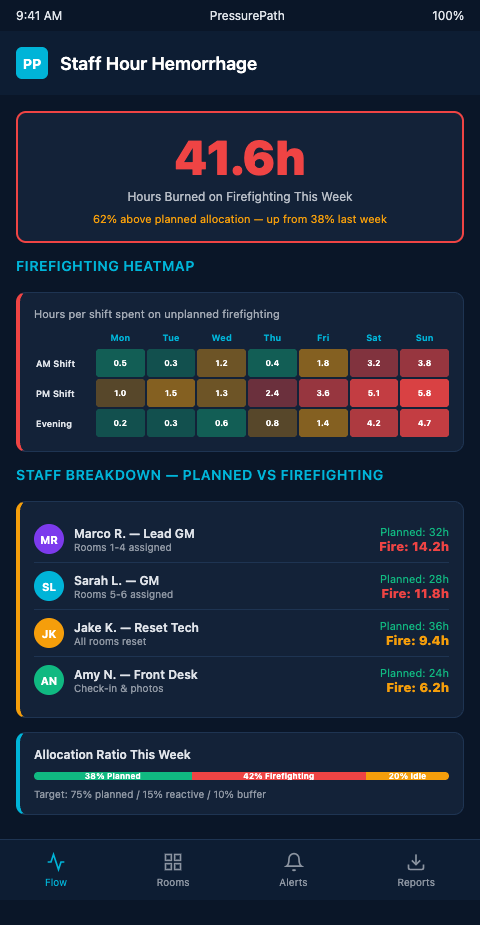
The game master load balancing fundamentals across 8-12 rooms provide the structural framework for distributing GM responsibility so that no single shift relies on one person's real-time problem-solving. Firefighting patterns always have a single point of failure at their center — usually one experienced GM who absorbs the chaos because they know where all the leaks are.
Scheduling tools without flow awareness default to reactive staffing adjustments. NetSuite's hospitality staff scheduling research confirms that without real-time visibility and structural planning, operators perpetually adjust schedules reactively rather than setting them strategically. The stage manager workflow from immersive theater productions addresses this structurally — SMs build pre-show risk matrices and cue contingency plans that prevent reactive interventions during performance, and escape room franchise GMs benefit from the same pre-shift risk framing.
Apply for Early Operator Access
Escape room franchise operators who've traced their Saturday labor costs back to a recurring firefighting pattern are exactly who PressurePath was designed for. If your unplanned overtime clusters in the same 2-hour window every peak weekend, there's a pacing-driven cause — and we can show it to you on a simulation map before your next Saturday opens. Apply for early operator access through the waitlist.
The firefighting pattern analysis starts with your shift reports and overtime records from the last four peak Saturdays. PressurePath correlates your staff reassignment timestamps against the booking grid's predicted pressure windows and identifies which specific booking slots generated each firefighting cascade. Operators who complete this analysis typically find that 70-80% of their reactive redeployment traces back to 3-4 recurring collision windows that are structurally encoded in the schedule. The pre-shift plan that prevents those collisions converts weekly firefighting labor into a single Monday morning scheduling session, and the recovered hours show up directly in your next monthly labor report as reduced unplanned overtime.