Why School Groups Skip Your Puzzle Stations (And What the Data Shows)
The Puzzle Station Nobody Touched
A third-grade class from Westbrook Elementary spent 47 minutes in the museum on a Tuesday in October. The docent's post-visit report noted strong engagement at the entry dinosaur display and the water table near the cafeteria exit. The Water Cycle puzzle—a $180K NSF-funded centerpiece positioned in the center of the science wing—received zero documented stops from the group. Zero. The 30-kid wave flowed in, peaked at the edges, and drained through the center without touching the lever once.
That isn't an isolated case. The observational data on visitor sweep rates is unambiguous: Beverly Serrell's dwell-time research establishes an average sweep rate of 200–400 square feet per minute, meaning most visitors never stop at the majority of exhibits in any given floor plan. School groups—moving as a coordinated wave under time pressure from bus schedules—compress that sweep rate further. A 30-kid wave with a 12:00 PM bus departure doesn't browse. It surges.
The puzzle station bypass problem is particularly acute because puzzle stations are specifically the exhibit type that children's museum designers and funders invest in most heavily. They require dwell time to deliver their learning value. They depend on a child choosing to stop, engage with the mechanism, and persist through initial confusion to the payoff. All three of those requirements are incompatible with bypass-mode wave movement.
What the Observational Data Shows
Research on children's engagement with STEM exhibits from a large observational study finds that 88% of children reach their highest engagement when exhibits permit active repetition. Puzzle stations should, by design, satisfy that criterion. The problem is that active repetition requires two things the bypass dynamic removes: time to start and social permission to stop.
When a 30-kid school wave enters a floor plan, it behaves like pressurized fluid surging through pipes. The wave flows toward the lowest-resistance path through the space. A puzzle station that requires a child to stop, read an instruction panel, and make an initial move is high resistance—not because it's hard, but because stopping breaks wave momentum. The fluid finds another route. The same dynamic appears in immersive theater, where audience drift in non-linear performance spaces follows identical pressure-path logic—audiences bypass critical narrative stations when forward momentum isn't interrupted upstream.
Visitor engagement research in interactive science exhibits confirms that dwell time and engagement vary dramatically by design, and that low-engagement exhibits are predictably bypassed. The mechanism isn't preference—it's architectural. Exhibits with unclear affordances from 20 feet away, placed mid-floor without natural traffic choke points, are invisible to a moving wave. The children don't decide not to stop. The wave's momentum makes the decision before they're close enough to read the exhibit's invitation.
The Springer study on museums as learning avenues frames the problem precisely: museum engagement is conditional on design quality. A puzzle station with strong pedagogical content but weak spatial positioning fails on design quality terms—not content terms. The puzzle itself could be perfect. If the floor plan doesn't route the wave to it, the puzzle might as well not exist.
The IMLS data on museum achievement outcomes shows measurable achievement gains tied to museum visits—but those gains are contingent on actual engagement, not mere physical presence. A school group that sweeps past your puzzle station receives none of the outcomes your grant promised. The visit happened. The learning didn't.
What Makes a Puzzle Station Bypassable
Three design variables predict whether a puzzle station gets skipped by a 30-kid wave.
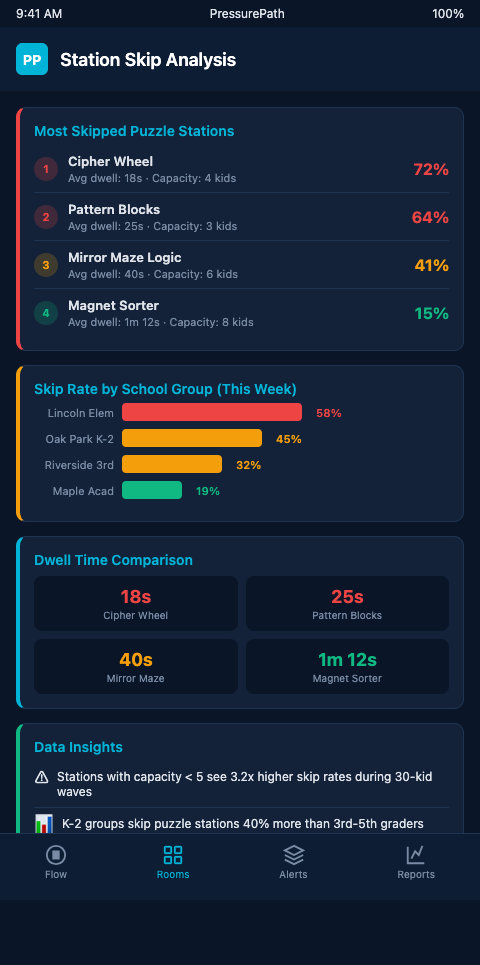
First: entry signal strength. Can a child identify what the station does from 20 feet while moving? A lever, wheel, or large physical affordance communicates action. An instruction panel at child-eye height reads as a sign, not an invitation. Puzzle stations that require reading before engagement are universally high-bypass under school-wave conditions—the wave doesn't pause long enough for a moving child to decode text.
Second: isolation from traffic flow. Puzzle stations positioned off the main circulation path require a child to make a deliberate turn. In a wave, deliberate turns don't happen without a social trigger—a peer stopping first, an adult directing movement, or a physical barrier that redirects the wave into the station. A puzzle station that sits 6 feet off the main corridor with no visual anchor from the circulation path receives the same contact rate as a station in a back room. The geometry makes it effectively invisible.
Third: the cold-start problem. Puzzle stations that require multiple steps before payoff have a cold-start penalty. The first child to approach has to solve the initiation problem alone while the wave moves past. Stations designed with immediate tactile response—pull this, see that—eliminate the cold-start penalty and lower the entry resistance for each successive child. The IMLS proficiency frameworks require situated engagement at specific exhibits to count as informal learning. That situated engagement only begins if the child stops and touches the exhibit in the first place. A cold-start penalty ensures that the wave's leading edge doesn't stop, which means the trailing mass doesn't stop either.
The Family Interactions research in Visitor Studies found that three learning behavior measures are poorly correlated with each other—meaning a single bypass can eliminate the entire expected learning outcome for a given station. One skip costs more than one interaction. The pre-visit preparation, the in-exhibit engagement, and the post-visit reinforcement are designed as a sequence. Miss the middle element and the sequence doesn't deliver.
The Social Dynamics That Amplify Bypass
Beyond the three structural variables, school groups experience bypass amplification that individual visitors do not. In a 30-kid wave, the bypass decision propagates socially. When the leading edge of the wave flows past a station, the mid-wave and trailing children observe that the fast kids—the socially dominant movement setters—passed it by. That social signal reads as "this station is not where the group is going." The trailing children suppress any impulse to stop because stopping now means falling behind the group, which is socially aversive for third-graders.
This social amplification is why puzzle station bypass rates for school waves are typically much higher than for family visitors or adult groups of similar size. A family of four might split—one parent and two children stop at the puzzle while the other parent continues—because the family unit tolerates dispersion. A 30-kid school wave does not tolerate dispersion. The social cohesion of the group enforces collective movement decisions, and those decisions propagate from the leading edge backward.
The implications for design are direct: interventions must target the leading edge of the wave, not the average child. A chaperone at the station entry intercepts the leading edge before it makes the bypass decision. A physical barrier that forces the leading edge to decelerate at the station's approach changes the social signal that propagates to the trailing mass. An exhibit with a large, visible, immediately actionable affordance catches the leading edge's attention while it's still in range.
Correcting the Bypass Before the Next Field Trip
PressurePath models school-wave pressure as a fluid simulation against your floor plan. For puzzle stations, the model calculates the bypass shadow—the zone around a station where wave momentum is high enough that no child will stop without an active redirect. That shadow is usually larger than designers expect: for a mid-floor puzzle station in a standard science wing, the bypass shadow under a 30-kid wave typically extends 8–12 feet in every direction from the station boundary.
The interventions that close the bypass shadow fall into three categories: spatial (rope partitions, raised platforms, floor markings that channel the wave through the station entry), signal (immediate tactile affordances visible from distance, sound or light cues that break the wave's forward attention), and social (chaperone scripting that places an adult at the station 30 seconds before the wave arrives).
On the signal and social levers, the solution is almost never to make the station louder—it's to redirect flow before the drift begins. The same upstream logic applies to puzzle station bypass. Fix the conditions upstream of the station, not the station itself.
The conditions that create learning goal failure often start here—at the puzzle station that no third-grader touched. And the patterns that predict which stations get bypassed are closely tied to magnet stations that slow pass-through, which covers the design attributes that convert bypass-prone stations into natural stopping points.
The Cost of a Missed Puzzle Station
For a children's museum exhibit designer, the cost of puzzle station bypass is not abstract. It's a grant evaluation where the targeted learning outcome shows zero documented engagement. It's a post-visit teacher survey where the exhibit the museum invested most heavily in doesn't appear in any student memory. It's a renewal application that has to explain why the centerpiece of the last award didn't generate measurable outcomes.
The fix is not a redesign of the puzzle. The fix is a redesign of the path the 30-kid wave takes through your floor—or a targeted intervention at the specific point where the wave currently bypasses your most important station. PressurePath identifies that point, calculates the minimum intervention needed, and predicts the resulting contact rate.
Children's museum designers interested in running that model can join the waitlist—no floor plan is too small to benefit from knowing where the wave goes when nobody's watching.