How Audience Drift Destroys Narrative Arcs in Sleep No More-Style Productions
The Moment the Arc Breaks
The Hecate staircase scene in McKittrick Hotel-style promenade theater draws a disproportionate crowd every night. Census data from productions using overhead tracking consistently shows the same pattern: roughly 60–70% of the audience gravitates toward one or two charismatic scenes while three or four adjacent rooms sit at fewer than five viewers. According to research documented in Together Here: Immersive Theatre, Audience, and Space from Trinity University, free audience roaming in Sleep No More-style shows is the primary mechanism through which directed narrative arcs fracture. The problem is not that audiences make wrong choices — they follow their instincts toward movement, light, and presence. The problem is that the director's arc was never modeled against those instincts before opening night.
Act 2, Scene 4 might require 24 viewers in the library during the Poisoning Monologue. When only 9 arrive because 41 drifted into the conservatory after Scene 3's corridor performance, the scene loses its witness mass. The monologue was blocked for 20 to 25 bodies. At 9, the actor adjusts involuntarily — volume drops, spatial range contracts, and the beat the director rehearsed for three weeks collapses. Rose Biggin's research on Punchdrunk productions confirms that spatial freedom in immersive work fragments linear story comprehension precisely because no flow map accounts for the pull exerted by high-status scenes on adjacent audience pressure.
Audience drift is a hydraulic problem disguised as an artistic one. Pressure builds where charisma concentrates. Rooms downstream in the narrative arc starve. The immersive entertainment market is projected to reach $442 billion by 2030 at a 26.3% CAGR, meaning the stakes of unresolved drift scale with every new production attempting Sleep No More-style blocking.
Flow Modeling Audience Drift as Pressurized Water
Imagine your venue as a network of pipes. Each scene room is a chamber with an inlet, an outlet, and a capacity ceiling. The audience is pressurized water moving through that network. When Scene 3 generates high-status action near its doorway, it acts as a low-resistance junction — water rushes in from upstream and pools. Scene 4, the library, sits downstream with a narrower inlet and lower inherent pull. Unless Scene 3 actively vents pressure at the right moment through a cue-exit mechanism, the library never receives the 24 viewers the director's arc requires.
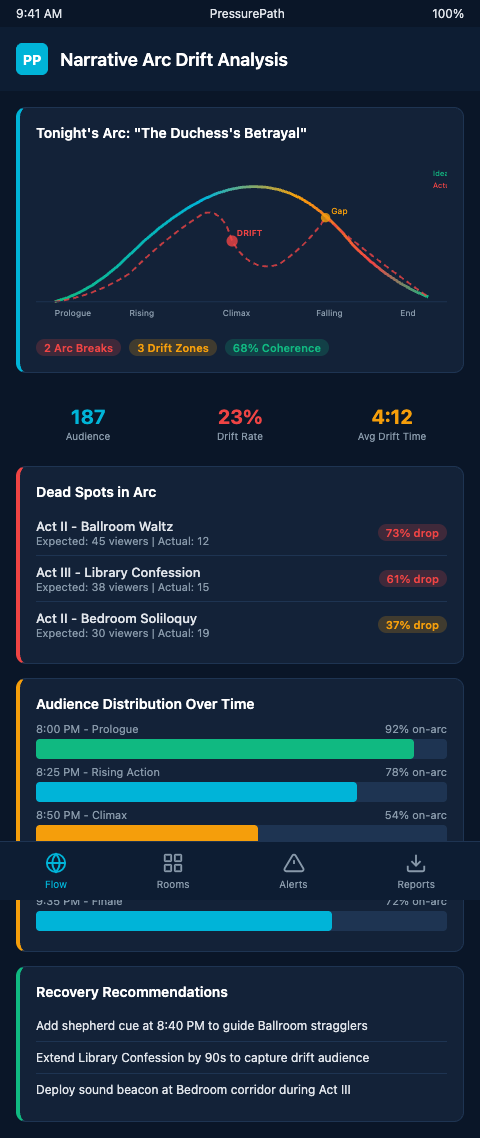
This is the core model behind PressurePath's audience drift analysis. The platform maps each scene room as a node with a defined pressure capacity, inlet flow rate, and outlet timing controlled by cue exits. When you input your blocking arc — which scenes require which viewer densities at which timestamps — PressurePath runs a simulation of how audience pressure distributes across the venue. It identifies scenes where pressure will over-concentrate (the conservatory), scenes that will under-fill (the library), and the precise cue-exit timing adjustment in Scene 3 that redistributes the audience before the monologue begins.
Research in Research of Immersive Theatre from Audience Perspective documents how audience agency in promenade theater leads to individualized, incomplete narrative experiences — not because the audience is disengaged, but because the spatial architecture was never pressure-tested. Flow modeling exposes the 90-second exit-cue shift in Scene 3 that a director rehearsing only blocking would never discover. PressurePath's simulation layer surfaces that shift before the first preview.
The key metric in audience drift analysis is the pressure differential between adjacent scene rooms at transition moments. A healthy transition shows pressure equalization — the upstream scene releases viewers into the corridor at the same rate the downstream scene needs to fill. An unhealthy transition shows a pressure cliff: viewers remain locked in Scene 3 because nothing in the cue design signals them to move. The narrative research framework from Nature HSSC identifies sequential immersion as the component most vulnerable to this kind of scene-to-scene pressure failure: when audiences scatter rather than flow, narrative comprehension degrades at the exact moment the director needs full witness mass.
Drift operates differently in first-act scenes versus second-act scenes. In Act 1, audiences have not yet established a mental map of the venue and tend to cluster near the entrance complex — the conservatory problem is typically an Act 1 phenomenon. By Act 2, viewers have developed spatial familiarity and follow performers more aggressively, often trailing a secondary performer from Scene 3 into an unintended room rather than routing toward the Scene 4 entrance. A flow model that treats Act 1 and Act 2 drift as identical misses this behavioral shift and produces inaccurate density projections for the second half of the show.
PressurePath models act-phased drift dynamics separately, using different pull value curves for Act 1 and Act 2 based on the spatial familiarity research embedded in the platform's behavioral model. Directors using the platform for Sleep No More-style productions find that Act 2 cue exits need to be 30–45 seconds earlier than Act 1 exits from equivalent scenes, because audience mobility — and therefore the speed of pressure redistribution — increases significantly once spatial familiarity develops.
Preventing Drift Before the First Preview
Three production-level interventions prevent audience drift from destroying your narrative arc before it becomes a performance problem.
Cue-exit re-timing. The most common drift source is a cue exit placed too late in an upstream scene. When Scene 3's exit cue fires at the scene's emotional climax rather than 90 seconds before it, viewers stay locked in place through the climax and then wander freely — typically toward the next charismatic attraction rather than the director's intended downstream room. Moving the cue exit to the pre-climax build phase, when emotional tension is rising but not yet peaked, creates a pressure release that channels viewers into the corridor while Scene 4 is still preparing to receive them.
Sightline density ceilings per scene. Every scene has a physical sightline ceiling — the maximum number of bodies that can occupy the room before actor visibility degrades for the majority of viewers. Establishing those ceilings in your flow map before rehearsal begins allows the director and stage manager to set soft and hard capacity limits. When PressurePath's simulation shows Scene 3 projected to receive 47 viewers against a sightline ceiling of 30, the model flags the overflow and suggests which earlier scene's cue-exit timing needs adjustment to reduce inlet pressure.
Corridor design as pressure valve. Corridors between scenes are not neutral connective tissue — they are active pressure regulators. A wide, well-lit corridor with a mid-length performance beat installed (a 45-second actor encounter, a sound design element, a prop discovery) creates resistance that slows viewer transit and smooths the pressure surge into downstream scenes. A bare corridor with no friction allows the full audience cluster from Scene 3 to arrive at Scene 4 as a single bolus rather than a distributed flow.
Blocking arc integrity scoring. After each performance, the director and stage manager need a measurable record of how closely the actual audience distribution matched the intended one. PressurePath's blocking arc integrity score compares projected density to actual count for every scene at every major timestamp. A score below 80 on Scene 4 for three consecutive nights signals a systematic drift problem, not random variation — and the platform identifies the specific upstream variable causing the pattern.
Night-over-night drift calibration. Audience drift patterns shift across the run. Early-week audiences explore the full venue more widely; weekend audiences follow word-of-mouth recommendations toward specific scenes, producing tighter clustering. A flow model that uses first-night behavioral data for a multi-week run will lose accuracy as the run matures. Recalibrating pull values and cue-exit timing against weekly performance data keeps the model predictive throughout the engagement.
The Gareth White analysis of audience movement in immersive interiors establishes that audience spatial behavior is shaped by the venue's resistance architecture as much as by individual choice. Directors who treat audience drift as a behavioral problem requiring audience management are fighting the wrong battle. The battle is architectural and temporal — it lives in the cue-exit schedule and the sightline density model, not in pre-show instructions.
For a structural foundation on why specific rooms become dead zones while others overcrowd, the dead rooms primer maps the spatial mechanics that produce uneven pressure distribution across multi-room venues. When drift compounds across multiple scenes into persistent arc damage, the failure pattern follows the density-driven arc failure model documented for high-attendance productions. The same pressure-collapse dynamic appears in non-theater venues: fear state collapse in haunted attractions follows an identical mechanism when jammed flow prevents audiences from reaching the scare beat they were routed toward.
Building Drift-Proof Productions
Productions that resist audience drift share one design discipline: they model flow before they rehearse blocking. The director's arc is written for specific viewer densities at specific timestamps. Those density targets become inputs to the flow model. The flow model outputs cue-exit schedules, corridor friction recommendations, and sightline capacity ceilings per scene. Rehearsal then refines the blocking within a spatial architecture that has already been pressure-tested.
PressurePath supports this pre-rehearsal flow modeling phase. Import your venue map, set your scene-by-scene density targets and sightline ceilings, and run the simulation. The platform identifies every scene where drift will starve your narrative arc and every transition where a cue-exit adjustment will restore the intended pressure distribution.
If you're producing Sleep No More-style work or any promenade-format immersive theater, join the waitlist for immersive theater companies before your next production enters rehearsal. The audience drift problem is solvable — but only before the blocking is locked.