How Fear State Collapses: The First Sign Your Haunt Is Flow-Jammed
The Night the Scream Became a Laugh
October 28th, 9:47 PM. Your Clown Alley actor has run this scare 200 times over two weekends. Same position, same timing, same lunge. But this time, instead of a piercing scream, the first teenager turns to laugh at their friends — who are standing close enough to feel the actor's breath. The fear state is gone. Three people collapsed it just by being in the wrong place.
Fear state collapse is the single most diagnostic sign that your haunt is flow-jammed, and most designers only notice it after the fire marshal has already started measuring pinch-point density in the corridor. By that point, you have a safety problem, not just a pacing problem.
The neuroscience explains why crowds are so destructive to individual fear responses. Fear-potentiated startle research shows that startle magnitude amplifies in genuinely aversive states but collapses when the surrounding context disrupts the fear frame — and nothing disrupts that frame faster than the social signal of a laughing peer inside your own group. When one person defuses the tension, the entire group's threat assessment resets. The actor's scare becomes a punchline.
Haunted attraction design practice reinforces this directly: scaring the front of a group backward into the people behind them destroys scare capacity for everyone in that chain. One mis-timed strike causes a cascade that ends with your actor standing in the middle of a group photo. The industry background on walk-through scare mechanics consistently shows that emotional delivery depends entirely on spatial separation — and spatial separation depends on crowd flow.
The first sign your haunt is flow-jammed is not a staff complaint or a guest injury report. It is a fear state collapse: actors landing scares that produce laughter, group members turning to talk to each other in the middle of a chamber, guests pulling out phones mid-scare. Every one of these behaviors tells you density has exceeded the threshold where individual fear processing can occur.
How Flow Jamming Destroys the Fear State: The Pressure Pipeline
Think of your haunt's crowd as water moving through a pressurized pipe. When flow is healthy, groups move at controlled intervals — pressure balanced, chambers emptying before the next group enters. When you oversell a Friday night or run dispatch intervals that are too tight for your actual walk-through speed, the pipe compresses. Pressure builds at every bottleneck. The water doesn't move; it stacks.
In a pressurized-fluid model of crowd movement, each scare chamber has a maximum working pressure — a density threshold above which the scare cannot function. For Clown Alley, that threshold is roughly 7 bodies in the strike zone before the fear state collapses. For your Butcher Room, it is 4. These numbers are not arbitrary; they come from the spatial geometry of the actor's scare sequence, the recoil radius required for the victim to process the threat, and the social contagion dynamics of group fear response.
When the pipeline backs up and pressure exceeds the chamber's working limit, the physics play out the same way every time. The first group stalls at a bottleneck. The second group compresses into the first group's tail. By the time the combined mass reaches your Clown Alley position, the actor is performing to a cluster of 9 or 10 people, not the intended 4 or 5. The leading edge of that cluster has no scare corridor to react into. There is no room to stumble backward. The fear state has nowhere to go.
Startle response habituation research explains the secondary effect: when repeated stimuli arrive faster than the brain can process and reset the threat signal, the defense cascade does not escalate — it degrades. Your audience learns faster than you want them to. If two groups compress through the same scare sequence within 90 seconds of each other, the second group is already partially habituated. The actor's lunge produces a reduced response. By the third compressed group in an hour, the chamber has effectively stopped working.
The defense cascade — arousal, flight/fight response, freeze — only follows that sequence when crowd noise does not override the threat signal from the actor. A flow-jammed haunt is too loud. Peer laughter, chatter, shouting between groups — all of it competes with the scare stimulus. The brain receives conflicting signals and defaults to the social interpretation: this is entertainment, not threat. Fear state collapses.
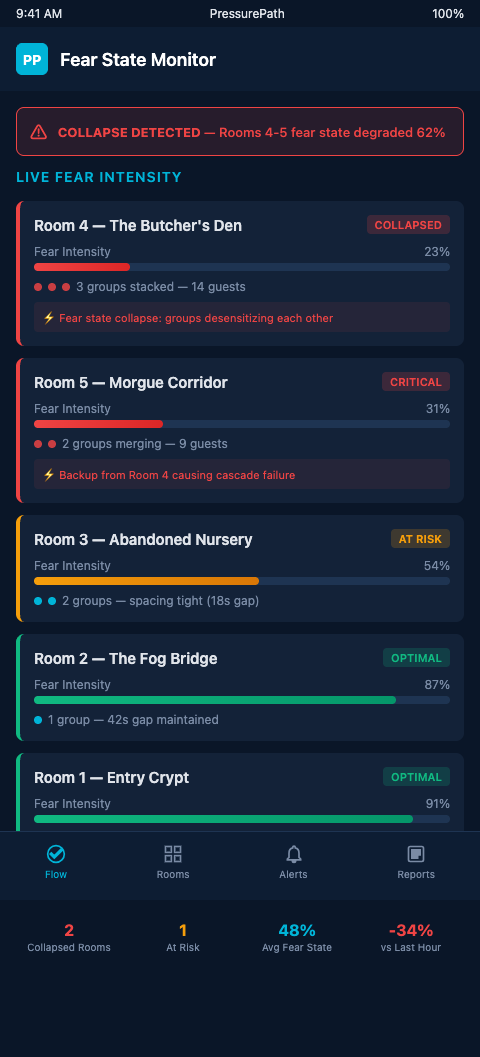
PressurePath models this as a pressure simulation, mapping every chamber's density threshold against your dispatch interval and peak-night arrival curve. The output is not a generic warning — it is a timestamped prediction showing exactly which chambers will fail under which queue conditions. You see the 9:47 PM Clown Alley failure before it happens on October 28th.
Haunted attraction ticketing data shows 71.8% of attendance falls on Friday and Saturday nights, which means your flow-jam problem is almost entirely a peak-night problem. You may run cleanly on Thursday. You may have perfect scare delivery during your preview weekend. The pipeline does not compress until Fri/Sat peak window fills the queue and your dispatch intervals stop matching your actual walk-through velocity. That is when fear state collapses begin.
What makes this particularly difficult to diagnose in the moment is that actors rarely know the jam is coming. They feel it after the fact — in the missed scares, the group that walked through without reacting, the laugh that stings more than any bruise. By the time actor instinct registers the problem, the fire marshal's density meter is already logging numbers. You need the simulation upstream of the performance, not downstream of the collapse.
Understanding why scare beats pile-ups happen is the natural next step once you have identified fear state collapse as the mechanism — because the specific sequence of events that kills a scare beat is a direct product of the same pressure dynamics.
Diagnosing Your Own Flow Jam Before It Collapses a Scare
The practical diagnosis starts not on the floor but in the data. Most haunts capture ticketing timestamps and dispatch logs without analyzing them against chamber performance. The gap between dispatch interval and walk-through time under real crowd conditions is where flow jams hide.
Run this check: take your average dispatch interval on a peak Friday, then record the actual chamber-to-chamber transit time at peak density versus your off-peak baseline. If peak-density transit is more than 40% slower than baseline — a common finding — your dispatch interval is not accounting for the speed reduction. Groups are arriving at chambers before previous groups have fully cleared.
That delay is not constant across the attraction. It compounds at bottlenecks. A narrow corridor with a 90-degree turn, a scare chamber where the actor blocks the path, a transition room that guests linger in — each one adds seconds to the downstream groups' chamber arrival time. Once you identify the three or four bottlenecks where delay accumulates fastest, you know where fear state collapses will cluster.
Watch for the peak-night warning signs in real time: actors making eye contact with each other across the chamber instead of focusing on incoming guests, staff in transition corridors starting to slow-walk groups deliberately without authorization, guests visibly bunched at scare chamber thresholds before entering. Each of these behaviors is your floor team responding instinctively to pressure they cannot formally measure.
The fix is not always a dispatch interval change. Sometimes it is a chamber redesign — widening the exit corridor by 8 inches to increase flow velocity, or adding a decompression beat between your Clown Alley and Butcher Room transitions to reset guest arousal levels. Sometimes it is a staffing solution — adding a second actor to handle overflow pressure during the peak 90-minute window. The right answer depends on your specific pressure map, not on general haunt advice.
Immersive experience designers face a structurally identical problem: when audience drift destroys narrative arcs, the root cause is the same pressure dynamics — people moving at different speeds through constrained space, collapsing the intended sequencing of emotional beats. The parallel is direct enough that flow-modeling tools developed for immersive theater apply immediately to haunted attraction design.
Start With the Chamber That Failed Last October
Every haunt that ran at peak capacity last season has at least one chamber where the fear state collapsed and everyone on the floor knew it. That is the right place to start your flow analysis — not with a general audit, but with a specific post-mortem of the worst night.
Pull your dispatch logs from the highest-attendance weekend. Identify the period between 8:30 PM and 10:30 PM where ticket density was heaviest. Then trace the transit chain from entry to every chamber that received complaints or logged a missed-scare incident. You will find a compounding delay that started upstream — often in an entry briefing corridor or a first-chamber transition — and propagated forward through the entire attraction.
PressurePath converts that forensic analysis into a predictive model. Feed in your chamber dimensions, your dispatch interval schedule, your ticketing data by time slot, and your peak-night arrival curve. The simulator runs the pressurized-flow model forward and shows you the exact minutes when each chamber's density threshold will be exceeded. You see the fear state collapse coming 45 minutes before your actors feel it.
Haunted attraction designers who approach October with a flow model in hand make fundamentally different decisions than those who wait for the floor to tell them something is wrong. The floor always tells you too late. The simulation tells you on paper in September, when you still have time to widen a corridor, adjust a dispatch schedule, or stage a second actor in the Clown Alley position during the peak window.
Your guests paid to be scared. Your actors trained to deliver that. The only thing standing between the rehearsed scare and the collapsed fear state is the density in that chamber at the moment the lunge happens. Model it before opening night.