Why Scare Beats Die When Groups Pile Up: A Pacing Primer
The Three-Second Window That Groups Destroy
Your Butcher Room actor has one job: hit a 3-second scare window that opens the moment the lead guest crosses the threshold line and closes the instant the group's trailing member enters the actor's peripheral vision. Outside that window, the scare either lands too early — before the victim is primed — or too late — after group social dynamics have already defused the tension.
That window exists only when groups move with correct spacing. The moment a second group compresses into the tail of the first, the window shrinks to zero. The actor launches the scare into a crowd, not a victim. The beat dies.
A scare beat is not the actor's lunge. The beat is the entire sequence: the pre-signal that builds anticipation (a sound cue, a sight line reveal, a temperature change), the victim's isolation moment, the strike, the recoil, and the reset. Research on tension and suspense confirms that this sequence requires anticipation of uncertain outcomes — and pile-ups collapse that uncertainty by flooding the chamber with social noise. When six people are already talking and laughing as they enter, the actor's pre-signal never registers. The beat is dead before it starts.
Piling up is not just a spacing problem. It is a timing destruction mechanism. Once you understand the exact sequence it disrupts, fixing it becomes a flow problem, not a rehearsal problem.
How Pile-Up Mechanics Kill Each Stage of the Scare Beat
Think of your haunt's crowd flow as pressurized water pushing through a series of pipes. When pressure is balanced, each chamber receives a controlled pulse of guests at the right interval — a clean, isolated group that the actor can read, time, and scare. When upstream pressure builds and a bottleneck backs up two groups into the same pipe segment, the actor receives a surge instead of a pulse. No scare beat survives a surge.
The damage happens in sequence, and each stage of failure accelerates the next.
Pre-signal stage. A properly spaced group enters the approach corridor with 90 seconds to build anticipation before the scare chamber. Your audio cues, lighting changes, and ambient effects tune their arousal upward — defense cascade begins, peripheral attention sharpens. When a second group is compressing into that same corridor from behind, the lead group can hear the trailing group's conversations. The social signal overrides the atmospheric signal. Anticipation drops.
Research on repeated acoustic startle reflex shows that back-to-back scare stimuli without a sufficient recovery gap cause sensitization rather than escalating fear. But sensitization requires at least reaching the first scare. Pile-ups often prevent the pre-signal from landing at all — the victim arrives at the chamber already partially desensitized because their arousal was interrupted by social noise in the corridor.
Isolation moment. The most critical stage. The victim needs to feel alone or separated from protection — the designed moment where your Butcher Room actor has the clearest path to a clean strike zone. In a pile-up, there is no isolation moment. The lead guest can see, hear, and touch the people behind them. The feeling of vulnerability never forms. Fruin Level of Service E-F density threshold documents this precisely: at that density, pedestrians lose independent movement freedom entirely. Your victim cannot step back, stumble sideways, or react naturally. The scare has nowhere to go.
Strike and recoil. The actor's physical scare requires a minimum 6-foot recoil corridor. The victim needs room to stumble backward without hitting another person. In a pile-up scenario, the space behind the victim is occupied. The stumble gets caught by the body behind them. Instead of a fear response, you get social stabilization — a friend catching a friend, laughter, reassurance. The defense cascade never completes. Research on tension and resolution confirms that relief after a scare requires temporal and spatial spacing; compression eliminates the relief cycle entirely.
Reset. After the scare lands, the group needs a clear exit path before the next group enters. In a pile-up, the exiting group collides with the entering group at the threshold. The actor has no reset window — they are visible to the incoming group before they can return to position. Professional haunt designers at Haunted Attraction Network explicitly address this: when groups pile up, actors have no reset window, and the next group enters before the actor can re-position. The actor timing basics of managing that reset window are the direct downstream consequence of flow control upstream.
PressurePath maps this sequence as a pressure simulation — modeling each chamber's beat window against the arrival density from your dispatch interval and queue volume. The simulation identifies the exact minutes when a pile-up will eliminate the beat window in each chamber, chamber by chamber, across your full October run schedule.
Industry data shows haunt expenses are up 15% year-over-year at capped ticket prices, meaning pile-up-driven scare failures directly reduce the throughput-driven margin that justifies peak-night capacity. Every dead scare beat on a Saturday night is not just a guest experience failure — it is a review that says "too crowded, wasn't even scary," and that review compounds into reduced repeat attendance and lower perceived value for next season's pricing.
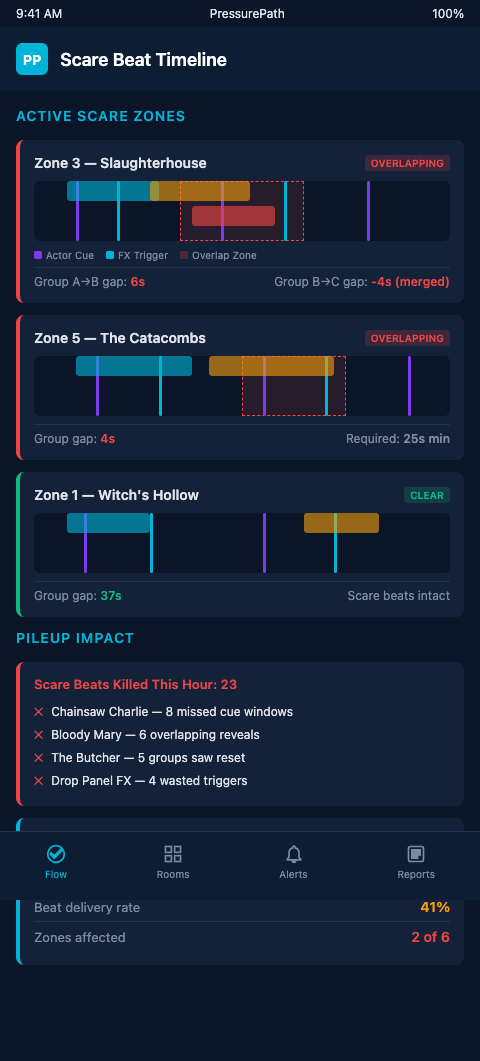
Advanced Tactics: Protecting Scare Beats Under Pile-Up Pressure
The goal is not to eliminate pile-ups entirely — that would require ticket reductions that destroy revenue. The goal is to protect the scare beat's critical stages even when pressure builds. Three tactics work consistently across different haunt layouts.
Buffer room sequencing. Install a designed decompression space between your highest-value scare chambers. This does not need to be large — even a 10-foot atmospheric corridor with ambient sound and lighting effects creates enough separation to let the trailing group's social noise decay. The lead group's arousal rebuilds in that space. By the time they reach the next actor's chamber, the anticipation stage has had time to reform. The buffer room acts as a pressure-release valve in the pipeline — it absorbs the compressed group energy before it reaches the next scare.
Dispatch interval adjustment by density band. Most haunts run a fixed dispatch interval all night — groups every 90 seconds, regardless of queue depth. The problem is that walk-through velocity drops as crowd density increases. A 90-second interval at 8:00 PM produces appropriate chamber spacing. A 90-second interval at 9:30 PM, when density has slowed transit velocity by 30-40%, produces pile-ups at every bottleneck. Dynamic dispatch — widening intervals by 15-20 seconds during peak density windows — preserves beat windows without requiring infrastructure changes.
Actor secondary position. For your highest-value chambers during peak windows, position a secondary actor or a staff member at the chamber exit to meter guest exit rate. The secondary role is not to scare — it is to control exit velocity, holding the exiting group at the threshold for 5 additional seconds to give the actor's reset window space. This is invisible to guests and adds no perceived wait time, but it dramatically reduces the reset-window failure rate during the 9:00 PM to 10:30 PM surge.
Understanding how pacing gaps protect scare delivery in high-density hauntings gives these tactics their structural foundation — gaps are not idle time, they are the mechanism that allows each stage of the beat to complete before the next group arrives.
The same pile-up dynamics that destroy scare beats in physical haunts affect narrative flow in immersive performance environments. Research on density-driven arc failure in immersive theater shows that viewer density spikes at scene transitions produce structurally identical failures: the emotional beat collapses before the scene completes, leaving performers reacting to an unresponsive audience rather than building toward a designed climax.
Protect the Beat Before October Arrives
Every scare beat your team rehearsed assumes a specific crowd density at the moment of execution. That assumption is built into the blocking, the timing, the actor's positioning, and the spacing of the approach corridor. None of that work survives contact with a pile-up if you have not modeled the density conditions under which it will run.
The practical planning implication is that your dispatch interval is not a static schedule — it is a density-dependent variable. The interval that delivers correct chamber beat windows at 8:00 PM is not the same interval that delivers them at 9:45 PM, because density-driven velocity reduction at 9:45 PM changes the chamber arrival timing by 2-4 minutes per group. A dynamic dispatch schedule — one that widens intervals as density rises — preserves beat windows across the full night without requiring any guest-visible changes.
Building that dynamic schedule requires knowing how your beat windows will shift under peak conditions before the first Friday night of October. The flow model produces that knowledge in August. The dynamic dispatch schedule is built from it in September. The briefing for dispatch staff happens before opening night, not during a crisis at 9:47 PM.
PressurePath gives haunted attraction designers the pressure map that connects your dispatch interval to your actual chamber beat window across every hour of peak night. You see which chambers will lose their scare beat windows and at what density thresholds — specific enough to make decisions in September rather than on the floor in October when it is too late to change the script.
Your October revenue depends on guests being scared. Your guests' fear depends on the scare beat landing. The scare beat landing depends on groups arriving at the right density and the right interval. Every scare your team has rehearsed deserves the flow conditions that let it land exactly as designed. Join the waitlist to run your dispatch schedule through the pressure simulation before opening night, and build the density-dependent interval table your cast needs before the first group enters Clown Alley.