How Narrative Arc Breaks When Viewer Density Spikes
Act 3, Scene 2: The Audience That Couldn't See the Arc Break
Act 3, Scene 2 was the production's narrative hinge. Everything before it was setup; everything after it was consequence. The director blocked it as a 22-person scene in a 400-square-foot library room — intimate, proximate, the entire blocking arc designed for the viewer who could see the actor's face at 12 feet. On performance night 8, the room held 39 viewers.
The viewers in the outer ring — roughly 17 of the 39 — could not see the actor. They could see other audience members. They could hear fragments of the monologue. But the blocking arc, the sightline-dependent emotional logic of the scene, was invisible to them. The narrative hinge happened for 22 people who were close enough to receive it. For 17 people, the narrative arc broke at the moment it needed to hold. The sightline clustering mechanisms that drive this failure operate the same way in every high-density scene.
Narrative comprehension collapses when attentional synchrony breaks — PMC neuroscience research on narrative film establishes that shared narrative uptake requires synchronized attentional engagement across the audience. In an immersive scene, synchronized attention requires sightline access. When 17 of 39 viewers lack sightline access, the scene is producing two simultaneous experiences: a narrative arc for 22 viewers and an incoherent auditory fragment for 17 others.
Biometric data from Michigan journals on physiological audience engagement shows that physiological disengagement spikes at high-density moments — viewers experiencing sightline blockage show measurable stress responses and disengagement signals that persist through the following scenes. The density spike in Act 3, Scene 2 doesn't just break the arc at that scene — it disrupts reception through the remainder of the production.
The Density-Spike Failure Cascade
Before mapping the cascade, it's worth distinguishing between an incidental density spike and a structural one. An incidental spike occurs when a cue exit fires late, a corridor element malfunctions, or an unusual audience behavior concentrates more viewers than expected in a single night. A structural spike occurs when the venue's pressure network is designed in a way that will always concentrate excessive density at that scene — it happens every night because the pull values, corridor resistances, and cue-exit timing produce that outcome predictably. Incidental spikes are managed through stage management intervention. Structural spikes require design changes. The most common mistake in density spike response is applying stage management interventions to structural spikes and wondering why the problem persists.
Density spikes in immersive theater follow a predictable three-stage failure cascade. Stage one is the sightline breach: viewer count exceeds the scene's sightline ceiling and the peripheral audience loses visual access. Stage two is the avoidance response: Sleep No More audience research from ResearchGate documents that overcrowded scenes activate avoidance schema — viewers begin exiting the packed scene, breaking arc continuity for themselves and creating corridor pressure that destabilizes adjacent scenes. Stage three is the downstream cascade: the exodus from the packed scene creates an unplanned pressure spike in the adjacent corridor and neighboring scenes, potentially producing a secondary packed scene or flooding a scene that was correctly sized.
The PressurePath pressure-pipe model maps this cascade before it occurs. Each scene room is a chamber with an inlet flow rate, a sightline ceiling, and an outlet mechanism. When the simulation projects a density spike at Act 3, Scene 2 — 39 viewers arriving against a sightline ceiling of 22 — it also projects the avoidance exodus that follows: 12–17 viewers leaving the scene within 90 seconds of the spike, routing into the corridor, and applying pressure to Scene 3 whose inlet was not designed to receive a mid-scene surge.
Immersive theatre reception research establishes that reception breaks down in immersive formats when viewer density exceeds scene capacity — not gradually, but at a threshold. Below the ceiling, the scene functions. Above it, reception fails for the entire marginal population. The failure is binary at the level of individual viewers, which means managing density below the ceiling is not an optimization goal — it is a production viability requirement.
Foundational narrative arc research identifies the inciting incident, rising action, and climax as the arc stages most vulnerable to density-driven interruption. These stages require full attentional synchrony from the audience. They are also typically the scenes that attract the highest audience density — because they are the most compelling content. The collision between narrative importance and audience pull is the structural source of density-spike arc failure.
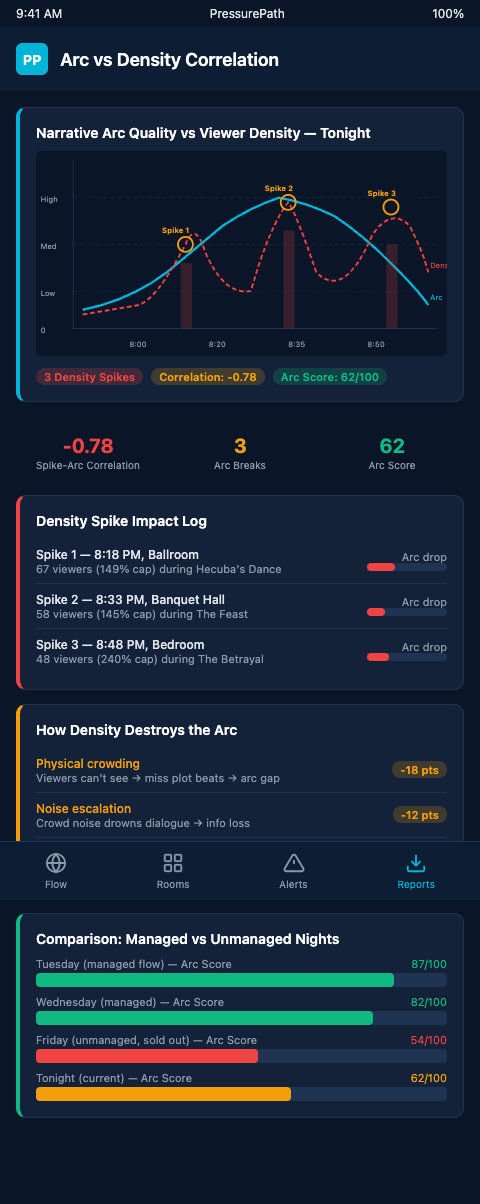
Four interventions prevent density-spike arc failure at the production design level:
Pre-spike cue exit. Set the upstream scene's cue exit to fire 90–120 seconds before the packed scene's audience is projected to reach its sightline ceiling. The 90-second lead time allows the released viewers to transit the corridor and enter the scene's inlet before the spike develops, distributing the audience arrival across a longer window rather than as a single bolus.
Sightline ceiling hard limits. Treat each scene's sightline ceiling as a hard inlet limit, not a soft guideline. When the scene's count reaches 90% of the ceiling, the inlet closes — a performer at the door, a stage management signal, or a physical configuration change prevents additional viewers from entering until the cue exit releases a proportional number.
Competing magnet activation. For scenes at high density-spike risk, install a competing performance beat in the adjacent corridor that fires 2–3 minutes before the at-risk scene's peak density moment. The corridor magnet draws 15–25% of the approaching audience away from the packed scene's inlet before they enter, maintaining count below the sightline ceiling without requiring explicit access control.
Post-spike corridor management. When the avoidance exodus occurs despite prevention measures, the corridor between the packed scene and adjacent scenes needs active management — a performer or design element that slows the exodus and prevents it from creating a secondary pressure spike in Scene 3.
Density spike documentation. For a production running extended engagements, density spikes should be documented systematically rather than managed reactively. Each spike event — scene, timestamp, count at spike, projected count, avoidance exodus timing — creates a data record that reveals patterns across the run. A scene that spikes consistently on Friday nights points to a Friday-specific cause: higher attendance totals, different audience behavior at evening performances, or a cast configuration that runs Scene 2 longer on Fridays. Documenting spikes makes these patterns visible and converts reactive stage management into predictive stage management.
PressurePath's spike documentation layer records each deviation event and annotates it with the show variables present at that performance. After 10–15 performances, the pattern analysis surfaces the primary cause of each scene's recurrent spikes, enabling a permanent fix rather than a per-night intervention.
The physical dynamics of clustering-driven sightline degradation pair with the prevention strategies described here. The $340 billion market growth projection for immersive entertainment through 2030 documented by BusinessWire's 2025 market analysis is explicitly tied to demand for coherent narrative delivery — productions that can't maintain narrative arc integrity under density pressure are entering a market that will penalize arc failure through negative word-of-mouth and reduced repeat attendance.
The audience drift patterns post maps the upstream cause of density spikes — it is audience drift accumulating in a single scene that creates the spike, and understanding the drift source is the prerequisite for the pre-spike cue-exit intervention. The same density-spike failure pattern occurs in educational contexts: learning goals failing under pacing discipline breakdown in museum settings follows the identical threshold collapse when visitor density spikes at exhibit stations, and the intervention methodology is transferable.
Managing Narrative Arc Integrity Across the Run
Narrative arc integrity is not a single-night achievement — it is a nightly production standard. Productions running extended engagements lose arc integrity gradually as small cue-exit timing drifts accumulate, corridor designs are modified by stage management without flow-model awareness, and pull values shift as audience word-of-mouth changes which scenes attract the most traffic.
PressurePath's blocking arc integrity scoring measures arc integrity performance across the full run. When arc integrity drops below the threshold — typically when three or more scenes in the same performance deviate from their target density — the platform identifies which cue exit, corridor modification, or pull value shift caused the degradation.
Arc integrity degradation across the run follows a predictable pattern in productions without active monitoring. The first two weeks of a run typically show the best arc integrity — the flow model is freshest, the cast is performing at rehearsed timing, and the corridor designs haven't been modified. By week four, small timing drifts have accumulated. Individual actors have adjusted their performance timing based on audience response, corridor elements have been modified by crew members trying to solve one-off problems, and the stage manager has made real-time adjustments that were never reflected in the flow model. Arc integrity drops by 10–15% compared to the opening week without any of these changes being intentional or even recognized.
The intervention is systematic weekly model calibration: at the end of each week, the stage manager reviews the deviation records, identifies which parameters have drifted, and resets the flow model to reflect current performance conditions. This takes 30–45 minutes per week and prevents the gradual arc integrity erosion that makes a show's fourth week noticeably worse than its first.
The $340 billion immersive entertainment market is growing on the promise of coherent, high-intensity narrative experiences. Immersive theater directors who want to deliver that promise consistently across every performance: join the PressurePath waitlist for immersive theater companies and build density-spike prevention into your production architecture before the first preview.