Why Learning Goals Fail Without Pacing Discipline
The Grant That Didn't Deliver
A children's museum received $180K in NSF AISL funding for an interactive water science exhibit. The exhibit was installed, the learning goals were documented, and pre-visit materials were sent to participating schools. In the end-of-year evaluation, the museum reported strong overall attendance from school groups. The targeted exhibit showed 12% documented engagement from field trip visitors.
Twelve percent. Eighty-eight of every hundred children in a school wave walked past the centerpiece of the NSF grant without touching it.
The exhibit wasn't poorly built. The learning goals weren't poorly designed. The content was age-appropriate, the interactivity was well-executed, and the pre-visit materials were actually used by two of the eight participating teachers. The failure was architectural: the exhibit sat mid-floor, off the primary wave corridor, with no affordance visible from the main circulation path. The 30-kid waves from P.S. 142 and six other schools flowed around it on every field trip day of the year.
That's a pacing discipline failure, and it's more common than the museum sector acknowledges. The sector invests heavily in exhibit content and almost nothing in the pacing infrastructure that routes school waves to that content. The result is a growing gap between what grants fund and what evaluations document.
What Learning Goals Actually Require
NSF's AISL program requires measurable learning outcomes from funded informal STEM exhibits. Those outcomes are not satisfied by physical presence in the building—they require documented engagement with the specific exhibit. A school wave that bypasses the funded station produces zero qualifying outcome data, regardless of how many children visited the museum that day.
Long-term effects research in informal science education establishes that learning benefits require a cascade of experiences—and a single bypass breaks that chain. The pre-visit preparation, the in-exhibit engagement, and the post-visit reinforcement are designed as a sequence. Skip the middle element and the sequence collapses. A teacher can deliver the most thorough pre-visit lesson in the district and still see zero learning transfer if the school wave bypasses the exhibit during the field trip.
NSF's framework for evaluating informal science education identifies eight outcome categories—all of which require dwell-time engagement to activate. There is no outcome category for "was in the same room as the exhibit." A school wave that blows past the Water Cycle puzzle activates none of the eight categories, even if every child was within 10 feet of the station.
The IMLS achievement data reinforces this: museum visit benefits are real but contingent on actual engagement. The benefits don't transfer through proximity. This is the core problem that pacing discipline addresses: the gap between a child being near a learning exhibit and a child actually engaging with it.
Pre-visit preparation and outcome research shows that skipping target exhibits collapses the pre-visit/visit/post-visit learning chain even when pre-visit preparation was thorough. The preparation creates readiness; the bypass prevents the readiness from activating. Those are two separate problems that require two separate solutions—and most museums only address the first one.
Pacing Discipline as a Learning Outcome Strategy
Pacing discipline is not the same as structured touring. A docent-led tour that walks children past exhibits and says "this is the Water Cycle puzzle" is not pacing discipline—it's a scripted bypass. Pacing discipline means designing the floor plan and field trip schedule so that school waves physically cannot bypass the stations that carry the learning goals. It's not about adding content or improving the exhibit—it's about treating the wave's movement as an engineering constraint and building the floor plan to route that wave through the required stations.
PressurePath models school waves as pressurized fluid bursting through your exhibit floor. Under that model, every station in your floor plan has a contact probability for a given wave density and entry point. A station with 12% contact probability under current conditions is not a learning goal failure waiting to happen—it's already happening, every field trip day of the season.
Pacing discipline converts a 12% contact station into a 75%+ contact station through three mechanisms. First, upstream wave management: a magnet station or physical partition positioned to slow or redirect the wave before it reaches the critical exhibit. Second, route discipline: a floor plan geometry that eliminates the low-resistance bypass path around the station—if there's no easy route around the exhibit, the wave goes through it. Third, chaperone activation: scripted chaperone instructions that position adults at the station entry before the wave arrives, converting the station from optional to mandatory in the children's social logic.
Structuring museum visits strongly predicts content-related conversation and retention. Pacing discipline is the structural component that makes that structure achievable. An unstructured field trip—where the school wave flows freely through the floor plan and natural wave dynamics determine which stations receive contact—produces engagement patterns that have very little to do with educational priorities and everything to do with wave physics.
IMLS informal learning proficiencies require situated engagement at specific exhibits. Worksheets designed for those exhibits don't substitute. Docent-led tours that pass by without stopping don't substitute. The child has to engage with the physical exhibit, and pacing discipline is the mechanism that makes that engagement reliable rather than accidental.
The measurement implications of pacing discipline are also significant. A floor plan without pacing discipline produces outcome data that's dominated by which exhibits happened to be near the wave's natural path—not by which exhibits the museum intended school groups to engage with. That data is noisy, hard to interpret, and nearly impossible to use for continuous improvement. A floor plan with pacing discipline produces outcome data that directly reflects the educational priorities the floor was designed around, making it much easier to identify what's working and what needs adjustment.
When Density Spikes Overwhelm Pacing Design
Pacing discipline is calibrated to expected wave density. A floor plan designed for 30-kid waves from a single bus may fail under double-density conditions—when two buses arrive within 15 minutes of each other and the atrium receives 60+ children before the first wave has cleared the science wing.
Under density spike conditions, even well-designed pacing structures can fail. The bypass paths that were closed by partitions and chaperone positioning for a 30-kid wave are reopened by a 60-kid double-wave, because the second wave's momentum is high enough to push around the intended flow controls. The rope partition that worked at normal density now creates a bottleneck that the wave flows around rather than through.
Density-driven narrative arc failure in immersive theater describes the same dynamic in a different venue type: pacing structures designed for expected audience density collapse under spike conditions, and the learning or narrative sequence falls apart not because of design failure but because of density mismatch. The parallel is exact, and the solution is identical—density spike scenarios must be modeled separately and managed through scheduling controls, not just physical design.
For a children's museum, density spike management means scheduling field trip arrivals with sufficient stagger time—typically 45–60 minutes between school bus arrivals—to allow the first wave to clear the critical stations before the second wave enters. PressurePath's schedule stagger planning tool models the clearance time for your specific floor plan and wave density.
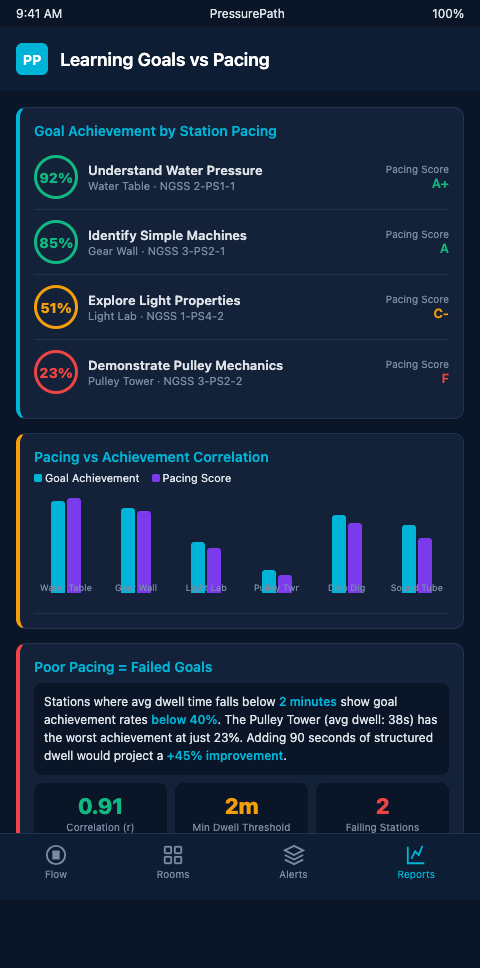
The stations most vulnerable to bypass under density spikes are often the same ones that are already marginal under normal conditions. The puzzle station bypass patterns that emerge under normal wave conditions intensify under density spikes, and the interventions that work at normal density may need reinforcement under higher-pressure conditions. Similarly, the field trip day audit process should include a density spike scenario to ensure your pacing design holds under the worst field trip days of the year.
Making Pacing Discipline Part of Your Grant Application
For children's museum exhibit designers preparing NSF or IMLS grant applications, pacing discipline documentation belongs in the project design section—not as an afterthought, but as a core mechanism for achieving the stated learning outcomes. An application that describes how the floor plan and field trip schedule will route school waves to the funded exhibit is a stronger application than one that describes only the exhibit itself.
Grant reviewers who fund informal science education understand that physical presence doesn't equal engagement. An application that acknowledges the school-wave bypass problem and proposes specific pacing interventions to address it demonstrates a realistic understanding of how field trips actually work. It also creates measurable commitments—a stated partition placement, a chaperone scripting protocol, a scheduling policy—that the evaluation framework can verify.
PressurePath generates bypass probability scores and predicted contact rates for individual stations under specific wave conditions. That data is usable in grant documentation as evidence that the proposed intervention will actually reach its target audience. A prediction of 75% contact rate for a 30-kid wave at the proposed exhibit location, derived from a pressure model calibrated to your floor plan, is a stronger outcome commitment than "we expect strong school group engagement."
Children's museum designers building grant applications or evaluating current funded exhibits are exactly who should be on the PressurePath waitlist. Join us to model the learning stations that matter most to your funding outcomes.