How Pacing Gaps Save Scare Delivery in High-Density Hauntings
The Buffer Room That Saved October
A mid-size haunted attraction added a single atmospheric corridor — 20 feet, fog effects, ambient audio — between their Clown Alley chamber and the Butcher Room transition. No actor, no scare. Just a 40-second decompression walk with a low red light and sounds of dripping water.
Scare actor incident reports from the previous season showed that the Butcher Room actor was executing into groups that were still processing the Clown Alley scare — laughing, replaying the moment, partially turned backward. The Butcher Room's effect was landing consistently flat. The decompression corridor reset guest arousal before they entered the actor's chamber, and the Butcher Room scare quality improved measurably across the entire season.
That 20-foot corridor was a pacing gap. It served no narrative function that guests could articulate. It served every function that made the subsequent scare work.
Pacing gaps are the least understood element of haunt design precisely because they produce no direct experience — their effect is entirely in the quality of the experience they precede. In a low-density haunt where dispatch intervals naturally create spacing, pacing gaps form on their own. In a high-density haunt where peak-night pressure compresses dispatch intervals and groups stack at bottlenecks, pacing gaps disappear. Designing them explicitly — as physical spaces with specific throughput functions — is what preserves scare delivery when the queue hits 400.
Why Gaps Are Functional, Not Decorative
The neuroscience of fear recovery is clear. Research on the acoustic startle reflex and recovery gaps documents that without a recovery gap between scare stimuli, sensitization replaces fear — the brain stops treating the stimulus as a threat and begins treating it as a known environmental feature. In practical terms: a group that experienced a strong Clown Alley scare and immediately walked into the Butcher Room is physiologically less scared by the Butcher Room, regardless of actor quality, because their threat-response system has not had time to reset.
The minimum recovery gap needed for the next scare to land at full effectiveness is approximately 40-90 seconds, depending on arousal intensity of the prior scare. A strongly-executed Clown Alley scare needs closer to 90 seconds. A moderate atmospheric scare may need only 40. Your flow model needs to incorporate these recovery windows as functional minimum dwell times in the space between chambers.
Think of the crowd flow as pressurized water through a pipe network. After a high-pressure chamber, the flow needs a decompression segment before entering the next high-pressure node. The decompression segment — the pacing gap — reduces the pressure state of the fluid (the group's arousal level) to the baseline required for the next chamber's scare mechanics to function. Remove the decompression segment and you send over-pressured fluid directly into the next valve. The valve does not function as designed.
Suspense structure research provides the theoretical parallel: a build-relief-rebuild cycle is the fundamental structure of escalating fear experiences. The "relief" stage is not a break in the experience — it is the mechanism that makes the next "build" stage possible. No gap means no relief. No relief means no rebuild. Your escalating scare sequence becomes a flat sequence of increasingly ineffective stimuli.
Experienced haunt designers use buffer rooms explicitly as pressure-relief zones between scare chambers. The design language here is not accidental — "buffer room" and "pressure-relief zone" are both fluid-dynamics concepts applied to crowd experience. The atmospheric corridor, the confusion maze, the darkened transition zone — all of these serve as pacing gaps that maintain the scare delivery capacity of the chambers they connect.
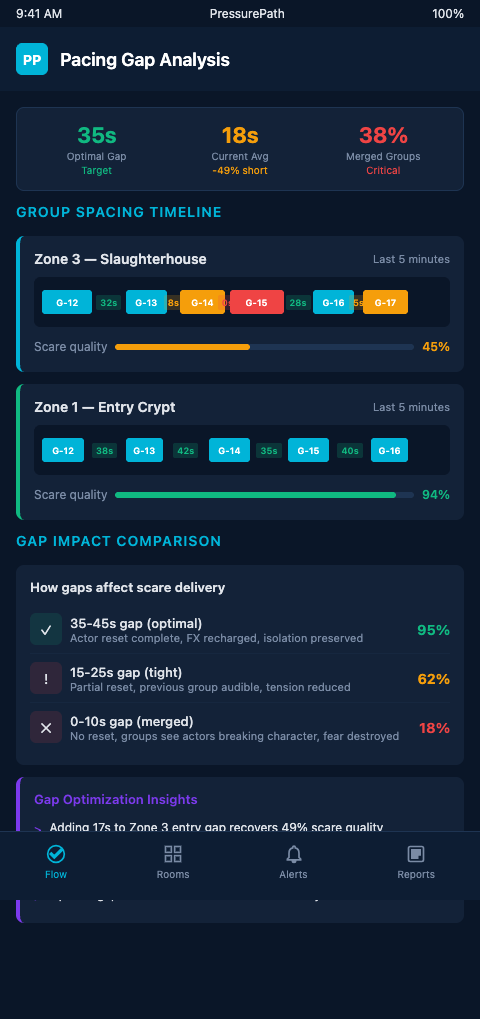
PressurePath models pacing gaps as functional flow segments with defined throughput rates and arousal-reset functions. The simulation accounts for the recovery time each gap provides, the density conditions under which that recovery is adequate, and the exact peak-night minutes when the gap will be compressed below functional recovery threshold. You see which gaps are working and which will fail before a single group walks through them.
The connection between scare beats dying under pile-ups and the gap structure that prevents it is direct: every stage of the scare beat that pile-ups destroy — pre-signal, isolation, strike, recoil, reset — requires a functional gap either between groups or between chambers. The gap architecture is the structural answer to the pile-up problem.
Sightline protection — the design principle that each group should be separated from the next by a sight-blocking architectural element before reaching the scare position — is the spatial implementation of the same gap principle. When audiences cluster and sightlines fail, scene transition redistribution in immersive performance contexts shows the same dynamics: the transitions between scenes function as pacing gaps that redistribute audience density and restore the spatial separation required for the next scene to work. The parallel is direct and the design solutions are structurally identical.
Advanced Tactics: Designing Gaps That Survive High Density
The core challenge with pacing gaps in high-density haunts is that the same pressure conditions that make gaps most necessary are the conditions that compress them. At low density, the natural walk-through velocity creates functional gaps between groups. At peak density, groups slow down and compress, eliminating the gaps your design relied on.
The solution is not to rely on behavioral spacing to create the gap. It is to design architectural and operational structures that maintain the gap function even when groups have compressed.
Throughput-metered transitions. Design your decompression corridors with a specific throughput ceiling — a maximum flow rate based on corridor width and the designed dwell time within the space. When groups enter faster than this rate, they naturally slow and the corridor acts as a buffer. For this to work, the corridor needs enough length (typically 15-25 feet at your expected walk-through velocity) to absorb the compression without letting the trailing group catch the leading group before they exit.
Actor-free separation zones. High-value scare chambers need at least one designed "dead zone" on either side — a transition space with no actor, no active scare, and no attraction element that encourages lingering. These zones exist solely to maintain group separation. They can be atmospheric (fog, sound, dim lighting) but must not create intentional dwell. Any deliberate dwell time converts the gap into a bottleneck.
Gap compression alerts in operations. Build a simple operational signal — a visual indicator at each transition zone — that tells floor staff when group-to-group spacing has compressed below the minimum gap threshold. When the indicator triggers, the nearest dispatch position holds the next release for one additional cycle. The gap is restored before the next group compounds the compression.
Real-time actor cues for gap condition. When gap compression is detected at a specific chamber, signal the upstream actor via a discreet cue (an earpiece prompt or a light signal) to extend their scare sequence by 20 seconds. The extension delays the exiting group slightly, allowing the gap downstream of the actor to recover before the next group arrives. Research on real-time actor cue systems for group spacing in high-density haunt contexts provides the operational framework for implementing this in a 15-actor haunt without creating communication confusion.
The business case is clear. Reviews that cite "too crowded" as the primary complaint are the direct result of gap compression — guests feel the density, and they associate it with the experience being worse than the price. The business case from haunt economics confirms that "too crowded" reviews damage repeat attendance, and repeat attendance is the revenue foundation that peak-Friday ticket pricing is built on. Pacing gaps protect the scare quality that drives repeat visits.
Design the Gap as Carefully as the Scare
Your actors rehearsed for weeks. Your lighting and sound design was built by experienced professionals. Your set construction was carefully executed. All of that investment delivers its return only if the pacing gap architecture gives each scare chamber the arrival conditions it was designed for.
There is a design principle that experienced haunt creators apply consistently and first-time designers discover the hard way: in a high-density haunt, the quality of every scare chamber is a function of the gap that precedes it, not just the chamber's own design. A brilliantly executed Butcher Room scare that follows an inadequate gap will land at 40% effectiveness. The same scare preceded by a functional decompression corridor lands at full effectiveness. The gap is not a transition — it is part of the scare.
This means the gap deserves a design specification just as detailed as the chamber itself. How long is it (measured in both feet and seconds at expected walk-through velocity)? What is its throughput ceiling under peak density? What atmospheric elements does it include, and are any of those elements likely to create dwell time that converts the gap into a bottleneck? What is the minimum gap length that provides adequate arousal recovery for the preceding chamber's scare intensity level? These are design questions with quantitative answers, and a flow model provides them.
PressurePath models every gap in your haunt as a functional flow element — showing whether each gap will provide adequate recovery time under peak-night density conditions and identifying the exact minutes when specific gaps will compress below threshold. That information, in September, lets you add 8 feet to a transition corridor, redesign a throughput-metering element, or shift a dispatch interval before the season locks.
Haunted attraction designers who treat gaps as designed elements rather than incidental connectors report measurably higher scare quality consistency across peak nights. The gap is not dead time. It is the mechanism that makes the next scare possible. Build it with intention, model it under pressure, and your Butcher Room actor will be executing clean scares at 10:30 PM that are indistinguishable from 8:00 PM. Join the waitlist to pressure-test every transition corridor in your haunt before the October surge collapses the gaps your scare chambers depend on.