How to Design Scene Transitions That Redistribute Audience Weight
The 90-Second Window Directors Waste
Scene 3 ends. The actor completes the final beat and moves into stillness. Forty-two viewers stand in the conservatory. Scene 4, the garden, needs 28 of those viewers in the next 90 seconds — but nothing in the transition is directing them there. The corridor to the garden is unmarked. Two adjacent rooms have open doors. A performer is visible through one of those doors and 19 viewers follow the performer rather than the garden's entrance.
Scene 4 opens with 11 viewers. The director, watching the monitor in the stage manager station, has just watched three weeks of scene-handoff rehearsal fail — not because the blocking was wrong, but because the transition did nothing to redistribute audience weight.
Transitions fail at a higher rate than scenes in immersive theater because they are designed after scenes. The typical immersive production sequence is: block Scene 3, block Scene 4, then figure out how to get the audience from one to the other. This sequence inverts the correct spatial blocking order. Scene 4's density requirement should be established before Scene 3 is blocked — because Scene 3's cue exit, corridor connection, and competing pull environment must be designed around Scene 4's inlet needs. Building scenes before transitions produces transitions that try to correct the density failures of scene-first blocking. Building transitions before (or simultaneously with) scenes produces a flow architecture where each scene receives the density it was designed for.
Research on cueing in theater establishes that transitions are among the most technically complex coordination challenges in multi-space productions. Directors and actors coordinate timing of transitions to manage audience movement — but in most productions, that coordination is treated as a staging concern rather than a flow-redistribution mechanism. The transition exits the scene correctly; it does not route the audience to the next one.
TheatreFolk's foundational analysis is direct: transitions must be blocked as carefully as scenes themselves to maintain audience flow. This applies even more forcefully in immersive work where audience routing during the transition is the primary mechanism for correcting density distributions before Scene 4 opens.
Designing Transitions as Flow Redistributors
The pressurized-water model makes transition design concrete. Scene 3 is a high-pressure chamber holding 42 viewers. Scene 4 needs 28 of those viewers. The 90-second transition window is the release valve — the moment when pressure can be directed from Scene 3's chamber into the corridor network and routed specifically toward Scene 4's inlet. If the release valve fires without direction, the 42 viewers follow random pull signals and distribute to the closest open door, the most visible performer, and the brightest light source.
Designing the transition as a flow redistributor means engineering the corridor between Scenes 3 and 4 to route 28 viewers to Scene 4's inlet while the remaining 14 are distributed to other rooms. PressurePath's cue exit re-timing tool models this distribution. You input the current density in Scene 3 (42 viewers), the target density for Scene 4 (28 viewers), the corridor configuration between them, and the competing pull sources visible from Scene 3's exit. The platform outputs the cue-exit timing, the corridor design interventions, and the competing-pull reduction strategies that achieve the target distribution within the 90-second window.
Pedestrian flow research through transition bottlenecks shows that curved bottleneck configurations outperform straight or angled configurations in redistributing pedestrian flow at transition points. The architectural implication for immersive theater: the corridor section immediately outside Scene 3's exit should curve slightly toward Scene 4's entrance, creating a natural flow bias without explicit direction. Viewers will follow the curve without perceiving it as routing.
Environmental design signals for crowd weight redistribution developed for large-scale events provide the design toolkit: directional lighting gradients (warmer toward Scene 4), sound design directionality (Scene 4's underscore audible from the corridor), and performer positioning (a corridor performer oriented toward Scene 4 draws viewer attention toward the correct inlet). The same magnet-station logic operates in museum design: museum magnet stations for slow pass-through use identical pull mechanics to route visitor flow toward underleveraged exhibits, and the calibration methodology transfers directly to immersive theater transition design.
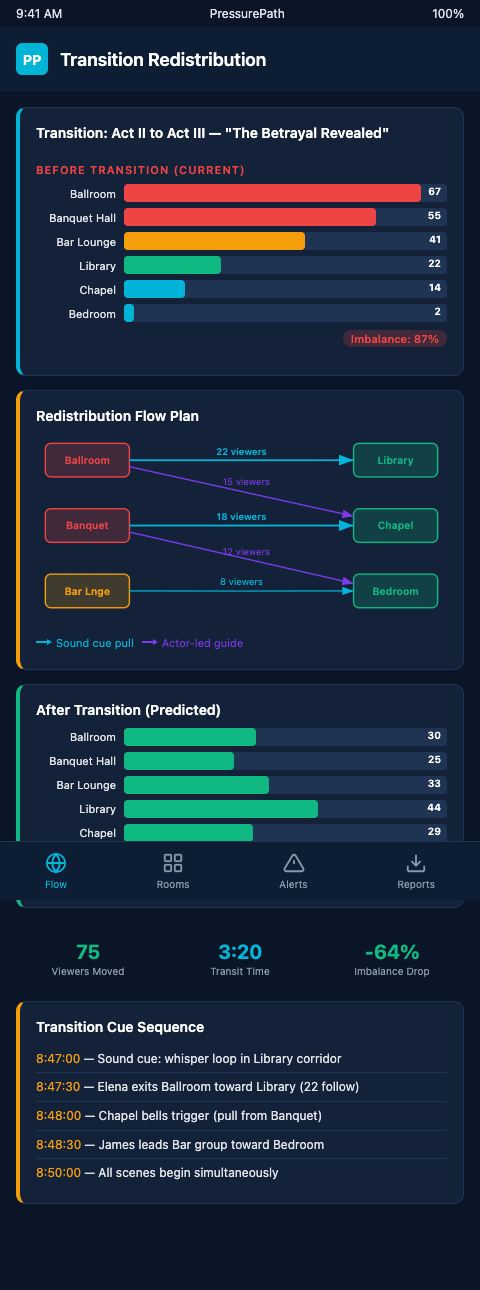
The psychology of audience movement choices identifies four primary drivers: follow a performer, follow light, follow sound, and follow other audience members. Transition design that activates all four toward Scene 4 and away from competing rooms stacks the hydraulic advantage. A 5-second sound design fade that ends on Scene 4's musical theme while a corridor performer gestures toward Scene 4's entrance while lighting dims in competing rooms creates a multi-signal environment that routes 70–80% of viewers correctly without explicit instruction.
The spatial tension framework also informs transition design. HowlRound's proximity and distance analysis identifies a grey zone in performer-spectator spatial relationships — a distance at which neither engagement nor disengagement is clear. Corridor performers positioned in this grey zone relative to the Scene 4 entrance create spatial ambiguity that viewers resolve by moving toward one of the two clear zones: full proximity (entering Scene 4) or full distance (returning to Scene 3 or moving to a competing room). Designing the corridor performer's position to make the Scene 4 entrance the closest clear zone converts spatial ambiguity into a Scene 4 routing decision for the majority of viewers who encounter the grey zone encounter.
Transition duration as a redistribution variable. The 90-second transition window is not fixed — it is a design parameter. A 60-second transition between Scene 3 and Scene 4 concentrates the redistribution challenge into a narrower window, requiring stronger routing signals and higher corridor efficiency. A 120-second transition gives the audience more time to transit but also more time to explore competing attractions. The optimal transition duration is the minimum window in which the corridor design and routing signals can move the required viewer count to Scene 4's inlet without creating a density spike at Scene 4's entry point. PressurePath's transition modeling tool calculates this optimal duration from the viewer count to be redistributed, the corridor routing efficiency, and the competing pull sources in the transition environment.
Between-act gating as the hard redistribution tool. When transitions between scenes are insufficient to correct density imbalances, between-act gating provides the structural reset mechanism. Gating between acts allows the production to hold audience cohorts in designated holding zones and release them in controlled batches into the act's opening scenes. This is a blunt instrument compared to transition design, but it is reliable for productions where scene-to-scene transitions consistently fail to achieve the required redistribution.
Magnet scene coordination. Transitions that need to route a large audience share toward a specific scene benefit from the magnet scene relief strategy: a high-pull performance beat installed near Scene 4's entrance draws viewers toward Scene 4's corridor during the transition window. The magnet does not need to be a full scene — a 90-second performer encounter, a striking prop, or a sound design event functions as a corridor magnet that supplements the transition's routing signals.
Building Redistribution Into the Blocking Arc
The most reliable test of a transition's redistribution effectiveness is to count the viewers arriving at Scene 4's entrance during the transition window — not after the scene has opened, but while the transition is still in progress. If 28 viewers are expected and only 14 have arrived by the 60-second mark of the 90-second transition, the transition is failing and the deficit cannot be recovered within the remaining 30 seconds. This mid-transition count is the stage manager's early warning signal, and it requires a pre-planned contingency: a corridor performer who can create additional pull toward Scene 4 in the final 30 seconds of the transition window.
Transitions that redistribute audience weight are not improvised during tech week. They are designed as part of the blocking arc from the first flow map session. Every scene's exit timing, every corridor's design, and every competing pull source in the venue is a variable in the redistribution model.
PressurePath integrates transition design into the full blocking arc simulation. When you set Scene 4's target density, the platform works backward through the transition to identify what Scene 3's cue-exit timing and the corridor design need to produce that density. The transition becomes a designed flow event with measurable inputs and predictable outputs — not a 90-second window that the audience uses to find their own path.
Transitions also have a narrative function that directors often sacrifice for flow efficiency. A purely efficient transition — bright corridor lights, direct path to Scene 4, no competing attractions — can feel abrupt and break the emotional continuity between scenes. The challenge is designing transitions that achieve both redistribution efficiency and narrative continuity: the corridor should feel like a space within the world of the production while simultaneously functioning as a pressure routing mechanism. Transitions where a brief corridor performer encounter maintains the scene's emotional register while physically guiding viewers toward Scene 4's entrance achieve both goals simultaneously. PressurePath's transition modeling can score candidate designs against both metrics: redistribution efficiency (percentage of target viewers reaching Scene 4) and dwell time (corridor transit time that preserves emotional continuity).
Modular scene design that accommodates variable audience flow is the underlying design philosophy: scenes built to receive variable density ranges rather than exact counts are more forgiving when transition routing achieves 80% of its target rather than 100%. Scene 4 designed to perform well at 22–32 viewers gives the transition a 10-viewer tolerance range. Scene 4 designed for exactly 28 viewers makes every transition deviation a scene quality failure.
Directors and production designers building new immersive productions: join the PressurePath waitlist for immersive theater companies and model your scene transitions as redistribution mechanisms before your venue design is locked.