Best Practices for Audience Gating Between Acts
The Drift You Carry Into Act 2
By the end of Act 1, an immersive production running without gating protocols has already distributed its audience in ways the director never blocked. The library, designed for 18 viewers during the Act 1 finale, holds 47. The conservatory, scripted as the emotional anchor of the act break, has six viewers and three actors performing to empty space. When the lights shift to signal intermission, those 47 viewers in the library do not redistribute evenly across the venue. They linger. They follow the actors they have been watching. They cluster toward the same scenes in Act 2 that over-attracted them in Act 1.
The default intermission in most immersive productions is an unmanaged hold: the audience drifts toward a bar area, a designated rest space, or stays in whatever room they occupied at the act-break signal. The drift continues during the intermission itself. By the time the Act 2 signal fires, the production has had 15 minutes of unmanaged redistribution on top of the accumulated drift from Act 1. The director's Act 2 blocking arc begins from a starting position that was never planned and was not designed to support the spatial composition the cast has been rehearsing.
Act-break gating is the intervention that prevents Act 1's drift from becoming Act 2's default starting position. Without it, the second act opens with the audience already misaligned, and every scene transition in Act 2 works against the director's arc from the first cue.
Audience Behavior in Immersive Theatre (Tandfonline) documented the mechanics of this: crowd walls blocking sightlines and competitive room-rushing were consistent patterns in high-capacity immersive shows, not isolated incidents. The drift is structural. Gating must be equally structural.
Sleep No More (Wikipedia) operationalized a version of this through staggered ticketing — distributing audience entry across 15-minute intervals over the first hour, which spread occupants across five floors and prevented Act 1 overcrowding from ever forming. That approach addresses initial distribution; act-break gating addresses the redistribution problem that emerges after audience members have been moving autonomously for 60 minutes.
Venue Capacity (SONCO) notes that fire codes require one trained crowd manager per 250 persons in assembly occupancies. Act-break gating protocols satisfy that regulatory floor while also serving the directorial goal of resetting spatial distribution.
Designing a Gating Protocol From Flow Data
A gating protocol without flow data is a best guess. A gating protocol derived from PressurePath simulation outputs is a directed intervention. The difference is whether the hold zones, release sequences, and corridor routing instructions are calibrated to the specific scenes and time points where drift accumulates in your production.
The core architecture of a flow-informed act-break gating protocol has three phases: hold, sort, and release.
During the hold phase, the act break begins with all audience movement paused. This does not require hard barriers — environmental cues work effectively. A full blackout with a directed audio transition signal stops most voluntary movement within seconds. A scene transition flow approach can prime this: audiences trained through Act 1 that blackouts signal a spatial reset will comply without explicit instruction.
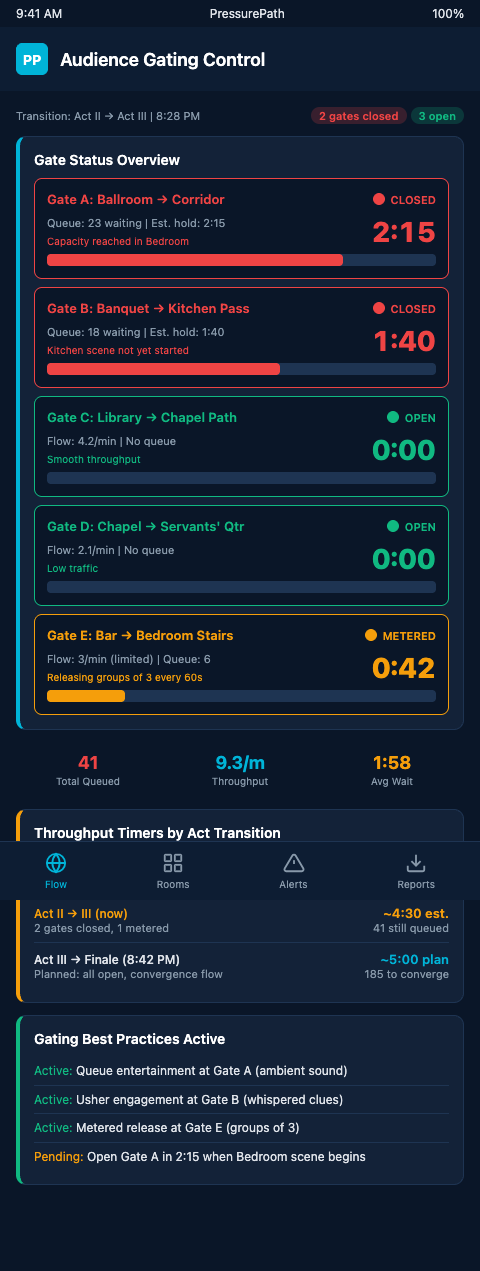
During the sort phase, ushers at pre-positioned hold zones count clusters and report density by zone to the calling SM. The SM compares reported densities against the Act 2 opening scene requirements derived from the flow model. If the library zone holds 31 viewers and Act 2 Scene 1 calls for 15, the library zone gets a two-cluster hold before any release. If the garden corridor is below Act 2 Scene 1 capacity, that zone releases first.
During the release phase, zones release in sequence based on Act 2 scene capacity. Releases are staggered by 90 seconds minimum — enough time for the first cluster to commit to a scene entry before the next cluster makes its navigation decision. Front of House Operations (Artist Producer Resource) recommends pre-assigned hold zones and sequenced release as core FOH protocol for complex venue configurations. Mastering Crowd Control: Event Ushers (Emora) adds that effective gating requires clear usher commands, deliberate body positioning, and pre-rehearsed hold assignments — improvised gating loses its precision under crowd pressure.
PressurePath's act-break module outputs hold zone assignments and release sequences calibrated to the production's specific scene capacity map. The protocol is written during tech, not improvised on opening night.
The queue-free scene entry workflow addresses how to maintain that fluid entry experience once Act 2 begins; this post focuses on the act-break reset that makes queue-free entry viable.
Advanced Tactics: Calibrating Hold Duration and Release Sequencing
Standard gating protocols hold all zones for a fixed duration — typically the length of the intermission entertainment. Flow-informed gating holds zones differentially: over-occupied zones hold longer, under-occupied zones hold shorter, and the net effect is an Act 2 opening distribution that matches the director's blocking targets rather than the audience's self-selected clustering.
The calibration question is how long to hold each zone. PressurePath generates hold duration recommendations based on the Act 1 end-state density and the Act 2 opening scene capacity targets. A zone that ends Act 1 at 47 viewers against an Act 2 Scene 1 target of 18 needs a hold long enough for 29 viewers to voluntarily drift to other zones during the intermission experience — typically 4 to 6 minutes beyond the standard hold duration. A zone that ends Act 1 at 12 viewers against a target of 20 should release immediately into Act 2, ideally with an environmental cue that draws additional viewers from adjacent zones before the hold releases them.
Hold zone assignments also allow the production to use the act break as an intentional dramaturgical transition. If the intermission experience is designed as a spatial beat — a corridor installation, an atmospheric sound environment, a performer stationed in the hold area — the hold duration becomes part of the production's arc rather than dead time imposed on the audience. The gating protocol and the intermission design work together, and the hold duration can be calibrated to match the intermission experience's optimal length for each zone independently.
Post-show deviation logs from PressurePath's gating module track whether hold zone assignments achieved their Act 2 target distributions. If Zone A was released at the correct moment but Act 2 Scene 1 still opened at 39 viewers rather than the target 18, the investigation points to Act 1 end-state density as the root cause — more viewers accumulated in that zone than the model predicted. That discrepancy is an input for the next night's revised hold duration.
Differential hold durations require rehearsal. Ushers must know their zone's release timing relative to the act break signal, not relative to other zones. The simplest implementation assigns each hold zone a cue letter — Zone A releases at the "A" cue, Zone B at the "B" cue — and the SM fires those cue letters from the running script the same way they fire light and sound cues.
Staggered entry peak weekends at high-capacity attractions uses the same staggered-release logic to prevent entry-point bottlenecks; the act-break application is the interior equivalent, managing not arrival but redistribution.
Acts of Spectating (Critical Stages) argues that the dramaturgy of act-break transitions shapes audience emotional readiness for the next act. A gating protocol that also functions as a deliberate transitional beat — using the hold time as part of the production's emotional arc rather than as a logistical inconvenience — serves both the flow goal and the dramaturgical goal simultaneously.
The most effective act-break gating systems treat the intermission as a designed spatial experience: the audience moves through a pre-architected redistribution that feels like discovery rather than management. By the time Act 2 Scene 1 fires, viewers are positioned where the director blocked them, and they believe they chose to be there.
Build the Protocol in Tech, Not During the Run
Act-break gating requires rehearsal time with ushers, deck supervisors, and the calling SM. Productions that attempt to implement gating protocols after opening night face the compounding problem of modifying live show protocols without a rehearsal window. The hold zone assignments, release sequences, and cue letters need to be embedded in the running script before the first preview.
The practical sequence for building a gating protocol during tech has four stages. First, the flow model's Act 1 end-state simulation identifies which zones will be over-occupied and under-occupied relative to Act 2 targets. Second, the production team assigns hold zones and release cue letters based on that simulation, documenting each zone's expected density and its target release timing. Third, the usher and deck supervisor team walks the hold zones during a full venue rehearsal, confirming that each position can physically execute its assigned hold and release at the required moments. Fourth, the calling SM integrates the release cue letters into the running script alongside the standard technical cues, so the act break reads as a single coordinated sequence rather than a separate operational track.
The total tech investment for a flow-informed gating protocol is typically four to six hours: one hour to review the simulation output, two hours to position and brief the usher team, and one to three hours to rehearse the release sequences against the intermission experience timing. That investment pays back on opening night when Act 2 opens with the intended distribution instead of the unmanaged drift that most productions inherit from Act 1. The alternative — discovering the distribution problem during the first preview and improvising a gating protocol during the run — costs significantly more in SM attention, usher learning curve, and audience experience degradation.
Immersive theater directors and production managers building multi-act promenade shows need act-break gating that resets audience distribution to match the blocking arc — not ad-hoc usher improvisation. Join the PressurePath waitlist for flow-calibrated gating protocols designed for multi-act immersive productions.