Queue-Free Scene Entry: A Workflow for Sleep No More-Style Blocking
The Queue That Should Not Exist
Twelve viewers are standing in the hallway outside Scene 9 because Scene 9 holds 18 and is currently at 17. The wait is, at most, three minutes. But those twelve viewers are not watching a scene — they are standing in a corridor, aware that they are waiting, experiencing the production as a managed queue rather than as an autonomous promenade. The mask is still on. The atmospheric sound is still playing. But the experience has become a line, and lines in immersive theater signal a design failure that no amount of atmospheric treatment can fully recover.
Queue formation in immersive productions is not caused by scene popularity — it is caused by a mismatch between the entry rate into a scene and the exit rate from it, amplified by corridor geometry that funnels viewers toward a single entry point. The scene may be excellent. The audiences standing in a queue have already been told, by the existence of the queue, that too many people want to see it.
Is Immersive Theatre Broken? (Exeunt) documents directors mid-run redesigning their shows because queue-free entry models that worked in theory collapsed in performance due to inadequate operational discipline. The production concept assumed flow; the venue and protocols produced queues.
Sleep No More (Wikipedia) resolved this through a structural approach: staggered entry by 15-minute intervals across the show's first hour, distributed arrival across five floors, and a strict no-clustering-with-companions rule enforced by masked ushers. The result was that queue formation at scene entries never reached critical mass — not because the scenes were unpopular, but because the audience was distributed before they had the opportunity to cluster toward any single location.
Meaningful Agency in Participatory Performance (Tandfonline) confirmed that audiences experience greater agency in open-flow entry conditions — and that queue formation collapses the sense of autonomy that immersive theater exists to produce. The experience problem and the operational problem are the same problem.
The Queue-Free Design Workflow
Queue-free scene entry is not a management outcome — it is a design outcome. Ushers managing a queue at peak are managing a symptom; the workflow that eliminates queues addresses the causes.
PressurePath models queue formation as a specific pressure phenomenon: when flow into a scene node exceeds exit flow by a sufficient margin, a backpressure builds in the inlet corridor. The corridor functions as a pressure buffer, and when the buffer fills, it becomes visible as a queue. The design interventions target the inlet/outlet ratio, the buffer geometry, and the arrival distribution — not the queue itself once it has formed.
Arrival distribution is the highest-leverage intervention. Sleep No More's 9 Tips (Playbill) describes how the mask rule and no-companion-clustering rule work in concert to prevent arrival clusters from forming at scene entries. The operational mechanism is that companions cannot move together — which prevents the social dynamic where a group of six creates a mini-queue by arriving simultaneously at an entry. Four Principles about Site-Specific Theatre (JHUP) identifies spatial cue design — environmental signals that direct movement at decision points — as the architecture of queue-free entry. The production tells viewers where to go through the space itself, not through staff instruction.
Corridor geometry either enables or prevents queue accumulation. A corridor that terminates at a single scene entry point creates mandatory queue formation whenever scene capacity is approached. A corridor with multiple scene entries at different distances creates natural flow distribution — viewers approaching from outside distribute across visible entries rather than stacking at a single point. This is a venue design consideration with meaningful impact on production flow; PressurePath's venue modeling identifies which corridors function as queue-accumulation risks and which provide natural flow distribution.
Scene exit rate management is the mechanism that receives the least attention. If Scene 9 runs 18 viewers for a 12-minute beat with no designed exit trigger, 18 viewers will remain in the scene until the beat ends — during which time, arriving viewers accumulate at the entry. The Drowned Man's 300-person promenade (A Younger Theatre) required deliberate anti-clustering design that included engineered exit signals within scenes — environmental shifts that invited viewers to move on before the scene's hard conclusion. This is a blocking decision: the director designs an exit inflection point within the scene's arc at which a portion of viewers will self-select to leave and continue their promenade.
The exit inflection point is a specific moment in the scene's narrative or atmospheric arc that signals incompleteness rather than conclusion — a moment that leaves the scene's emotional thread unresolved enough that the most mobile viewers feel no obligation to stay for the ending. Well-designed exit inflection points do not undercut the scene for viewers who stay through the ending.
They simply lower the perceived cost of leaving early, which is sufficient to generate 30 to 40% voluntary exit before the scene's conclusion. That exit rate is the primary determinant of queue-free entry conditions at peak occupancy.
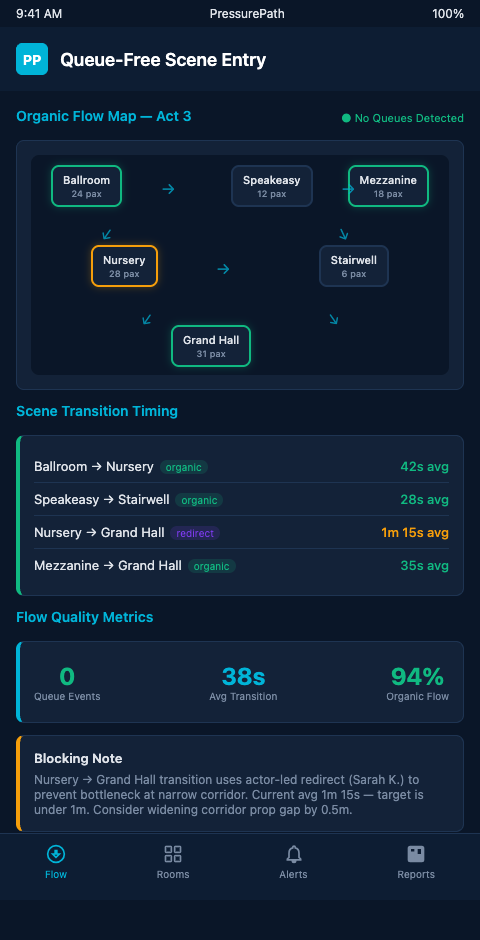
PressurePath models scene exit rates based on scene duration, designed exit inflection points, and historical audience behavior data. The queue-free entry simulation can test whether a proposed exit inflection point placed at minute 7 of a 12-minute scene generates sufficient exit flow to keep the entry corridor below queue-formation threshold at expected peak arrival rates. This verification step replaces the current norm of discovering queue formation at the first preview and working backward to understand why it formed.
The between-act gating approach handles the redistribution problem at act breaks; queue-free entry is the continuous-flow equivalent during each act.
Spatial Design of Immersive Ride Layouts (Vocal) demonstrates that attraction designers use threshold transition zones — architecturally designed entry spaces that absorb arrival clusters before they reach the attraction itself — to eliminate queue formation at high-traffic nodes. The transition zone functions as a pressure buffer with a designed release mechanism; PressurePath models this geometry for immersive theater venues.
Advanced Tactics: Non-Proscenium Staging and Entry Design
Queue-free entry in non-proscenium staging requires one additional consideration that single-entry proscenium environments never encounter: the entry space and the performance space are the same space. A viewer entering a scene in a non-proscenium room is not walking through a door and finding a seat — they are entering an active performance area and navigating to a position relative to an already-in-progress performance. This means that entry and scene-interior navigation compete for the same spatial bandwidth, and a high entry rate will disrupt the performance even before the sightline ceiling is reached.
Non-proscenium staging creates fundamentally different entry dynamics than rooms with a single focal point. When the performance space has no designated front, viewers can enter and position themselves anywhere relative to the performance — which means entry and exit flow simultaneously through the same openings. Non-proscenium staging requires entry workflow design that accounts for this bidirectional flow, because a conventional single-door entry model creates collision pressure when exit flow is also routed through the same opening.
PressurePath's queue-free entry module maps the inlet/outlet ratio for each scene, flagging scenes where the entry geometry requires redesign to prevent queue formation at expected peak headcounts. The model also simulates the impact of designed exit inflection points on inlet flow — quantifying how a 4-minute internal exit signal reduces average queue formation time at the entry from 3.2 minutes to under 60 seconds.
Corn maze queue engineering at high-throughput attractions applies a comparable threshold design methodology — the architectural approach to preventing queue formation translates directly from outdoor attraction design to multi-room theater venue layout. Both domains share the core insight: the queue is a symptom of inlet/outlet imbalance, and the design solution addresses the imbalance rather than the queue.
Productions running queue-free entry successfully are not managing their way to it. They designed the venue flow to make queue formation structurally improbable — and used simulation to verify that design before opening night exposed its failure points.
Design Queue-Free Entry Before the Venue Is Finalized
The highest-leverage moment to design queue-free entry is before the venue layout is fixed — during initial production planning, when corridor geometry, scene entry placement, and audience circulation routes can still be specified. Productions that attempt to implement queue-free entry after load-in are working against fixed architectural constraints.
The pre-venue design checklist has four items. First, audit the proposed venue layout for corridor termination points — any corridor that ends at a single scene entry is a queue-formation risk and should either be modified to include multiple entry options or matched with an exit inflection point in the scene it serves. Second, identify every scene whose inlet/outlet ratio exceeds 1.5:1 at the expected peak arrival rate — these are the scenes most vulnerable to queue formation and should either have their exit rates increased through designed inflection points or their inlets restricted through entry staging. Third, calculate the minimum corridor buffer capacity needed for each scene to accommodate peak-period arrival variance without visible queue formation — this buffer capacity should be designed into the corridor geometry before the venue is dressed.
Fourth, validate the design against the flow simulation at the planned peak capacity and iterate until the simulation shows queue formation probability below 5% for every scene in the show.
Productions that run this checklist during pre-production catch queue risks while they are cheap to fix. A corridor redesign during pre-production is a set design decision; a corridor redesign during previews is a crisis response. The difference in cost and production disruption is significant, and the checklist is how directors move queue-free entry from aspiration to execution.
Immersive theater companies producing Sleep No More-style promenade work in multi-room venues need queue-free entry design that is structurally sound rather than operationally heroic. Join the PressurePath waitlist for queue-formation risk modeling built for non-proscenium immersive production workflows.