Queue Engineering Without a Queue Line: Inside the Corn Maze
The Density Problem You Can't See Coming
On the last Saturday of October, a corn maze-based haunted attraction in Ohio ran 600 tickets for its five-acre experience. The path network had three main routes converging at a central scare chamber — the Scarecrow's Lair — that was designed for a maximum group size of eight. By 8 PM, twelve to fourteen people were arriving at the chamber simultaneously because two of the three routes had similar transit times, causing synchronized arrivals regardless of how staggered the entry batches were.
The floor manager had no advance warning because the maze has no visible queue line. In a traditional haunt, compressed groups are visible in corridors. In a corn maze, they're invisible until they emerge from a path junction simultaneously, already past the point where intervention is possible. The Scarecrow's Lair actor lost her strike zone completely at peak, and the fire marshal later cited the chamber for exceeding occupant density limits she hadn't anticipated from a field-based attraction.
EcoFarming Daily's analysis of corn maze operations confirms that corn maze operators use timed entry, varied path widths, and GPS checkpoints to manage visitor flow — but most implementations treat these as independent tools rather than an integrated density model. The result is that flow management is reactive: operators respond to visible pile-ups rather than predicting where simultaneous arrivals will occur.
Columbia Gorge News reporting on corn maze attendance growth notes that U.S. corn maze attendance is increasing — creating operational flow challenges on peak weekends that outpace most operators' current management tools. The scale problem is real: 600-ticket corn maze nights are no longer exceptional.
Building Fluid-Dynamics Queue Engineering for Open-Field Haunts
Queue engineering in a corn maze starts with accepting that the maze path network is a pipe system with no visible pipes. Each path is a conduit with a defined width, length, and transit time. When multiple conduits converge at a scare chamber, arrivals at that chamber are a function of each conduit's flow rate — predictable from the geometry, not visible until it's too late to address.
Fluid dynamics crowd control modeling from Bannari Amman Institute applies directly to maze funnel-points where paths converge: the pressure at a junction is the sum of flow rates from each incoming path minus the junction's throughput capacity. When the sum exceeds capacity, pressure builds at the junction and group merging occurs. In a corn maze, that junction is the scare chamber or checkpoint — and if you don't know the incoming flow rates by path, you can't predict when the junction pressure will exceed actor strike zone limits.
Maze structure research from Wikipedia's maze entry documents the key distinction: continuous versus non-continuous maze structures create fundamentally different flow patterns. Continuous mazes — where all paths eventually connect — create synchronized convergence risks at junction points. Non-continuous designs with dead ends and forced backtracking distribute path transit times more variably, reducing convergence probability. That's a design tool for haunt-specific corn maze layout: deliberate asynchrony in path lengths prevents the simultaneous-arrival problem without requiring complex timing adjustments.
The pressurized-water model applies with one key modification: in an enclosed haunt, pressure accumulates in corridors you can observe. In a corn maze, pressure accumulates in paths you can't observe — so the engineering needs to move upstream to the entry point, where the stagger interval and batch composition can be set to prevent convergence at the downstream junction.
The staggered entry model for peak weekends is foundational here. For a corn maze with three converging paths and similar transit times, the batch interval needs to be set so that groups released at time T, T+interval, and T+2×interval don't arrive at the convergence point simultaneously. That requires knowing the path-specific transit distribution for each batch composition — not just the average transit time.
Pedestrian simulation software reviewed by PTV Viswalk models open-field flow, bottleneck formation, and queue length pre-opening. Applied to corn maze design, this type of simulation can calculate convergence probabilities at each junction for a given batch interval and ticket count — the exact analysis that the Scarecrow's Lair operator needed before opening night.
PressurePath applies the same modeling logic to corn maze path networks. The pre-opening pressure check for a corn maze identifies convergence risk at each junction point and recommends the batch intervals and path-assignment strategies that reduce simultaneous arrivals to the scare chamber. The model doesn't require sensor infrastructure — it uses path length, width, and average transit time to predict flow state.
Advanced Techniques: GPS Checkpoints and Dynamic Path Assignment
Standard corn maze queue engineering uses fixed entry staggering and path signage to distribute load. Advanced implementations use GPS checkpoints — real-time location data for groups inside the maze — to detect convergence risk before it reaches the scare chamber and adjust dynamically.
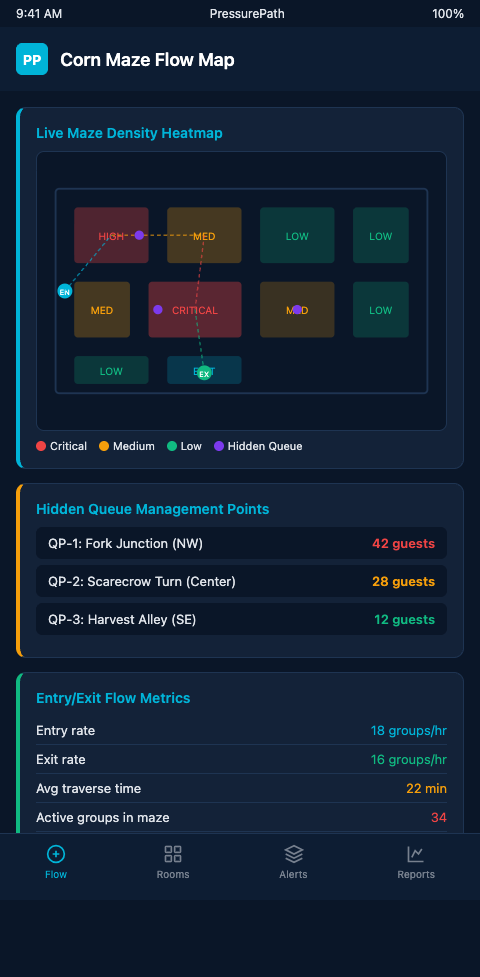
Crowd heat mapping in open-field venues, per Mapsted, identifies density build-up before blockages form. For corn mazes, that heat map shows which paths are running above normal density and which junction points are approaching convergence risk. A floor manager with that read can redirect incoming groups to a lower-density path or hold entry batches until the convergence clears.
Dynamic path assignment — directing each group to a specific path at entry based on current density state — requires knowing real-time path load for all active paths simultaneously. That's not achievable with GPS checkpoints alone on a 5-acre maze with 600 concurrent visitors. But it's achievable if the density model is built correctly: a pre-season simulation that maps convergence probability across all batch compositions gives floor managers a decision table they can use in real time without requiring live sensor data.
Peek Pro's corn maze business guide advises operators to streamline flow with online ticketing and timed entry to prevent bottlenecks — but the entry configuration advice assumes a standard haunt. For corn maze operations, timed entry interval needs to account for path convergence specifically, not just admission-gate throughput.
Kid queue engineering from children's museum design offers a cross-context insight: visitor populations with variable movement speeds require wider path widths and longer stagger intervals to prevent density accumulation at junctions. In a corn maze, groups with young children, elderly visitors, or hesitant guests move significantly slower than the average — their path transit time is longer, and they're likely to be overtaken by faster groups if path widths allow it. Building a density model that accounts for transit time variance, not just average transit, is the difference between a simulation that holds at peak capacity and one that fails the first time a slow group creates a convergence anomaly.
Model Your Maze Before It Becomes a Pile-Up Prediction Problem
The field-based attraction's hardest constraint is invisibility: the floor manager cannot see pressure accumulating until it surfaces at a junction, and by then the response window is gone. At 600 tickets across a 5-acre maze with three converging paths, the convergence risk window begins roughly 45 minutes after the first batch enters — meaning a stagger interval set on opening night needs to be calibrated for the density state 45 minutes into the run, not the initial load. Most operators set the interval once and leave it, discovering at 9:30 PM that what worked at 7:45 has compressed every downstream chamber.
The fix is not more staff on the maze floor. It is a pre-season flow model that maps convergence probability for every batch composition at every ticket volume, producing a tiered stagger table the operator activates based on tonight's ticket count. At 425 tickets, the 9-minute stagger with balanced path assignment holds. At 550, the stagger widens to 12 minutes and path assignment shifts to the asynchronous route pattern that deliberately lengthens one path's transit time to break synchronized arrivals. Neither decision requires live sensor data — both are pre-modeled from your maze's specific path geometry.
PressurePath builds corn maze flow models from path geometry and batch configuration, then identifies the stagger intervals and path assignments that prevent scare chamber convergence at your peak ticket volume. Haunted attraction designers building field-based experiences need density engineering tools that work without queue lines. Join the waitlist and get the convergence prediction model before your peak Saturdays reveal it the hard way.