Reading Your Queue Before Opening Night: A Pressure Check
The Inspection That Happens Whether You Model for It or Not
The fire marshal's pre-opening inspection is not optional. Under NFPA 1 fire code requirements for haunted houses, haunted houses classified as special amusement buildings require occupant load verification and egress review before opening, and site inspections in most jurisdictions are finalized at least one week before opening — which means the queue layout, chamber occupancy counts, and corridor widths are reviewed before your first guest arrives.
What most haunted attraction designers do not do before that inspection is run their own queue pressure model. The fire marshal will check whether you meet code. The pressure model tells you whether you will actually meet it under peak-night conditions — and those are two very different questions.
A corridor that passes inspection at low-load occupancy can fail legal density thresholds at 9:45 PM on October 28th when 400 people are moving through the attraction in the same 2-hour window. The inspector does not simulate surge; they measure static. You need to simulate the surge yourself, before opening night, when you can still change something.
The business stakes are straightforward. Your entire revenue model runs across roughly 10-15 peak weekend nights. A safety throttle or a fire marshal shutdown on any one of those nights does not just cost one night of tickets — it costs the reputation and the word-of-mouth that drove those ticket purchases. A pre-opening queue pressure check is the cheapest insurance you can buy.
Pre-event safety checklists from haunted attraction insurance providers explicitly overlap with queue pressure and crowd flow risk. That overlap is not a coincidence. The same conditions that trigger safety throttles also produce the scare failures, actor override incidents, and guest injury reports that drive insurance claims. Fixing the flow before opening fixes the safety problem and the scare problem simultaneously.
Running a Queue Pressure Check: The Framework
Think of your haunt as a pressurized water system. Your entry gate is the pump. Your ticket sales by time slot set the flow rate. Your corridors and chambers are the pipes and valves. Your exit is the drain. Before you turn on the pump at full Saturday-night pressure, you need to verify that every pipe segment, every valve, and every chamber can handle the flow rate you have sold.
Little's Law gives you the baseline formula: queue depth equals arrival rate multiplied by expected wait time. If you are selling 600 tickets in a 2-hour window and your walk-through takes 18 minutes, you have roughly 90 people in the attraction at any moment at steady state. But peak nights are not steady state. Arrivals cluster in the first 45 minutes of each peak window. Your actual in-attraction density spikes well above the steady-state calculation during that cluster.
The pre-opening pressure check runs this calculation for your specific arrival distribution — not the average, but the 85th-percentile arrival cluster that represents a heavy Saturday night. That number, mapped against your chamber dimensions, produces the working pressure for each section of your pipe. Occupant load calculations per NFPA 101 confirm the legal ceiling. The pressure model shows you where you approach or exceed that ceiling under surge conditions.
The Fruin Level of Service framework adds operational specificity. At LOS C, guests still have personal space and movement freedom — your actors can execute clean scare beats. At LOS D, movement is constrained and comfort drops, but scares can still land. At LOS E-F, guests lose movement freedom entirely and your fear state collapses. Your pressure check should map which chambers and corridors will reach LOS E or above during your peak arrival cluster, and at what ticket volume that transition occurs.
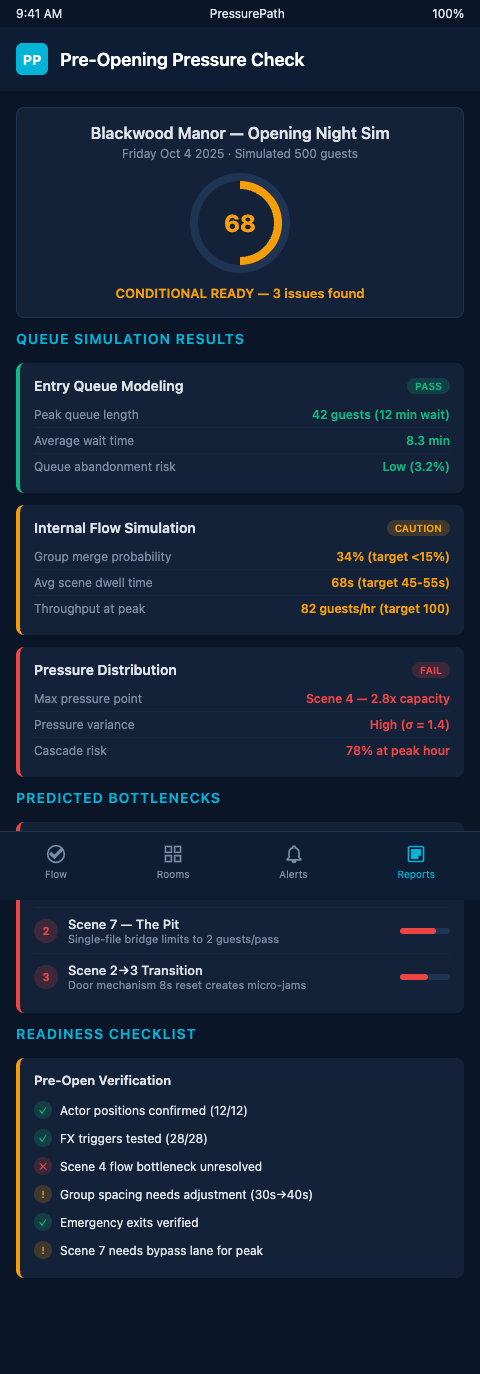
PressurePath runs this pressure simulation before you open. Feed in your chamber dimensions, your corridor geometry, your ticketing data by slot, and your peak-night arrival distribution. The model produces a per-chamber, per-minute density forecast for your heaviest expected night, with threshold alerts at the points where LOS and NFPA occupant load limits will be exceeded.
The practical output is a list of decisions to make in September: which entry windows need to be spread, which chambers need physical modification, which dispatch intervals need to change, and what the maximum sustainable ticket volume is for each 30-minute entry window. These are decisions you make with a flow model in hand, not decisions you make on the floor at 9:45 PM when the fire marshal is already measuring.
Timed entry windows — sold in capped capacity slots — function as the most direct pre-opening pressure valve available to most haunts. Distributing your 600 peak-Saturday tickets across four staggered 30-minute entry windows, with strict per-slot caps tied to your flow model's LOS threshold, converts a dangerous surge arrival into a controlled pressure flow. The pressure model tells you what those caps should be.
The staggered entry approach for peak weekends gives haunted attraction designers a deeper framework for the timing and spacing of these entry windows once the pressure check has established the density thresholds that each chamber can tolerate.
Advanced Tactics: What to Change Based on Your Pressure Check Results
The pressure check produces findings. The advanced work is converting those findings into specific operational adjustments that survive contact with a real peak night.
Chamber occupancy flags. Any chamber your pressure model shows reaching LOS D for more than 15 continuous minutes during peak window needs either a physical modification or a dispatch interval change. Identify which chambers those are. For your highest-density chambers, calculate the square footage modification needed to raise the LOS threshold by one level — sometimes widening an exit path by 10 inches is sufficient. For chambers where physical change is not feasible, the dispatch interval change is mandatory.
Corridor bottleneck ranking. Map every corridor segment that narrows below 5 feet. Rank them by their contribution to downstream density accumulation. The narrowest corridor at the furthest upstream position has the highest leverage — widening it reduces pressure through every downstream chamber. Your pressure check results show exactly which corridor modifications produce the largest reduction in peak chamber density.
Dispatch interval by hour. Build a variable dispatch interval schedule for peak nights based on your pressure model's forecast. A 90-second dispatch at 8:00 PM may be appropriate; the same dispatch at 9:30 PM is likely causing pile-ups given the slower walk-through velocity under peak density. Build three dispatch tiers — standard, elevated, and peak — with specific clock times for each transition. Brief your dispatch staff on the schedule before opening night, not during it.
Fire marshal pre-communication. Bring your pressure model to the pre-opening inspection. Show the fire marshal your occupant load calculation, your LOS forecast by chamber, and your dispatch interval schedule. Inspectors who see a designer with a flow model in hand approach the inspection as a collaboration rather than an enforcement action. Many will confirm that your model's thresholds align with their code interpretation, which gives you both a shared framework for the night's operation.
Understanding peak-night surge warning signs is the real-time complement to this pre-opening framework — knowing what the floor will look like when your pressure model's predictions are materializing gives your staff the vocabulary to respond without escalating to a safety incident.
The briefing room bottleneck diagnosis developed for escape room franchises translates directly to haunt entry corridor design — the same upstream accumulation dynamics that create escape room briefing room pile-ups also create haunt entry queue compression, and the diagnostic approach is identical.
Open Night Ready, Not Night-of Reactive
The pressure check is not a complex operation. It is a structured application of the flow data you already have — your attraction dimensions, your ticketing system data, your historical walk-through velocity — run through a pressure simulation before opening night instead of on opening night.
Most haunted attraction designers who have been through a fire marshal shutdown or a peak-night safety incident describe the same retrospective: they knew something felt wrong in the queue but did not have a framework to quantify it before it became a problem. The pressure model gives you that framework three weeks early.
There is also a staff briefing benefit. When you run a pre-opening pressure check and can show your floor team the specific 30-minute windows when density will peak, the specific chambers that will approach LOS D thresholds, and the specific dispatch intervals scheduled for those windows, you are briefing your team on a plan — not asking them to improvise in real time. Floor teams who have seen the density forecast before opening night make better decisions at 9:45 PM because they have already mentally rehearsed the scenario.
The pressure check also creates a feedback loop that improves your model over time. Your first peak-Saturday data validates or adjusts your pre-opening forecast. By your second season, your model is calibrated to your specific attraction's crowd behavior and the forecast accuracy is substantially higher. The pressure check becomes more valuable each year, not less.
PressurePath converts your haunt's physical dimensions and ticketing plan into a peak-night density forecast with chamber-level specificity. Build the model in September. Adjust the dispatch schedule, the entry windows, and the chamber geometry based on the results. Walk into opening night knowing exactly what your pipe can handle — and what it cannot.
Your guests and your actors both deserve an opening night that was designed for the crowds that will actually show up — not the Thursday-afternoon staff group that walked through during setup.