How to Diagnose Briefing Room Bottlenecks Before They Eat Staff Hours
The Briefing Room Is Your System's First Constraint
A group finishes "Cryogenic Breach" at 2:45 PM. Another completes "The Vault" at 2:47 PM. A third exits "Deep Freeze" at 2:48 PM. All three now need the same briefing room host, the same floor space, and the same photo-op transition — simultaneously. Your host hasn't cleared the previous cohort. The 2:47 PM window you thought was fine turns into a nine-minute cascade.
This isn't bad luck. It's structural. According to a survey of 175 escape room facilities by Scott Nicholson, shared infrastructure — briefing areas, reset zones, corridor hubs — is the standard design pattern across multi-room venues. Shared assets are the rule, not the exception.
The escape room industry has grown aggressively: Room Escape Artist's 2024 industry report shows the majority of facilities now run 3-6 parallel rooms, and average group size sits at roughly 4.58 players according to Xola's industry statistics. Back-to-back groups at that density quickly exceed briefing room floor space, especially when exits cluster.
The briefing room is not a waiting area. It's a service stage — and when it becomes your binding constraint, everything upstream backs up with it.
Treating Briefing Room Flow as a Pressure Problem
Queueing theory offers the clearest framework for diagnosing why your briefing room breaks. Linda Green's Columbia Business School research on queueing models establishes a foundational rule: a system becomes unstable when utilization approaches 100%. Your briefing room operates at near-100% utilization during Saturday peak hours not because it's too small, but because exits are scheduled without accounting for shared-asset contention.
Think of your 10-room franchise as a pressurized pipe network. Each room is a pressurized segment. When groups move from rooms into the briefing transition area, they're like fluid exiting multiple pipes into a single junction. If that junction can't drain fast enough — because the host is still occupied, or the floor space is full — pressure builds upstream. Groups stack. Staff scramble. One late exit in "Reactor Room 4" propagates as a delay into the photo wall, then into the lobby, then into the next booking wave.
Research on hospital patient flow from the IHI shows this same domino pattern: discharge delays cascade backward through intake. The briefing room bottleneck in an escape room franchise operates identically — downstream pressure at the briefing junction backs up into every room feeding it.
PressurePath models this directly. You load your real Saturday booking grid, and the simulator maps every room exit as a fluid event entering the junction. It flags every 90-second window where briefing-room demand exceeds host capacity. You see the 1:15 PM collision on Monday morning, not at 1:16 PM on Saturday.
Effective briefing queue engineering for franchises with shared lobbies goes further than spacing starts — it requires knowing which room combinations are structurally dangerous at which times of day.
The diagnostic process has three steps. First, map every room's average completion time range. A room with a 20-40% success rate creates wide exit-time variance — groups finishing early cluster with groups finishing on time. Second, overlay your Saturday booking grid against those completion distributions. Third, identify the windows where two or more rooms hit their expected exit range within the same 90-second span AND share a briefing asset. Those windows are your collision points.
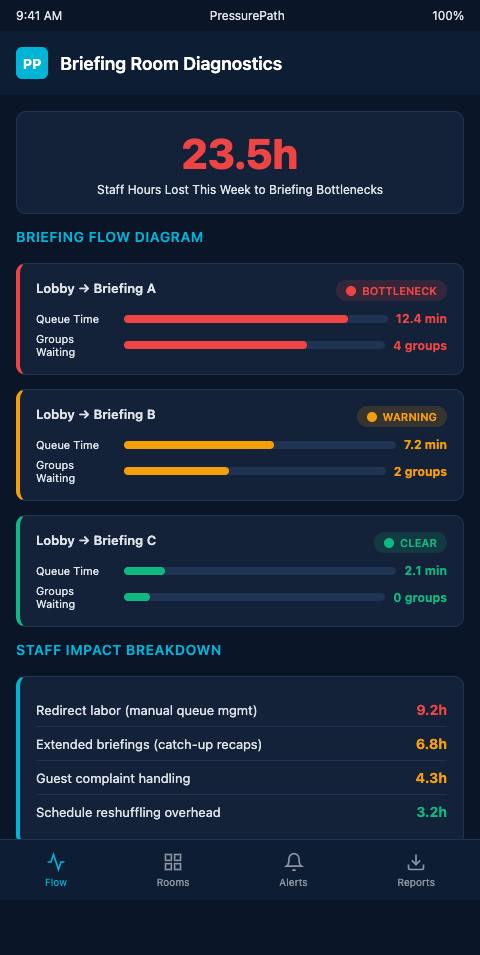
A one-time manual pass through your booking grid can surface obvious collisions. But at 10 rooms with six-minute exit-time variance, the collision matrix becomes too large to read accurately. A simulator that treats group flow as fluid dynamics finds the non-obvious collisions — the ones at 3:22 PM that only happen when rooms 4, 7, and 9 all start within the same 12-minute window.
Advanced Diagnosis: Cascade Patterns and Compounding Pressure
Single-collision diagnosis is the entry level. The harder problem is cascade diagnosis: which collisions cause secondary collisions two or three time slots later?
When the 2:47 PM briefing collision runs nine minutes long, your host is occupied until 2:56 PM. The group originally slated to start their briefing at 2:50 PM now starts at 2:56 PM. Their room entry shifts. Their exit shifts. Now the 4:15 PM wave inherits a six-minute latency it has no way to know about.
This is what staff hour hemorrhage from firefighting actually looks like at the microscale: your GM isn't reacting to a single bad booking, they're absorbing a cascade of latency that was baked into the schedule before the day started.
Theme-park research confirms the pattern. A PMC study on perceived crowding at shared amenities found that satisfaction collapses at shared service points when perceived crowding is high — regardless of actual wait duration. Your briefing room doesn't need to fail for 20 minutes to damage a group's experience. Three minutes of visible confusion at the threshold is enough.
The solution is pre-shift cascade modeling. Before your Saturday opens, run every booking slot through a cascade simulator that propagates exit-time variability forward through shared assets. Flag any cascade path where a second-order collision lands within 90 minutes of the primary one. Those are the shifts that need either a booking adjustment or a staffing supplement before the day begins.
The practical depth of this modeling matters at franchise scale. A 10-room franchise running six 60-minute sessions per room across an 8-hour Saturday generates 480 individual exit events and roughly 96 junction pressure decisions at the briefing room alone. Walking through those manually is not a reasonable ask of any GM; the combinatorial math exceeds human working memory somewhere between rooms 6 and 7. Cascade modeling replaces that intuition with a set of 90-second exit windows flagged ahead of time, each labeled with the downstream node it threatens and the latency it propagates. When your 2:47 PM briefing collision is visible as a red cell on Monday's pressure map, the GM response stops being improvisation and starts being a 3-minute schedule nudge — typically shifting a single group start by 4 to 6 minutes to decouple the cascade.
Think of the franchise as a pressurized pipe system where each cascade event is a pressure wave that travels downstream at a measurable speed. A 9-minute briefing delay at 2:47 PM arrives at the photo wall junction around 3:48 PM as a 7-minute queue. That queue arrives at the reset station at 3:55 PM as a 5-minute blockage for the next room entry. Each step dissipates slightly, but the wave never reaches zero within the same shift — it lands somewhere in the 4-6 PM window as a compressed overtime spike your GM absorbs without naming it as a cascade. Pre-shift simulation traces every wave before it forms, so the pressure release happens on Monday morning with a 6-minute start-time adjustment rather than at 4:30 PM with a guest waiting in the lobby.
A pre-opening pressure check workflow applies the same pre-shift logic — auditing shared asset contention before the first group enters — and the diagnostic principles translate cleanly to escape room franchise operations.
Join the Waitlist
PressurePath is built for multi-room escape room franchise operators who've watched their Saturday briefing room become the silent cost center behind three-hour firefighting shifts. If you operate 8 or more rooms and want to see your actual Saturday collision map before it runs live, join the waitlist and we'll run your booking grid through the pressure simulator as part of onboarding.
The onboarding process starts with your real Saturday booking data. You provide your room layout, shared asset configuration, and three recent peak-day booking grids. PressurePath maps every exit window, every briefing room collision, and every cascade path your current schedule produces. The output is a pressure map showing every 90-second risk window across your shift, annotated with the specific start-time adjustments that would prevent each collision. Most franchise operators who complete the initial analysis identify 4-6 booking slots per Saturday that are structurally guaranteed to produce briefing room contention under their current configuration. Those slots become the first targets for schedule adjustment, and the recovered time compounds across every subsequent peak weekend.