Briefing Room Queue Engineering for Franchises with Shared Lobbies
What Makes the Shared Lobby the Most Expensive Failure Point
Labor accounts for 48% of gross revenue at escape room facilities, according to Financial Models Lab's escape room profitability analysis. When briefing queue spillovers happen in shared lobbies, the cost isn't just staff time — it's the direct erosion of franchise margin through extended session overruns, comp tickets, and the guest experience damage that drives negative reviews.
A shared lobby at a 10-room franchise is structurally different from a single-room venue's reception area. It's a convergence node receiving flow from multiple upstream rooms simultaneously. When rooms 2, 4, and 6 finish at roughly the same time and feed groups into a single shared lobby leading to the briefing room, the lobby becomes an M/M/c queue — multiple arrival streams, one shared service point.
Queueing theory's M/M/c multi-server model describes exactly this configuration: when multiple servers (briefing sub-rooms) are downstream of a shared queue, utilization at the lobby junction determines whether arrivals see near-zero wait or multi-minute delays. The transition between the two states isn't gradual — it's sharp. A lobby running at 70% capacity is comfortable. At 90% capacity, queue length grows without bound.
The engineering question isn't "how big should the lobby be?" Most franchises can't change their physical footprint. The question is: how do you manage arrival timing so the lobby never exceeds 80% of its steady-state capacity during a peak Saturday window?
Briefing Room Queue Engineering in Practice
Queue design research consistently shows that the physical layout of a queue space shapes guest behavior before staffing interventions are needed. Visiontron's analysis of queue design and guest emotions found that poor queue flow correlates with guest anxiety, and that serpentine layouts buffer crowd surges by distributing waiting groups across a longer path rather than a dense cluster. For a shared franchise lobby, serpentine queue barriers — even if used only during peak hours — convert a pressure spike into a managed flow.
The more powerful intervention is temporal rather than physical. Visiontron's guide to queue layout for any crowd size establishes that grid-planning shared spaces identifies optimal queue configurations for varying volumes — but the underlying insight is that arrival timing drives queue length more than lobby square footage. Control when groups arrive at the shared lobby and you've solved most of the engineering problem.
Think of the shared lobby as a pipe junction in PressurePath's pressure model. Six upstream pipes (rooms 2, 4, 6, 8, 10, and the photo wall) push flow toward a single junction (the shared lobby). When all six push simultaneously, junction pressure exceeds capacity and the queue forms. When starts are offset to stagger arrivals — rooms 2, 4, 6 finishing at 2:05, 2:17, 2:29 PM rather than simultaneously at 2:05 PM — the junction receives sequential flow rather than simultaneous surge. The queue never forms.
FastPass systems at theme parks operate on the same principle. PMC research on FastPass queue management found that timed-slot entry increased ride efficiency approximately 40% by converting simultaneous arrival surges into staggered streams. The mechanism — timed entry rather than simultaneous release — is directly applicable to briefing room scheduling at a multi-room franchise.
OfficeFinder's research on effective queue management identifies directional signage and floor arrows as the lowest-cost intervention for smoothing flow through shared amenity areas. In a shared franchise lobby, clear floor arrows directing which group goes to which briefing sub-room reduce the GM coordination burden — groups self-route rather than waiting for direction.
PressurePath models your shared lobby as the most pressure-sensitive junction in your 10-room network. The simulation outputs the exact time windows where simultaneous room exits will push lobby occupancy above threshold, and the minimum start-time offset needed to prevent each collision. That output feeds directly into your booking grid configuration — you adjust room 4's Saturday start from 2:00 PM to 2:15 PM and the lobby collision disappears from the pressure map.
The lobby acts as the convergence chamber of the entire upstream pipe network. Six rooms feeding a single lobby during a peak 2-hour Saturday window generate roughly 18-24 group arrivals at the lobby junction depending on reset timing and group size mix. A lobby sized for 12 concurrent groups at steady state — a typical spec for a 10-room franchise — can absorb that arrival rate only if the arrivals sequence cleanly across 8-minute intervals. When three of those arrivals cluster inside a 90-second window, lobby occupancy briefly spikes to 15-18 groups, which is above the physical comfort ceiling and measurably above the M/M/c queue stability threshold. The simulation identifies each of those spikes as a named coordinate on the Saturday grid, and the fix is typically a 6-9 minute offset on one of the three colliding rooms — not a larger lobby.
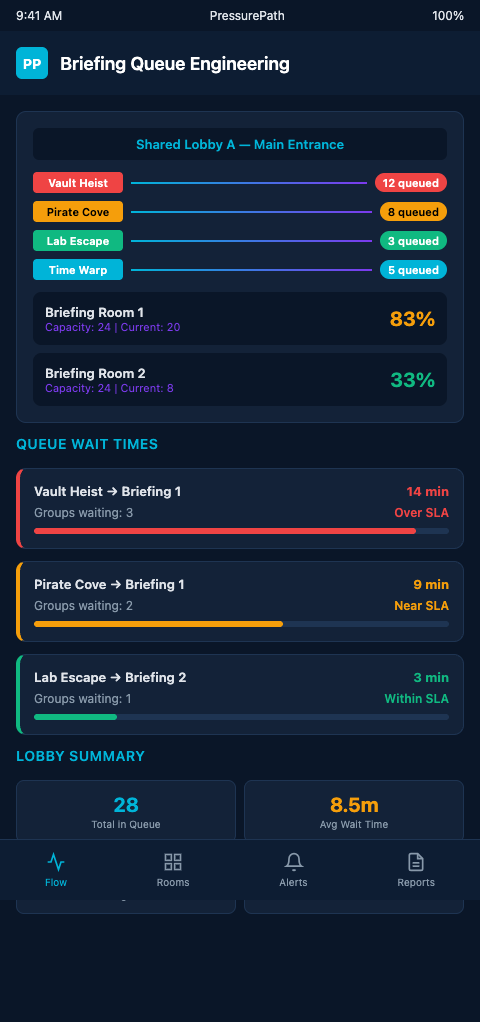
For operators who haven't yet run a systematic briefing bottleneck diagnosis on their franchise, the shared lobby queue analysis is the most revealing starting point — it surfaces which room pairings are the chronic collision sources rather than treating every Saturday problem as a staffing issue.
Advanced Queue Engineering Tactics
Once the basic timing intervention is in place, the next layer is demand prediction. Wiley's research on mitigating theme park crowding found that prospective coordination — coordinating flow before crowds arrive rather than managing them after — reduces crowd collisions at convergence points most effectively. For escape rooms, prospective coordination means reviewing PressurePath's Saturday pressure map on Friday afternoon and briefing the GM team on which windows require active queue management.
A tiered briefing room assignment protocol manages the shared lobby at the staff level: during amber-pressure windows (2–3 groups projected within 15 minutes), assign one GM to lobby queue management exclusively. During green windows, that GM returns to room monitoring duties. The threshold-triggered assignment ensures lobby coverage exactly when needed rather than maintaining a permanent lobby station that's idle 70% of the shift.
For shared lobbies serving families with children, the queue engineering challenge compounds — kid-scale queue engineering addresses how physical queue structures designed for adults create flow hazards for smaller groups, a consideration that increasingly applies to family-focused escape room franchises.
Reset station routing is the upstream control point for briefing queue engineering: if reset delays push room exits back by 4 minutes, the carefully engineered stagger collapses and the shared lobby collision reappears. Queue engineering and reset routing are interdependent systems, not independent interventions.
Queue Engineering Produces Margin, Not Just Comfort
Multi-room escape room franchise operators treating shared lobby queues as a guest experience problem are underestimating the margin impact. Every Saturday afternoon briefing queue collision that produces a 10-minute wait also produces a downstream cascade: the reset team starts late, the next group enters late, and the booking grid's carefully planned slot sequence degrades for the remainder of the afternoon window. That cascade converts a single lobby pressure spike into 20-30 minutes of compounding delay across the facility — delay that erodes margin through comp tickets, overtime, and the review score damage that suppresses future bookings.
PressurePath's shared lobby pressure analysis identifies the exact Saturday windows where your current booking configuration produces briefing queue collisions, calculates the start-time offsets that prevent them, and outputs a modified booking grid that your team can implement without changing your total room capacity or staffing headcount. The same rooms, the same staff, the same Saturday — just with pressure arriving at the shared lobby in sequence rather than in a surge. If your franchise has a shared lobby and a recurring Saturday afternoon queue problem, join the waitlist and bring your room configuration; the pressure analysis runs in under four minutes.