Queue Engineering for Small Limbs: Why Kids Line Up Differently
The Queue That Kids Don't Use
The interactive geology table at your museum has a nominal capacity of six simultaneous users. You've installed a queue lane — two rope stanchions, standard museum configuration — that extends about eight feet from the table's edge. The lane is adult-width: 24 inches between stanchions, positioned at adult shoulder height.
On Tuesday morning, 12 third-graders approach the geology table at approximately the same moment. Four of them fit at the table. Of the eight remaining, three enter the queue lane. The other five glance at the line, note that the stanchions come to their chins, see no interesting activity in the lane, and drift toward the Electricity wall 30 feet away. By the time a spot opens at the geology table, five of the original group have left the queue zone entirely.
This is the small-limb queue problem: queue infrastructure designed to adult dimensions creates a waiting experience that third-graders disengage from quickly, and that disengagement reads as exhibit bypass in the flow data. The station isn't failing because kids aren't interested — research on children's restlessness and bypass behavior in queues shows that kids need active engagement in queues or restlessness and bypass behavior spike. The standard rope-and-stanchion configuration provides no active engagement.
Ergonomics research for children (Routledge) establishes that children's proportions, reach, and spatial behavior require distinct queue geometry from adults. The specific differences — lower handrail heights, narrower lane widths, shorter wait-zone depths — are not aesthetic choices. They're the anthropometric requirements for a queue structure that children experience as a navigable space rather than an adult-scale environment they're moving through.
Designing Queues From Child Anthropometrics
CDC anthropometric reference data gives exhibit designers the specific measurements: school-age children's height and reach require lower counters, narrower corridors, and visual sight lines calibrated to 42-54 inch standing eye heights rather than adult 60-66 inch heights. A queue lane designed from those measurements produces a different physical environment than a queue lane designed by scaling down an adult configuration. The anthropometric calibration differences between child and adult queue behavior are especially visible in high-throughput settings — corn maze queue engineering at scale illustrates how adult crowd dynamics produce different queue behavior even when the queue architecture is formally similar.
Most of that infrastructure was installed based on adult-scale specifications or borrowed from a general retail queue standard. Neither of those sources reflects the ergonomic reality of 34 third-graders trying to wait for a turn at an interactive geology table. The museum visit becomes frustrating before the station is even reached — and frustrated kids route to the next available option rather than waiting.
The specific design changes for a third-grade queue at an interactive station are:
Lane width: 16-18 inches between lane markers, which is tight enough to create a structured queue without the excess width that kids fill with lateral movement and position-trading. Adult-width lanes allow the kind of jostling and shuffling that signals "informal gathering" rather than "queue," and kids respond to that signal by treating the zone as a congregation area rather than a waiting line.
Lane height: Rope stanchions at 36 inches or lower. Above that threshold, the stanchion becomes a barrier that blocks visual access to the station ahead — a third-grader at standard stanchion height cannot see the activity they're waiting for, which accelerates disengagement. Visual access to the target activity is the primary engagement mechanism in a kid queue.
Lane activity: The Worlds of Wow museums research on play-integrated queue zones documents that play-integrated queue environments triple dwell time and reduce station-skipping. At a geology station, this means embedding a "preview" activity in the queue zone — rock samples in a tactile display, a sorting puzzle, a question card — that engages kids while they wait and frames the primary station activity as the next step.
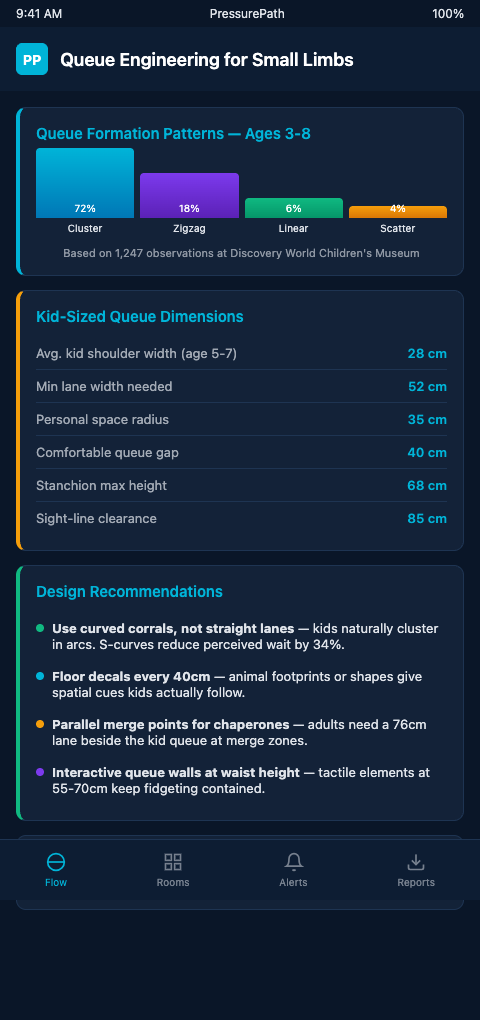
PressurePath models queue retention rate — the percentage of kids who enter a queue zone and remain until they reach the station — as a flow variable. A queue zone with 40% retention rate is functionally diverting 60% of the approaching wave to other stations before they reach the interactive mechanism. That diversion is not voluntary bypass — it's an artifact of queue geometry. Redesigning the queue to improve retention from 40% to 75% changes the station's effective visit rate without any change to the exhibit itself.
The queue management research on 12 design factors for children (PMC) identifies specific variables — activity information density, physical constraint fit, spatial legibility — that determine whether a child reads a queue zone as "wait here" or "optional." The redesign targets are those variables, applied to the anthropometric baseline of your visitor population.
Advanced Queue Engineering for Wave-Scale Traffic
The geometry problems at the single-station level multiply at the wave scale. When 30 kids arrive at a cluster of stations simultaneously, the effective queue at each station is not just the kids in the lane — it's the kids in the lane plus the kids hovering in the approach zone who haven't committed to the queue yet. That hovering population makes routing decisions based on queue length, visual access, and lateral movement signals from other kids. Small-limb queue design that produces clean, legible lane structures reduces the hovering population by giving kids a clear "yes, I should enter this queue" signal. Reducing the peak load that any single station queue faces is the first lever — wave-staggered entry weekday practices covers the floor-level scheduling approach that spreads arrival pressure across a wider window so queue geometry doesn't have to absorb the full 30-kid burst at once.
Design principles for queue environments with children from theme park research (ResearchGate) confirms that visible queue length is a primary decision variable — kids and adults alike use queue length as an estimated wait-time signal, and they exit or avoid queues when visual length exceeds their wait-time tolerance. For third-graders with low wait tolerance, queue length visibility must be managed: a queue that appears to extend 15 kids deep (even if wait time is only 3 minutes) will repel more kids than a queue that appears to extend 4-5 kids deep with the same actual wait time.
The design solution is queue segmentation: rather than a single 20-foot lane, use two 8-foot lanes with a visual break between them. Each segment appears shorter, which improves approach commitment. The practical implementation for a children's museum exhibit uses temporary rope-and-stanchion segments with a mid-lane tactile engagement element at the break point.
Even with staggered entry, a 30-kid group arriving at the geology cluster will generate simultaneous queue pressure at two or three stations. Queue geometry designed for child anthropometrics absorbs that pressure by retaining kids in the lane rather than deflecting them to adjacent stations.
The connection to refreshing bypass-heavy stations is direct: when a station shows high bypass rates in PressurePath data, the first diagnostic step is distinguishing between a queue-retention problem (kids approach and leave the queue) and a content-attraction problem (kids don't approach at all). Queue engineering addresses the first; exhibit redesign addresses the second. Confusing the two leads to redesigning exhibit content when the actual problem is a stanchion set at adult shoulder height.
The Floor-Level Impact of Queue Retention Gains
A queue retention improvement from 40% to 75% at one station sounds like a single-station fix. At the floor level, it's a redistribution of wave pressure across all stations. When more kids stay in the geology queue rather than routing to the Electricity wall, the Electricity wall's peak occupancy drops, which reduces compression there, which creates space for kids who would have bypassed the Wall due to crowd saturation to actually engage with it.
This cascade effect is what PressurePath models across the full exhibit floor. Queue retention at each station is an input variable in the wave-pressure calculation, not an isolated metric. Improving queue retention at three stations simultaneously can reshape the wave's pressure distribution as substantially as installing a new exhibit. Children's museum exhibit designers who understand this relationship prioritize queue redesign as a flow engineering investment, not a cosmetic improvement.
Ergonomic design for inclusive public spaces research (Tandfonline) confirms that most public spaces are ergonomically unsuitable for children — a finding that applies directly to queue design. The ergonomic correction required is not extensive: targeted changes to lane width, stanchion height, and activity provision at two or three key stations produce measurable queue retention improvements within a single field trip day.
Measure Retention, Not Just Throughput
The implementation timeline for queue redesign at children's museums is shorter than most exhibit teams expect. Physical changes — adjusting stanchion height, narrowing lane width, installing a midpoint tactile activity — can be prototyped in a single day with portable equipment before any permanent installation. A one-day prototype test during a live field trip session, with a sensor at the queue zone entry and a staff observer at the station threshold, produces enough retention data to decide whether the redesign is worth formalizing. Most museums that run this test find the retention improvement is measurable within the first two groups, making the case for permanent installation straightforward.
Queue retention rate is not a standard museum metric. Most children's museum operations track throughput — how many kids visited each station over the course of a field trip day. Retention rate requires a different measurement: how many kids entered the queue zone versus how many reached the station. The gap is the queue-deflected bypass.
PressurePath calculates queue retention from sensor data at the queue zone entry point and the station threshold — two sensor readings that, combined, produce the retention rate without requiring observation. Children's museum exhibit designers who want to separate queue-engineering problems from content problems in their bypass data should join the PressurePath waitlist and see which of their stations are losing kids in the line rather than at the exhibit.