Best Practices for Wave-Staggered Entry on Busy Weekdays
Four Buses, One Atrium, No Spacing Plan
Your Tuesday calendar shows four school groups: P.S. 142 at 9:30 AM (32 third-graders), Lincoln Elementary at 10:15 AM (28 fourth-graders), Jefferson at 11:00 AM (34 third-graders), and Washington Middle at 1:00 PM (41 sixth-graders). On paper, the 45-minute gaps look comfortable. By 10:20 AM, the P.S. 142 group has not cleared the interactive wing — they compressed at the Electricity wall and the Water Cycle puzzle, and 19 of the 32 kids are still in a 400-square-foot zone. The Lincoln group enters the atrium, reads the same visual cues, and funnels directly into the same zone.
This is wave collision, and it's the characteristic failure mode of weekday field trip scheduling that treats arrival-time spacing as equivalent to floor-clearance spacing. A 45-minute gap between arrival times produces a 45-minute gap between peaks only if the first group disperses at a predictable rate. When kids cluster at high-magnet stations — as they reliably do at interactive, visually dramatic exhibits — the first wave's trailing edge extends well past the nominal 45-minute window.
ASTC Science Center Statistics shows school groups represent roughly 15% of attendance at science centers, with weekday concentration making them the dominant occupancy driver on school-calendar days. That concentration means wave collision is not an edge case — it's the default outcome of a busy weekday without stagger engineering.
Major museums like the Museum of Science Boston already specify advance reservations and staggered arrival windows as standard field trip practice. The operational question for children's museum exhibit designers is not whether to stagger but how to calculate the right intervals — and current practice mostly relies on experience-based rules of thumb rather than flow modeling.
Those rules of thumb are calibrated to the floor's average behavior, but average behavior doesn't describe any specific day. A day with a 34-kid third-grade group followed by a 28-kid fourth-grade group followed by a 41-kid sixth-grade group is three different wave-pressure profiles arriving in sequence. The rule of thumb that worked when the first two groups were similarly-sized third-graders fails when the profiles diverge. Stagger engineering based on flow models handles that divergence by calculating dispersal times from the actual wave characteristics, not the average.
Engineering Entry Intervals From Wave Pressure Data
The pressurized-water framing makes the calculation tractable. Each school wave is a fluid burst entering your exhibit floor through the atrium entry point. The burst disperses through the pipe network at a rate determined by station dwell times, corridor widths, and partition configurations. The question for stagger planning is: how long before the first burst has dispersed sufficiently that a second burst can enter without collision?
PressurePath models that dispersal rate from historical tracking data. For a 30-kid third-grade group at your specific floor layout, it calculates time-to-dispersal — the point at which the wave has spread across enough stations that the atrium entry zone is clear of the initial compression cluster. That calculation becomes the minimum stagger interval: not 45 minutes by convention, but 38 minutes or 52 minutes based on your actual floor's dispersal characteristics.
The pedestrian simulation research on museum circulation (MDPI) demonstrates exactly this: entry pulse timing reshapes downstream station load in ways that arrival-time gaps alone cannot predict. Two groups with identical arrival-time gaps but different group sizes and dwell profiles will produce dramatically different floor-pressure patterns. Simulation makes those differences visible before the buses arrive.
Visitor experience research (Springer) connects engagement quality directly to the conditions a group encounters — sustained engagement requires sustained access to interactive mechanisms, which wave collision directly prevents. Third-graders who arrive to find a station occupied by 18 other kids don't wait; they move on. The station registers a bypass even though the group would have stopped under uncrowded conditions.
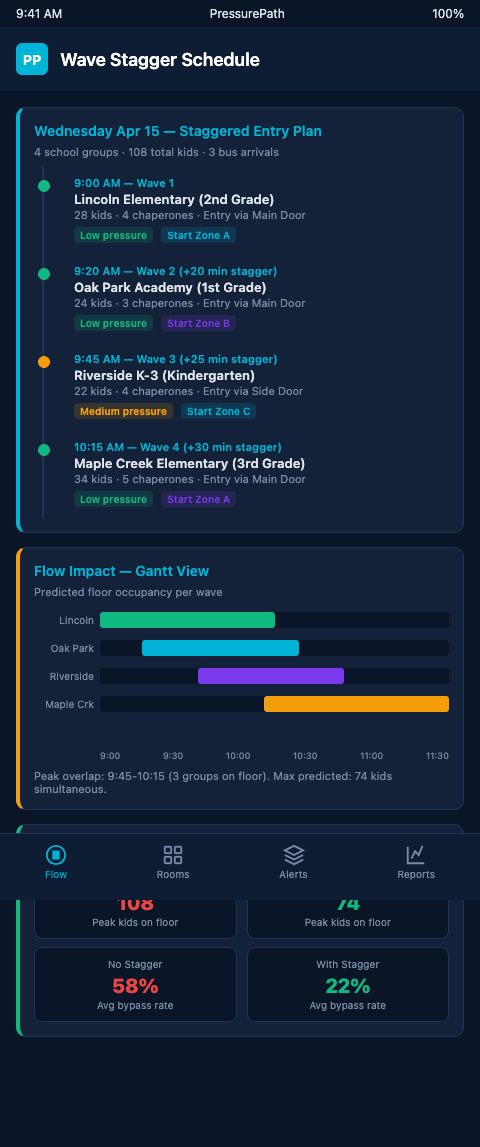
The stagger engineering workflow has four components. First, classify incoming groups by wave-pressure profile: group size, grade level, and predicted dwell distribution combine to produce an estimated dispersal time for each group. A 34-kid third-grade group at your floor layout disperses differently than a 28-kid sixth-grade group — not just because of size but because of dwell-time distributions at specific station types.
Second, set minimum stagger intervals by group pair. A third-grade group followed by another third-grade group requires longer stagger than a third-grade group followed by a sixth-grade group, because third-graders cluster at the same interactive stations while sixth-graders distribute more widely toward text-heavy and demonstration exhibits.
Third, build the stagger schedule into the school district booking integration workflow so that reservation acceptance automatically checks whether a proposed arrival time meets the calculated minimum stagger for the preceding group. Rather than discovering the wave collision problem at 10:20 AM on Tuesday, you prevent it at the booking stage.
Fourth, use partition and funnel configurations to extend effective stagger even when actual arrival-time gaps are fixed. Quinn Evans' visitor flow architecture research describes transitional-pause techniques — physical design elements that slow wave ingress and create natural dwell points before a group reaches the main exhibit floor. A configured rope partition at the atrium threshold, combined with a docent-led two-minute orientation, effectively adds 8-10 minutes to the stagger window without requiring the next group to arrive later.
Advanced Weekday Stagger Tactics
For children's museum exhibit designers managing six to eight school groups on peak weekdays, static stagger intervals break down quickly. The first three groups might follow the plan; by Group 4, a delayed bus or an extended dwell at the Water Cycle puzzle has shifted the dispersal timeline, and the calculated stagger no longer reflects the actual floor state.
Reservation systems like Versai support scheduling groups into specific time slots, but they don't dynamically adjust based on real-time floor state. PressurePath closes that gap: real-time pressure data from the floor feeds back into the stagger model, surfacing when the preceding group's dispersal is running behind schedule and flagging that the next group's entry needs to be held or redirected.
The practical intervention is a docent positioned at the arrival checkpoint with a simple rule: if the floor pressure map shows the atrium zone still above 60% of the preceding group's peak occupancy, delay the next group's entry by five minutes with a structured preview activity at the lobby threshold. That rule requires no complex judgment — it's a threshold check against a real-time dashboard reading.
The deeper strategic use of stagger data connects to exhibit redesign priorities. The stations that consistently cause dispersal delays — the ones where a wave fails to clear within the expected window — are the same stations creating bypass pressure for subsequent groups. Understanding which stations extend dispersal time directly informs which interactive mechanisms need redesign to distribute attention across a longer time window rather than concentrating it in a single peak.
Connecting these patterns to earlier-stage design work reinforces the stagger model's value: the 30-kid waves exhibit bypass primer establishes the baseline dynamics that stagger engineering is managing. Stagger intervals aren't arbitrary buffers — they're calculated responses to the wave-pressure characteristics that bypass analysis has already quantified.
For museums with time-block group starts across franchise or multi-venue operations, the stagger discipline maps directly: controlling when each group enters the active zone determines whether staff overlap creates a coordination problem or a coverage advantage.
Measuring Stagger Effectiveness
Once a stagger schedule is in place, measuring whether it's working requires the same tracking infrastructure that powers the pacing model. The metric is wave collision rate: how often does the tracking data show two groups simultaneously occupying the high-magnet stations at levels above each station's comfortable capacity? A stagger schedule that eliminates wave collision at the Electricity wall but still allows collision at the Water Cycle puzzle is a partial fix.
PressurePath calculates wave collision rate per station pair per day, which produces an empirical record of stagger effectiveness rather than a qualitative assessment. If the 45-minute arrival gap that your team calculated is working — the preceding group has cleared the high-magnet zones before the next group compresses into them — the collision rate will be low. If it isn't working, the data surfaces which specific station pairs are experiencing collision and which arrival-gap pairs are generating them.
That feedback loop closes the iteration cycle: stagger intervals are adjusted based on actual dispersal data rather than recalibrated by instinct after a bad Tuesday. Over a full school season, a museum running PressurePath accumulates enough dispersal data to produce reliable interval calculations for every combination of group size and grade level it typically books, replacing the rules-of-thumb with empirically calibrated schedules.
Build the Stagger Into the Calendar, Not the Floor
The common mistake in weekday stagger planning is treating it as an operational problem to solve on the day — repositioning docents, adjusting partitions, redirecting groups verbally. Those tactics work. They're also exhausting, and they require a skilled floor team to execute in real time under time pressure.
The alternative is building stagger intervals into the reservation calendar so the problem is solved before the first bus arrives. PressurePath produces the interval calculations from your floor's historical dispersal data and integrates them with your booking workflow, so each confirmed reservation is automatically checked against the stagger requirement. If you design or manage field trip programming for school groups and want weekday wave collisions to become a scheduling calculation rather than a daily scramble, join the waitlist for PressurePath.