How 30-Kid Waves Cause Exhibit Bypass: A Field Trip Flow Primer
When the Bus Arrives, the Wave Begins
At 10:15 AM, a yellow bus from P.S. 142 pulls up to the curb. Thirty-two third-graders spill into your atrium within 90 seconds. The group hasn't split into stations yet—it's still a single social unit, moving as a coherent mass with collective momentum. The first interactive station near the entrance captures eight kids. The second catches six. By the time the wave reaches the Water Cycle puzzle at the back—the centerpiece of a $180K NSF grant—twenty of the thirty-two have blown past it without pulling a single lever.
This is exhibit bypass, and it is not random. It follows predictable mechanics that designers can model and, with the right interventions, redirect.
ASTC data puts worldwide school group visits at roughly 18 million per year, making field trips the dominant mode of organized child-group engagement with museum content. Research from Education Next confirms that field trip students score higher on assessments and show stronger cultural empathy—but only when they actually engage with the exhibits. Bypass collapses that outcome before the teacher re-counts heads.
The gap between what the museum planned—an immersive learning sequence that builds toward the Water Cycle centerpiece—and what the wave delivers is not a content problem. It's a pacing problem. The floor plan was designed for individual visitors who self-navigate at variable speeds. The 30-kid wave is not a group of individual visitors. It's a pressure event.
Why 30-Kid Waves Behave Like High-Pressure Fluid
The core insight behind PressurePath's modeling approach is that 30-kid school groups behave like pressurized water moving through pipes. A mass of children entering a floor plan at once creates a pressure differential: they push from the entry toward any open path, flowing around obstacles and bypassing stations that require deceleration unless the layout forces contact.
Research on school-age grouping behavior documents that children in groups exhibit highly variable, wave-like movement that consistently skips intervening elements. The wave doesn't navigate—it flows. It takes the path of least resistance through your floor plan, and your grant-funded exhibits are not pipes—they're eddies. Without a physical constraint, the fluid bypasses them entirely.
A key factor is time pressure from the bus schedule. ASTC teacher surveys show that tight time windows and bus return schedules are the primary structural drivers of rushed visits. That urgency communicates to the wave before anyone says a word. The result: children are already in bypass mode when they cross your threshold, regardless of how carefully the docent greets them at the door.
Three mechanical conditions convert a school group into a bypass wave. First, entry concentration—when all 30 kids enter through a single atrium point, forward momentum from the group behind pushes the front of the wave deeper into the floor. Second, early capture saturation—the first two exhibits absorb a fraction of the group, but those kids' noise and energy act as a magnet pulling the remaining wave sideways rather than forward into your learning sequence. Third, visibility tunneling—children in motion orient toward exits, open spaces, and bright objects. A puzzle station with a vertical learning curve and no visible affordance from 20 feet away is transparent to the wave.
Museum design guidance notes that peak school-group timing drives bypass risk and that spatial planning must account for wave-style arrivals. That's exactly what most standard floor plans do not do. The typical children's museum floor is designed around adult-mode browsing: individual arrival, dispersed exploration, self-directed dwell. None of those assumptions hold for a 30-kid school wave arriving simultaneously from a single bus.
Understanding the wave also means understanding its component parts. The wave is not uniform. It has a leading edge—the fastest-moving 6–8 children who set the pace and direction—and a trailing mass that follows the leading edge's social cues. The leading edge makes the bypass decision before the trailing mass arrives at a station. If the leading edge flows past the Water Cycle puzzle, the trailing mass reads that as the correct path and follows. Interventions that capture the leading edge—a chaperone positioned at the station entry, a physical element that breaks the leading edge's forward momentum—can redirect the entire wave.
Modeling and Countering the Bypass
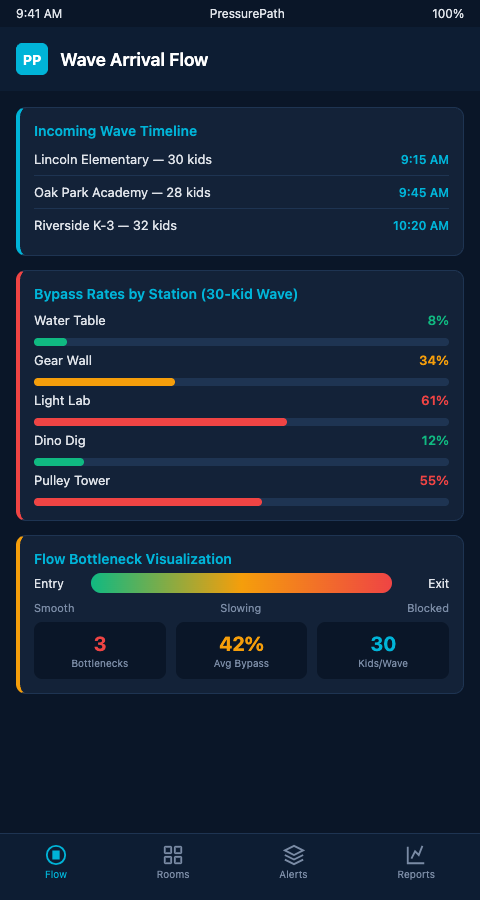
Understanding the wave mechanism is the first step; the second is knowing which stations are structurally vulnerable before the field trip day arrives. PressurePath treats your floor plan as a pipe network and simulates where each school wave will concentrate, where pressure drops, and which stations fall in the bypass shadow.
The three primary bypass conditions each have a corresponding design countermeasure. Entry concentration can be addressed with a soft split at the atrium—a second focal point 15 feet from the door that divides the wave before it builds full momentum. Early capture saturation can be moderated by limiting the sensory intensity of the first two stations so they attract without absorbing the entire group. Visibility tunneling is solved by improving the affordance signal of critical stations: a prominent physical element—a rope partition, a raised platform, a floor-level light cue—that registers from 20+ feet of distance.
The Springer research on museums as learning avenues frames engagement as contingent on design quality, not group intention. A wave of well-prepared third-graders will still bypass a station that reads as optional from a distance. Design quality here means bypass-resistance, not aesthetic polish. A museum can spend $180K on an exhibit and $0 on its bypass-resistance and produce exactly the outcome P.S. 142 experienced—zero lever pulls, zero grant outcomes, zero third-grader memory of water cycles.
Chaperones matter, too. Research on chaperone effectiveness shows that scripted inquiry can transform chaperones from passive observers into active flow redirectors—but only when the script tells them where to stand and what to say at specific stations. Without that scripting, they default to crowd management, which keeps the wave moving rather than stopping it. A chaperone telling kids to "keep moving" at the exit of the first exhibit has already committed the wave to bypassing every subsequent station at higher velocity.
The bypass model also has a time dimension. A wave that enters a 12,000-square-foot floor at 10:15 AM with a 12:00 PM bus departure has 105 minutes. But field trips don't distribute that time evenly. The first 20 minutes absorb 60–70% of total engagement because the wave's energy is highest at entry. By the 40-minute mark, the wave has often reached the exit atrium, with entire wings unvisited. PressurePath models this time distribution alongside the spatial pressure map, identifying which stations need to be in the wave's first 20 minutes to receive any contact at all.
If you want to understand puzzle station bypass mechanics in depth, that post covers what the observational data shows about which exhibit types get skipped and why. For real-time approaches to catching bypass while the group is still in the building, the techniques in wave-read detection apply directly to field trip scenarios. And for context from a crowd-flow discipline outside museums, crowd flow fundamentals from haunted attraction design addresses the same pressure dynamics with a different spatial vocabulary.
Start With One Station, One Wave
The practical starting point for any children's museum exhibit designer dealing with school-wave bypass is not a full floor plan redesign. It is identifying the single most-bypassed station in your current layout and running a bypass model for that one node.
For most museums, that station is a mid-floor learning exhibit with a moderate dwell-time requirement—exactly the type that NSF and IMLS grant outcomes depend on. Find the pressure path that the wave takes from your entry point to your exit, identify where that path runs closest to the station without stopping, and calculate the narrowest physical intervention that forces contact. In PressurePath's models, a 9-foot rope partition at a critical station entry converts 80% of bypasses into 4-minute engaged stops for a 30-kid wave.
That number matters to funders. It also matters to the third-graders who would otherwise blow past the water cycle without pulling a single lever. A 4-minute engaged stop at the Water Cycle puzzle activates the learning goals that the NSF grant funded, generates the evaluation data that supports renewal, and—most importantly—gives 28 children an experience they would not have had in a floor plan that treats waves as visitors rather than pressure events.
The starting point for any bypass intervention is documentation: which stations are being bypassed, at what rate, under what wave conditions. That documentation doesn't require sensors or advanced analytics on day one. A docent with a tally counter and 30 minutes of observation during a school wave produces enough data to identify the top three bypass points in any floor plan. Start there. Build the model from observed data. Then use PressurePath to simulate the effect of specific interventions before committing to physical changes.
Children's museum exhibit designers ready to model their first school-wave scenario can join the PressurePath waitlist. We're building the simulation tool specifically for field-trip-scale challenges—30-kid pressure bursts, bus schedules, grant-funded stations, and the floor plans that currently send waves around all of them.