How to Time-Block Group Starts Without Staff Overlap Chaos
The 15-Minute Start Interval That Breaks at 10 Rooms
A 10-room franchise setting 15-minute start intervals between each room has, on paper, 40 possible booking slots per 10-hour operating day. In practice, the 15-minute interval was designed for a 4-room venue where the briefing room, two corridor zones, and one reset team can absorb the cadence. At 10 rooms, the same 15-minute interval generates a briefing room collision every 45 minutes and a corridor overlap every 30 minutes — not because the rooms are too close together, but because the shared assets servicing those starts haven't scaled.
The escape room market is growing at 14.8% CAGR according to Allied Market Research's market forecast to 2032. Chain scaling — adding rooms to existing locations or opening parallel-format locations — forces stricter start-time coordination precisely because adding rooms increases shared asset demand without proportionally increasing shared asset capacity.
Shiftbase's analysis of staggered shifts identifies the core operational benefit: distributing workload peaks by offsetting start times reduces simultaneous demand on shared resources and creates smoother transitions between staff roles. The critical word is "distributing" — a stagger only works if the offset is calibrated to the shared asset's processing time, not just chosen for convenience.
The 15-minute default inherited from smaller franchises is a particularly misleading rule-of-thumb at 10-room scale. In a 4-room venue, a 15-minute interval gives the briefing room, corridor, and reset station enough recovery time between groups that shared assets clear before the next arrival. The pipe network is effectively uncongested. At 10 rooms running 40 slots per day, the same 15-minute interval packs groups into the shared asset pipeline at nearly 3x the density, and the briefing room's 7-minute processing time stops being a comfortable buffer and starts being a binding constraint.
Think of it as doubling the water pressure into a pipe network designed for a lower throughput — the physics stay the same, but every junction absorbs more than it was sized for. Operators who scale from 4 to 10 rooms without recalibrating their interval design inherit a collision pattern that's baked into the schedule before Saturday opens, and no amount of real-time firefighting can undo what the interval configuration pre-committed 48 hours earlier.
Designing a Start Cadence That Matches Your Staffing Topology
Your briefing room processes one group in an average of 7 minutes. Your two-person reset team needs 12 minutes minimum for a standard room and 20 minutes for a high-prop room. Your single central corridor can absorb two groups in transit simultaneously without creating friction. Those three numbers are your staffing topology constraints, and they define your minimum viable start interval more precisely than any rule of thumb.
Myshyft's research on staggered scheduling methodologies establishes wave scheduling as the framework: align staffing surges with anticipated demand peaks while maintaining baseline coverage between waves. In escape room terms, this means grouping your heaviest booking windows around staffing waves rather than running a uniform interval that may have no alignment with your actual peak periods.
The math for multi-room start cadencing follows the same logic as academic staggered shift models. A Wiley/Hindawi study on integrated shift scheduling for inbound call centers develops a formal model for staggered scheduling that minimizes overlap cost while maintaining coverage — and the key variable is the service time at the shared resource (in their case, the incoming queue; in yours, the briefing room or corridor node).
Applied directly: if your briefing room takes 7 minutes per group, you need a minimum 7-minute gap between consecutive group starts that share that briefing room. If two rooms feed the same briefing room (a common layout), you need 14 minutes of sequential briefing windows between those two rooms' starts, not 7. Most 10-room franchises running 15-minute universal intervals have, without realizing it, created a structural briefing room collision every time two rooms from the same zone start within 15 minutes of each other.
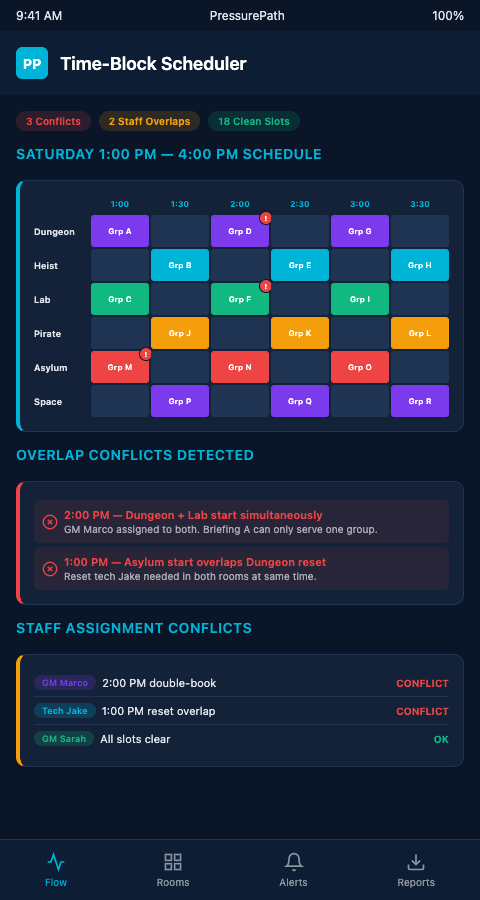
PressurePath translates this into an operational tool. When you enter your room-to-briefing-room mapping and your current booking cadence, the simulator identifies every start window where the briefing room or corridor node is over-committed and generates an adjusted start schedule. The adjustments are typically 3-8 minutes per affected slot — small enough not to affect total daily throughput, large enough to prevent the briefing collision cascade.
In practice, a 10-room franchise running 15-minute universal intervals across an 8-hour Saturday generates about 32 booking slots per room, or 320 total slot decisions across the day. PressurePath's cadence analysis typically flags 14-18 of those 320 as structurally collision-prone given the briefing room's 7-minute processing time and the reset team's 12-20 minute window range. Each flagged slot needs a 4-7 minute offset, not a wholesale schedule rewrite. The total cadence delta across the Saturday is typically 80-110 minutes of cumulative adjustment spread across 14-18 slots, which fits inside the day's existing booking envelope without reducing total room-hours sold. The critical point: these adjustments are made against a pressurized network model, so each offset is sized to the specific junction it relieves rather than applied uniformly across all slots.
Think of the booking grid as a pressurized pipe network feeding into a junction. Every group start is a fluid pulse entering the system. When two pulses arrive at the briefing room junction within a shorter interval than the junction's drainage time, pressure accumulates. The group gap workflow for spacing starts formalizes the drainage time calculation and builds it into the scheduling rules.
Theme parks apply a structurally equivalent solution. PMC research on fast-pass queue management documents how timed-entry staggering optimizes throughput and guest satisfaction by preventing simultaneous arrival clustering at ride queues. The booking platform equivalent — per-room buffer-time configuration and start-time offsets — gives escape room franchises the same tool.
Purpose-built escape room booking software like ROLLER supports buffer-time and stagger configuration, meaning the operational scheduling logic derived from flow analysis can be encoded directly into the booking system's constraints. Operators who've done the flow analysis first and configured their booking platform second consistently report fewer mid-shift schedule adjustments.
Three Common Staggering Mistakes at Multi-Room Scale
Mistake one: uniform intervals regardless of room complexity. A 12-minute reset room and a 22-minute reset room need different post-session buffer times. Using the same 15-minute interval for both means the high-complexity room is structurally guaranteed to cause a delay every time it runs. Tiered interval design — 15 minutes for standard rooms, 25 minutes for high-prop rooms — is the correct starting point.
Mistake two: ignoring zone boundaries. Groups from different zones may share different briefing rooms or no briefing room at all. Setting intervals based on total room count rather than per-zone shared assets over-constrains some zones and under-constrains others. Your start cadence should be designed at the zone level, not the venue level.
Mistake three: setting the interval at average reset time rather than 90th-percentile reset time. If your average reset takes 12 minutes but 10% of resets take 20 minutes, an interval set at 14 minutes will generate a collision 10% of the time. At 8 rooms running four sessions each on a Saturday, that's a guaranteed collision every shift. The 90th-percentile reset time is the correct planning basis.
The game master load balancing framework for 8-12 rooms directly affects interval design: when GMs are covering multiple zones, their transit time between zone responsibilities becomes a hidden interval constraint that standard booking cadence design ignores. Account for GM transit time as a flow variable, not a scheduling assumption.
The staggered entry management for peak weekends faces a structurally identical problem in a higher-volume environment, and the interval design principles translate cleanly — particularly the insight that tighter physical spaces require wider stagger intervals, not narrower ones.
Request a Cadence Audit
Franchise operators running 8 or more rooms who've built their booking cadence on universal intervals without a zone-level stagger analysis have almost certainly encoded briefing room collisions into their Saturday schedule. PressurePath can run a cadence audit against your existing booking grid and show you the specific interval adjustments that prevent those collisions — join the waitlist and specify your room count and current interval settings.
The cadence audit maps your current booking intervals against your briefing room processing time, reset team capacity, and corridor throughput at the zone level. The output is a per-zone stagger recommendation that preserves your total daily booking count while eliminating the structural collision windows your current universal interval creates. Operators who have completed the audit typically adjust 14-18 slots by 4-7 minutes each — small enough that guests and booking volume are unaffected, but large enough that the briefing room and corridor nodes no longer exceed their throughput capacity during peak Saturday hours. The adjusted cadence is directly configurable in booking platforms that support per-room buffer settings.