The Group-Gap Workflow: Spacing Starts to Prevent Bottlenecks
The Compression Problem at the Heart of Back-to-Back Bookings
The global escape room market reached $9.27 billion with 19,800+ facilities worldwide, growing at 17.5% CAGR according to GlobeNewswire's 2030 market forecast. That growth means more bookings per day, shorter gaps between cohorts, and intensifying pressure on shared assets. A 10-room franchise running peak Saturday capacity may have seven or eight groups cycling through the same briefing room over a six-hour window.
The compression problem is straightforward: when two or more groups exit parallel rooms within the same 10-minute window, the briefing room, photo wall, and lobby all receive simultaneous demand. The queue doesn't clear between waves — it accumulates. By mid-afternoon, a queue that should resolve in 8 minutes takes 22 minutes because each new wave arrives before the prior one finishes.
Queueing theory research from Columbia Business School establishes that bottlenecks form when arrival rate approaches service rate. At a 10-room franchise, the briefing room is typically the M/M/1 service node with the tightest capacity. Once arrival rate (groups finishing) approaches service rate (briefing room throughput), average wait grows nonlinearly — a small reduction in start-time gaps produces a disproportionately large queue impact.
Little's Law frames it precisely: L = λW, where L is average occupancy, λ is arrival rate, and W is average time in system. CFI's explanation of Little's Law confirms that reducing arrival bunching (λ) directly reduces system occupancy. The group-gap workflow is operationally how you control λ.
Designing Start-Time Gaps That Match Your Shared Asset Capacity
The group-gap workflow starts with a capacity audit of every shared asset: briefing room, reset station, photo wall, and lobby corridor. For each asset, you need two numbers — maximum concurrent group load and minimum clear time between cohorts.
A briefing room that seats 12 and requires 8 minutes for setup between cohorts can safely process one group per 8-minute slot. If two rooms finish simultaneously and each feeds a group of 6 into the briefing room, you've consumed the full 12-person capacity in one wave. The third room finishing 4 minutes later creates a queue before the room has cleared.
The pipe network analogy makes this concrete. Each shared asset is a junction in a pressurized system. Rooms upstream push fluid (groups) toward the junction. When two upstream pipes (parallel rooms) discharge simultaneously, junction pressure spikes. The group-gap workflow adds a controlled release delay — a pressure regulator — between upstream discharges so the junction never receives more flow than it can process.
Practically, this means staggering starts rather than clustering them. Instead of rooms 1, 3, 5, and 7 all starting at 2:00 PM, you offset them: room 1 at 2:00, room 3 at 2:12, room 5 at 2:24, room 7 at 2:36. Each room exits roughly 60-70 minutes later. Room 1 exits at ~3:05, room 3 at ~3:17, room 5 at ~3:29 — sequential briefing room entries rather than a simultaneous surge.
Timed entry ticketing research from Little Box Office found that staggered arrivals reduced congestion 40% and cut wait times from 45 minutes to under 5 minutes at high-volume venues. The mechanism is identical to what the group-gap workflow achieves for escape rooms.
PressurePath runs your actual Saturday booking grid through this analysis. Load your room start times, set your briefing room capacity parameters, and the simulator identifies which time windows have simultaneous discharge events across parallel rooms. The output is a pressure map — you see the 3:05 PM surge before Saturday arrives and can adjust starts on Tuesday.
Picture the full Saturday as an 8-hour pressure profile across 10 rooms. Without the group-gap workflow, a typical 10-room grid at 75% occupancy produces 5-7 discharge clusters — moments when two or more rooms release groups within a 6-minute window — and each cluster generates roughly 8-14 minutes of junction pressure at the briefing room or photo wall. Multiply that across 4 peak Saturdays per month and the franchise is absorbing 150-200 minutes of structurally induced queuing monthly, most of it invisible to the booking calendar.
The group-gap workflow replaces that invisible backlog with a set of 12 explicit start-time offsets on Monday morning, each sized to the exact junction it protects. The Saturday runs with the same 10 rooms, the same 4.58 average group size, and the same total bookable hours — just with pressure waves arriving sequentially rather than in colliding clusters. The workflow's discipline is pre-shift rather than real-time, which is what converts a chronic weekend stressor into a 15-minute Tuesday configuration task that repeats cleanly across the peak season.
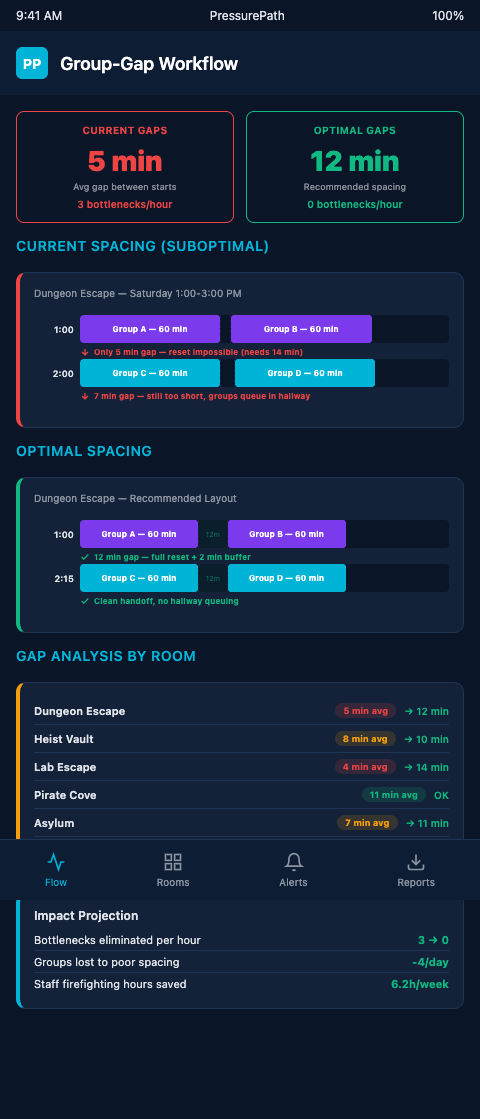
For time-block group starts, the group-gap framework adds a staffing dimension: staggered starts don't just smooth asset pressure, they spread the GM load across the shift rather than clustering all briefings at the same hour.
M/M/1 queue theory shows that as utilization ρ approaches 1.0, queuing delay grows without bound. The group-gap workflow is how you keep ρ below the danger zone at every shared asset in your franchise.
Calibrating Gaps for Different Room Types and Group Sizes
Standard gap recommendations (12–15 minutes between parallel starts) work as a baseline, but high-difficulty rooms and large group sizes both require longer gaps. A 10-person group takes longer to brief, longer to photograph, and longer to exit the lobby corridor. If your booking system treats a 10-person booking identically to a 4-person booking for gap purposes, the briefing room queue will tell you the difference.
Research on dynamic capacity allocation for group bookings shows that group arrival size affects seat fragmentation and that optimal allocation policies must account for size variability. For escape rooms, the equivalent is gap variability: 4-person groups might clear briefing in 7 minutes; 10-person groups routinely take 14.
A tiered gap model sets minimum start offsets by group size bracket: 0–4 people, 12-minute minimum gap between parallel starts; 5–8 people, 18-minute gap; 9+ people, 24-minute gap. When PressurePath flags a parallel booking contamination risk, it uses these tiered parameters to recommend which specific slots need offset adjustments.
Operators managing high-volume weekends can also learn from how haunted attractions handle group respacing. Mid-walkthrough respacing techniques address what to do when gaps collapse during live operation — a useful complement to the pre-shift group-gap workflow.
The group-gap workflow is ultimately a scheduling discipline: audit shared asset capacity, calculate minimum clear times, set start-time offsets by room type and group size, and review the resulting pressure map before each peak weekend. It takes 20 minutes to configure in PressurePath and prevents the 40-minute queue spirals that cost five-star reviews.
Why Multi-Room Operators Need This Before Peak Season
Multi-room escape room franchise operators often underestimate how quickly parallel room exits compound into briefing room chaos. The compounding effect is nonlinear: two rooms exiting simultaneously doubles briefing room load, but three rooms exiting within 8 minutes can triple or quadruple queue depth because the briefing room hasn't cleared the first cohort before the third arrives. That nonlinearity is why intuitive gap-setting fails — the difference between a 10-minute gap and a 6-minute gap isn't 40% more pressure, it's often 200% more queue time at the downstream junction.
PressurePath runs your Saturday grid as a live pressure test — enter your room count, booking pattern, and briefing room specs, and the simulation identifies every gap that's too tight before groups walk in. If your current scheduling leaves rooms 3, 5, and 7 all exiting within 8 minutes of each other on a Saturday afternoon, that's a fixable gap configuration, not an unavoidable operational hazard. Join the waitlist and bring your booking grid; the bottleneck prevention analysis runs immediately.