Best Practices for Re-Spacing Groups Mid-Walkthrough
What a Merged Group Looks Like to the Ninth Actor
By the time a merged group reaches Room 9 of a 14-room haunt, the actor there has no direct knowledge of what happened in Rooms 4 and 5. What she observes is a group of eleven people arriving in her zone at 8:45 PM on a Saturday with no gap behind them. She can see the spacing failure. She cannot see the cause — a scare in Room 4 that startled the first group backward into the second group's lead position, causing a partial merge that then fully consolidated in the narrow Clown Alley passage between Rooms 5 and 6.
Without that upstream context, the Room 9 actor has two options: fire her scare into a compromised strike zone, or hold and log a missed beat. Neither option is good. The correct response — hold the group briefly at a pre-scare element while a runner re-gaps the merged group — requires that someone upstream has already detected the merge, communicated it forward, and deployed the runner. In most haunted attraction operations, that chain doesn't exist.
Nevermore Haunt's research on actor safety identifies a specific cause of group merge: scaring directly in front of a group causes the lead person to step backward into the group behind them. Lateral scares preserve spacing. But even with perfect lateral scare execution, groups merge from corridor compression, chaperone behavior, and guest movement variation — and when they do, the downstream response chain needs to function.
HAA's 2024 Haunt Industry Report cites group merge as a specific pain point in peak-night crowd management — operators know it happens, few have systematic protocols for detecting and correcting it mid-walkthrough.
The Detection-Response Chain for Mid-Walkthrough Spacing Failures
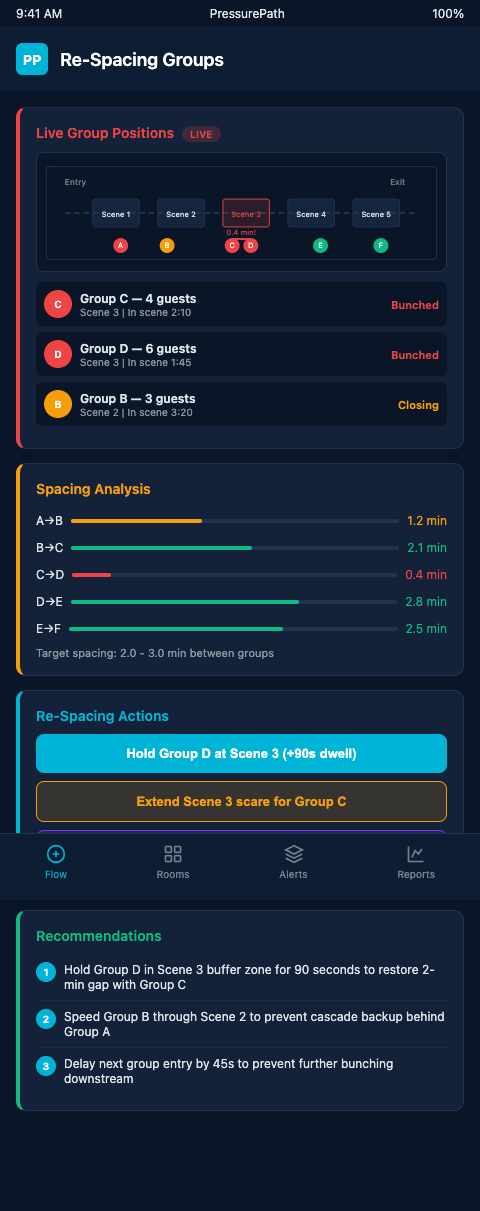
Re-spacing a merged group mid-walkthrough requires four things: detection of the merge at or near the point it occurs, a communication channel to forward zones, a physical intervention protocol that recovers spacing without disrupting the guest experience, and a handoff signal that tells downstream actors the group is still re-spacing.
Detection is the hardest element. Elia.io's visitor flow management research describes crowd flow as a living system requiring ongoing adjustment, not a one-time configuration — and detection is what makes ongoing adjustment possible. Without a mechanism to identify that a specific group has merged, the information reaches downstream actors too late or not at all.
The pressurized-water-in-pipes framework helps here: in a pipe system, a compression event at one section creates a pressure wave that travels downstream at a predictable rate. In a haunted attraction, a group merge in Room 5 reaches Room 9 approximately equal to the walk time between them — typically 4-8 minutes in a 14-room haunt with a standard floor plan. The detection window is that transit time. If the merge is detected at Room 5, the downstream actor at Room 9 has up to 8 minutes to receive the signal and prepare a re-spacing hold.
G. Keith Still's PhD crowd dynamics research shows Fruin density-flow curves: re-spacing groups before they exceed 2-3 people per square meter restores throughput to pre-compression levels. That's the intervention threshold — when a merged group approaches 2-3 per square meter, the re-spacing hold is required. Above that, the group has fully consolidated and a brief hold in a pre-scare position is no longer sufficient to recover safe spacing without a manual runner intervention.
Fluid dynamics research on pedestrian flow at constrictions from arXiv shows that pedestrian flow at narrow points oscillates — active intervention disrupts compression cycles. The haunt implication: a runner stationed at a known compression corridor can actively disrupt the consolidation cycle by slowing the second group before they reach the pinch-point, rather than trying to re-gap after the merge has completed.
The re-spacing protocol that addresses this has three tiers. Tier 1 (early detection, 8+ minutes to downstream actor): the merging group is detected at the pinch-point, a forward alert goes to Rooms 7-9, and each actor adds 30 seconds to their hold timing to let the re-spacing passive recovery work. Tier 2 (mid-detection, 4-7 minutes): the merged group is past the pinch-point but not yet at the next scare chamber; a runner intercepts at the next pre-scare element and physically re-gaps the group. Tier 3 (late detection, under 4 minutes): the actor at the next zone receives a direct hold signal and withholds the scare until the group has self-re-spaced inside the room or a runner can reach them.
ESI Technologies' real-time monitoring for event spaces shows that IoT sensor platforms detect density spikes and alert staff before group merges become safety issues — the technology-enabled version of Tier 1 detection. Without sensors, the detection chain depends on actor observation and radio discipline at each zone.
The pacing gaps that preserve scare delivery built into the pre-season flow model are the first layer of protection. When those gaps fail — when peak-night density collapses them — the re-spacing protocol is the recovery mechanism. PressurePath identifies which zones are most likely to experience merge events at specific ticket volumes, so the detection chain can be pre-positioned at the right rooms rather than deployed reactively after the merge has already traveled downstream.
Advanced Recovery: Bypass Lanes and Group Split Protocols
When a merged group is too large for a hold-and-re-gap approach, the only full recovery is a group split — dividing the merged group into two properly spaced groups and sending them through with appropriate delay. This requires a physical split point in the floor plan: a location where two paths diverge and can carry separate groups at separately controlled intervals.
Attractions that weren't designed with split points need to find functional equivalents — a pre-scare element wide enough to hold one subgroup while another advances, a staff-attended gate at a corridor junction, or a low-congestion room that can hold the second subgroup at a timed hold. The peak-night warning signs detection model identifies which rooms are most likely merge accumulation points, which is also the right place to position a functional split point.
Refreshing bypass station design from children's museum exhibit design offers a cross-context technique: stations positioned to pull high-density groups off the main flow path and into a side experience, reducing the density on the primary path. Applied to haunted attractions, a "bypass hold" element — a short actor performance or display positioned off the main corridor at a known merge accumulation point — gives floor staff a tool to divert one subgroup off the main path while the other advances. When the diversion completes, both subgroups resume the main path with recovered spacing.
Sithon's actor safety guidance for haunts confirms that real-time actor communication enables mid-walkthrough spacing corrections — the communication infrastructure is as important as the physical split point. A floor manager who can't reach Room 5 staff in real time can't deploy Tier 1 detection effectively regardless of how good the re-spacing protocol is on paper.
Build Your Re-Spacing Response Before Peak Night Reveals the Merge
Re-spacing is not a skill floor teams develop through experience — it is a protocol they execute when the detection chain fires. Teams that rely on experience end up executing Tier 3 interventions (late-detection direct holds) for what should have been Tier 1 corrections (early passive adjustments). The difference in scare preservation across a 14-room haunt is roughly 6-10 salvaged beats per peak Saturday, depending on how many merge events the ticket volume produces. At 420 tickets, a well-trained re-spacing response typically prevents three cascade events from degrading scare quality in Rooms 7 through 11 — which is exactly where the guest-experience reviews on Sunday morning will concentrate.
The pre-requisite is a density model that tells you which specific rooms will experience merge events at tonight's ticket volume, and a briefing document that positions runner coverage, radio cadence, and hold protocols at those specific rooms before doors open. Neither element requires sensor infrastructure. Both require that the pacing model has been run against the specific ticket count and batch configuration you are operating tonight, and that the briefing deck has been updated before the pre-show.
PressurePath identifies the rooms in your haunted attraction where group merges are most likely at peak ticket volumes and pre-positions the detection and response protocol at those zones. Stop discovering merged groups at Room 9 when the problem started at Room 5. Join the waitlist and build your mid-walkthrough re-spacing system from the density model outward.