The Peak-Night Surge: Five Warning Signs It's Already Broken
The New Year's Crowd That Took Thirty Minutes to Go Wrong
A December 2025 EPCOT incident captured on video showed the UK Pavilion bottleneck creating a body-to-body standstill within 30 minutes of peak arrival — guests unable to move forward, backward, or laterally, with no clear egress path visible from the middle of the crowd. Witnesses said nothing looked dangerous at the 10-minute mark. At the 30-minute mark, it was a serious safety situation.
The failure was not the density. It was the absence of any recognized warning signals in the staff response during the 20-minute window between "this is getting crowded" and "this is an incident." The crowd density physics that produced the EPCOT standstill produce the same result in your Clown Alley corridor at 9:47 PM on peak Saturday. The warning signals appear in the same sequence. Whether your team recognizes them in time is the variable.
Peak-night surge breakdowns in haunted attractions follow a predictable progression. Attendance data confirms the pattern: 71.8% of haunted attraction visits fall on Friday and Saturday nights, and the arrivals cluster in a 90-minute surge window rather than distributing evenly across the operating period. That cluster creates predictable surge conditions that look identical every year — and that produce the same five warning signs on the floor before density reaches functional failure.
The value of recognizing these signs is a response window. Warning Sign 1 gives your team 45 minutes. Warning Sign 5 gives them roughly 5 minutes. After Sign 5, the surge is already a crisis and the responses available to you are emergency protocols rather than flow interventions.
The Five Warning Signs, In Order
Sign 1: Dispatch staff starts improvising. Your entry dispatch staff has a briefed interval — groups every 90 seconds or every 2 minutes, depending on your schedule. When floor density rises and groups are visibly backing up in the approach corridor, dispatch staff instinctively begin adding a few seconds to each interval without authorization. They are reading the pressure correctly. Their improvisation is the first signal that your flow model's predictions are materializing.
This is Warning Sign 1 because it is the earliest behavioral indicator and the furthest from crisis. At this point, dispatch interval adjustment is still a clean solution. If your operation has a briefed variable-interval schedule based on your pressure model, the staff is executing it. If it does not, they are doing the right thing informally — and you need to get ahead of them with a formal protocol before the improvisation diverges from what the pressure requires.
Sign 2: Actors stop executing and start watching. Your Clown Alley actor is performing. Then they execute a scare, reset, and instead of immediately re-setting for the next group, they pause at their position and look toward the chamber entrance for longer than the reset window. They are reading the incoming flow and hesitating. The group density they are seeing is outside their rehearsed parameters — too large, too compressed, or moving at a speed that conflicts with their timing.
Actor hesitation is a floor-level density sensor. When actors across multiple positions start showing this behavior within the same 10-minute window, your surge is moving through the attraction. A high-density crowd state judgment model classifies this zone as a high-density condition approaching the threshold where density-driven crowd behavior begins to override individual movement decisions. Your actors are experiencing it directly.
Sign 3: Guests are making themselves small. This is the physical manifestation of Fruin LOS D — guests begin moving with their shoulders turned, walking in single file through spaces designed for two abreast, stepping against walls to create passing room for groups moving in the opposite direction through transition corridors. They are adapting their movement to density they can feel.
At this sign, your corridor widths are functionally below the design specification under real crowd behavior. The space exists on the blueprint but not in the actual traffic pattern.
Sign 4: Staff in transition corridors start manually spacing groups. Floor staff who were briefed to monitor safety begin physically holding groups at chamber thresholds — stepping in front of a group to slow their entry — without a formal signal from dispatch. Like actor hesitation, this is instinctive density management. The difference is that it introduces human judgment into a spacing problem that should be governed by a briefed protocol.
Manual floor spacing by individual staff members is not consistent. One staff member holds groups for 15 seconds. Another holds them for 45. The inconsistency creates waves of alternating over-spacing and under-spacing that propagate through the attraction, making the surge worse in some sections while temporarily relieving it in others.
Sign 5: The previous group is still visible to the entering group at the scare position. This is the terminal diagnostic for fear state collapse. When the exiting tail of one group is still visible to the entering front of the next group at your Clown Alley or Butcher Room position, your sightline separation has failed completely. Every scare from this point forward will land on a dual-group audience, not an isolated victim. The peak-night surge has compromised your scares at the chamber level.
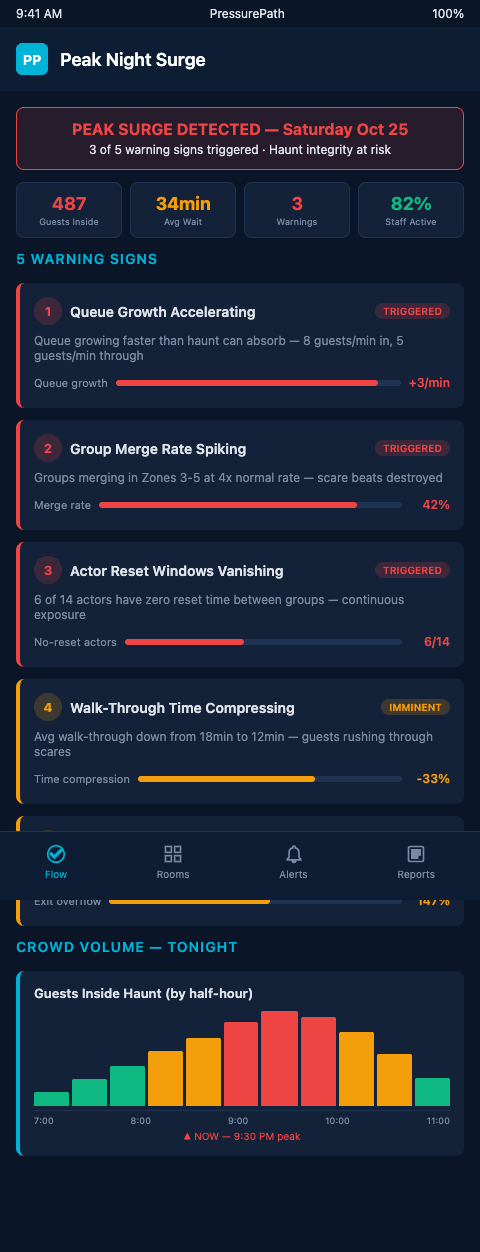
PressurePath maps these five signs as operational thresholds on your peak-night density forecast. Warning Sign 1 corresponds to approximately 80% of your corridor LOS threshold. Warning Sign 5 corresponds to the point where chamber sightline separation fails. The simulation shows you when each threshold will be crossed during your peak window — 45 minutes before Sign 1 appears on the floor, not 5 minutes before Sign 5.
Advanced Tactics: Response Protocols for Each Warning Sign
Recognizing a warning sign without a briefed response protocol is only half the intervention. Floor teams need a specific action tied to each sign — one they can execute without consulting a manager or waiting for authorization.
Sign 1 Response: Activate the peak dispatch protocol — shift from standard interval to peak interval (add 15-20 seconds per group) and notify the supervisor that surge conditions are beginning. No guest communication required. This is invisible to the queue.
Sign 2 Response: Radio the Clown Alley and Butcher Room positions to confirm they are seeing compressed groups. If confirmed, signal dispatch to hold one additional cycle — a single empty interval — to create a gap in the pipeline that will propagate downstream and give actors a clean reset opportunity.
Sign 3 Response: Open any designated overflow corridor or bypass path that reduces traffic through the primary bottleneck corridors. If no bypass exists, this sign becomes the signal to add a second staff member to the narrowest corridor to physically guide movement and prevent cluster formation.
Sign 4 Response: Centralize the manual spacing decision — remove it from individual floor staff judgment and communicate a specific hold duration (20 seconds at every chamber threshold) via radio to all positions simultaneously. Consistent holds are far better than improvised ones.
Sign 5 Response: Halt dispatch entirely for two dispatch cycles. The two-cycle gap propagates through the attraction in 3-4 minutes, creating a physical separation between the compressed groups and allowing the attraction to reset to functional sightline spacing. This is the hardest call because it produces visible queue movement slowdown, but it is the only intervention that actually fixes the scare delivery problem Sign 5 represents.
Detecting skipped stations and flow irregularities is a structurally parallel skill — identifying where the expected crowd pattern has broken down from observable floor behavior rather than from instrumented data. The behavioral reading skills transfer directly to haunt surge detection.
When a surge has already created spacing violations, mid-walkthrough respacing protocols give floor teams a structured intervention to restore chamber separation without stopping the attraction entirely.
Brief the Signs Before October Opens
None of this works if floor staff are seeing these signals for the first time on peak Saturday. The briefing happens in September, with specific scenarios, specific response protocols, and a shared vocabulary that the entire floor team uses when they talk to each other about what they are observing.
PressurePath's peak-night forecast gives haunted attraction designers the timeline to run through in the briefing — showing staff exactly when Warning Signs 1 through 5 are expected to appear and what the response sequence is. Floor teams who have internalized that timeline make better real-time decisions because the situation they are managing on October 28th is not a surprise. They have already seen it on a chart.
Build the warning sign briefing from the flow model, not from a general safety talk. The specifics — which corridor shows Sign 3 first, which actor position shows Sign 2 earliest, what minute the forecast shows peak pressure — make the briefing real. Real briefings produce prepared teams.
There is also a post-night debrief value. After each peak-Friday or peak-Saturday run, compare the actual warning sign timeline your floor team observed against the flow model's forecast. When they match, your model is calibrated and your team is reading the signs correctly. When they diverge — when Sign 3 appeared earlier than predicted, or Sign 2 appeared at a different position than expected — you have new data that refines the model for the following weekend.
Over a 3-week October run, three rounds of forecast-versus-actual comparison produce a model that is significantly more accurate by closing weekend than it was on opening night. The briefing and the debrief together are what turn a one-time pressure check into an operational system that your haunt improves against each season. Join the waitlist to get the warning sign timeline your floor team will rehearse in September, before the first peak-Saturday surge hits Clown Alley.