Preventing Cross-Room Contamination in Parallel Booking Slots
How Parallel Bookings Contaminate Each Other Without Overlapping
Venues implementing booking overlap prevention report 8–12% improvement in resource utilization, according to myshyft.com's research on overlapping appointment prevention. That statistic reflects calendar-level overlap — two bookings competing for the same room at the same time. Cross-room contamination in parallel booking slots is a different failure mode entirely: the bookings don't overlap on the calendar, but they interfere in the physical and operational space they share.
The mechanism is straightforward. Room 4 books a 2:00 PM start. Room 6 books a 2:05 PM start. Both rooms exit into the same reset corridor at approximately 3:05 and 3:10 PM. The reset team begins room 4's turnover at 3:05. Room 6's group exits at 3:10 and needs the same corridor to reach the photo wall. The corridor is blocked. Room 6's group waits 4 minutes. The photo wall backs up. The 3:30 PM group in room 6 starts 4 minutes late, which pushes their exit to 4:35 PM, which collides with the 4:30 PM start in room 8.
The original calendar showed no overlap. But the domino ran four rooms deep before anyone caught it.
Agent-based simulation research from ScienceDirect shows that corridor interference between groups propagates delays through connected nodes — exactly the pattern described above. The simulation literature calls this "group bleed-over"; in escape room operations, it's cross-room contamination.
Modeling Contamination Paths in a 10-Room Franchise
Cross-room contamination follows predictable paths. Every 10-room franchise has a set of room pairings where contamination risk is structurally elevated: rooms that share a reset corridor, rooms that share a photo wall exit, rooms that feed into the same briefing room, and rooms whose exit timing is naturally synchronized by identical session durations.
The first step in preventing contamination is mapping those paths. Draw your floor plan as a directed graph: each room is a node, each shared asset (reset corridor, briefing room, photo wall, lobby) is a junction node. Each directed edge represents the flow path a group takes from room exit to lobby departure. Where two rooms' exit paths share a junction node — even briefly — there's a contamination risk if their session timing overlaps.
Industrial research on shared production line contamination from LKMixer frames the principle directly: shared-line contamination occurs when leftover material from the prior cycle shifts into the next one. For escape room operations, the "leftover material" is a group occupying a corridor, lobby, or photo wall position that the next group's session flow requires to be clear.
INFORMS pedestrian flow research confirms that when two pedestrian flows share a corridor without separation, throughput degrades sharply for both flows. The 4-minute corridor blockage in the room 4 / room 6 example above isn't an edge case — it's the predictable outcome when two groups are routed through the same corridor within the same 10-minute window.
PressurePath models your 10-room franchise as a pressurized pipe network where each group is a unit of fluid moving through the system. Cross-room contamination is visible in the simulation as two pressure waves arriving at the same junction node simultaneously. The simulator identifies every contamination-risk pairing in your Saturday booking grid and outputs the minimum start-time separation needed to prevent each interference.
A typical 10-room Saturday grid at 75% utilization surfaces 6-12 contamination-risk pairings per peak day, each costing 3-8 minutes of cascade latency when left uncorrected. Across 4 peak Saturdays monthly, that's roughly 90-150 minutes of structurally embedded contamination delay — most of which shows up as GM firefighting rather than as any single traceable booking error.
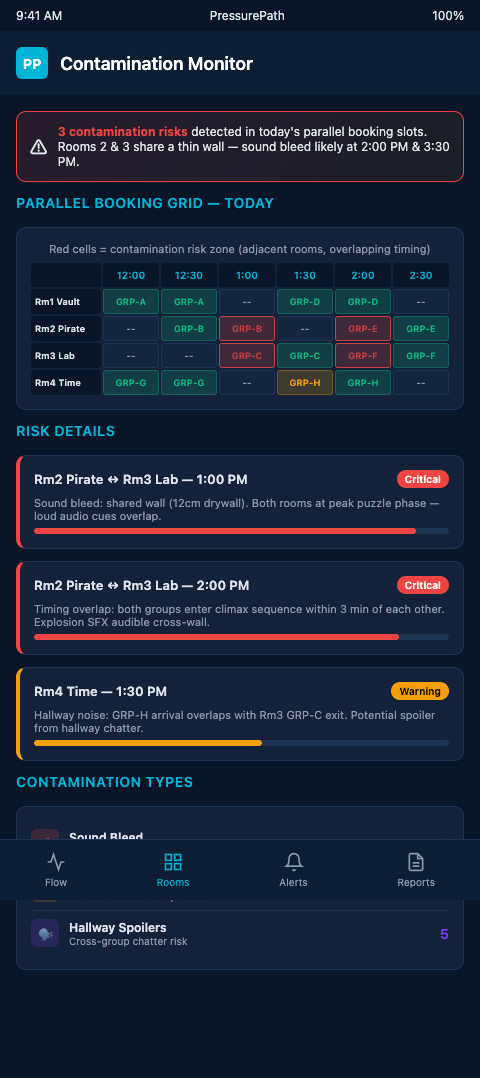
For operators who have identified specific contamination pairings but haven't calibrated their group gap spacing, the gap sizing should be derived from the contamination path analysis: if rooms 4 and 6 share a 40-foot reset corridor that takes 3 minutes to transit, the minimum safe gap between their starts is the transit time plus the reset team's room 4 clearance window — typically 12–16 minutes total, not the standard 5-minute calendar buffer.
Practical Contamination Prevention Protocols
Once contamination paths are mapped, prevention operates at three levels:
Scheduling prevention: Start-time offsets between contamination-paired rooms, derived from your floor plan's shared-asset dwell times. This is the highest-leverage intervention — it prevents contamination before any group walks in.
Physical separation: Where contamination-paired rooms share a corridor, define which groups use which corridor path during the exit window. Even a simple directional sign — "Room 4 exits left, Room 6 exits right" — separates flows that a single shared corridor would otherwise mix.
Reset routing priority: When two contamination-paired rooms exit close enough in time that the reset team must handle both, define which room gets priority based on which has the earlier next booking. The reset team shouldn't be making that call in real time — the priority protocol should be in the pre-shift brief.
Automated calendar conflict detection is documented to yield up to 87% fewer appointment overlaps. The mechanism for contamination prevention is analogous but operates at the asset level rather than the booking level: conflict detection for shared corridor usage rather than shared room usage.
TeamUp's documentation on parallel event scheduling describes calendar rules that prevent overlapping reservations from competing for the same resource. Extending that logic to contamination prevention means adding a second layer of conflict detection: not just "is the room booked twice?" but "will these two bookings share a downstream asset within an unsafe time window?"
Peak-hour throughput ceiling analysis connects to contamination prevention at the system level — when your franchise is operating near its throughput ceiling during Saturday afternoon peak hours, contamination-paired rooms are the most dangerous scheduling decisions because there's no buffer capacity to absorb the cascade.
For operators who manage high-volume peak weekends at attractions where contamination between groups is a chronic operational problem, staggered entry protocols at haunted attractions offer a reference model for how physical staggering between groups prevents cross-group interference at shared passage points.
Perfect Venue's booking management research found that venues using automation report 60% fewer scheduling conflicts. For escape room franchises, "automation" at the contamination level means a pacing simulator that flags contamination risks in the booking grid before the shift — which is exactly what PressurePath does when you load your Saturday configuration.
From Contamination Awareness to Contamination Prevention
Multi-room escape room franchise operators who recognize the cross-room contamination pattern in their Saturday debrief data — the cascade that ran from room 4 through room 6 and into room 8's start time — now have a structural framework for preventing it. Map your contamination paths, calculate minimum start-time separations from your shared-asset transit times, and verify the gaps in your booking grid before each peak weekend. PressurePath runs the contamination analysis from your booking grid and floor plan configuration, identifies every high-risk pairing for the coming Saturday, and outputs the scheduling adjustments needed. If your franchise currently experiences unexplained cascade delays on Saturday afternoons that don't trace to any individual room running long, cross-room contamination is the likely cause. Join the waitlist and bring your floor plan; the contamination path analysis runs in a single session.