Best Practices for Staggered Entry on Peak Weekends
When Staggered Entry Creates the Problem It Was Supposed to Solve
A haunted attraction running 420 tickets on the last Saturday of October staggered its entry groups every seven minutes. The floor manager had used that interval since opening week and it had worked fine for 250-ticket nights. By 9:15 PM, the Clown Alley corridor had three groups stacked within 40 feet of each other. The stagger interval hadn't changed — the crowd density had. At 420 tickets, seven-minute intervals weren't enough to maintain group separation through the attraction's two slowest rooms.
This is the structural flaw in most staggered entry practices: the interval gets set once, usually based on gut instinct or the previous season's rough performance, and then it doesn't change as ticket volume scales. TicketFairy's festival crowd management research confirms that staggered entry without real-time monitoring produces ingress surges — the stagger addresses entry bottlenecks but leaves interior density to accumulate unchecked.
HauntPay's 2024 industry report found that 67% of haunts say tickets account for 76-100% of revenue, which means peak Saturday crowd levels are as high as they can be pushed. At those ticket volumes, a stagger interval calculated for a lighter night will fail systematically — it's a predictable consequence of applying the wrong input to a fixed formula.
Designing Stagger Intervals That Hold Under Peak Density
Staggered entry works when the interval matches the throughput constraints of the slowest rooms inside the attraction — not just the entry gate throughput. A group released every seven minutes at the gate will arrive at Room 4 at the same time as the group released seven minutes earlier if Room 4 has a 10-minute average transit time. The stagger collapses exactly where actor timing is most vulnerable.
The corrective framework treats the attraction as pressurized pipes: each room has a flow capacity. When groups enter faster than the slowest room can pass them through, pressure builds at that bottleneck. The stagger interval at the entry gate needs to be calibrated to the slowest room's transit time, not the gate's comfortable dispatch pace. In fluid terms, the pipe diameter is set by the narrowest section — not the inlet.
For most haunted attractions, this means modeling three variables before setting the peak-weekend stagger interval. First, room-by-room average transit time under different group sizes. A six-person group moves through a 60-foot dark corridor faster than a twelve-person group, but that difference compounds across eight rooms. Second, pinch-point accumulation rate — the rooms or corridors where groups merge because transit time exceeds stagger interval. Third, actor strike zone threshold — the minimum clear distance a group needs to maintain so the next zone actor has a usable scare window.
Ticketchainer's event management analysis shows batch-processing cuts entry time by 80% and staggered windows control peak arrivals — but that metric measures entry efficiency, not interior flow preservation. The batch size and interval that optimizes gate throughput often conflicts with the interval that protects interior spacing.
TicketLeap's timed ticketing best practices recommend buffer windows between slots to prevent door pile-ups. For haunts, those buffer windows should be calculated from interior flow constraints, not entry gate preferences. A 12-minute buffer looks excessive at the gate and exactly right at the Butcher Room.
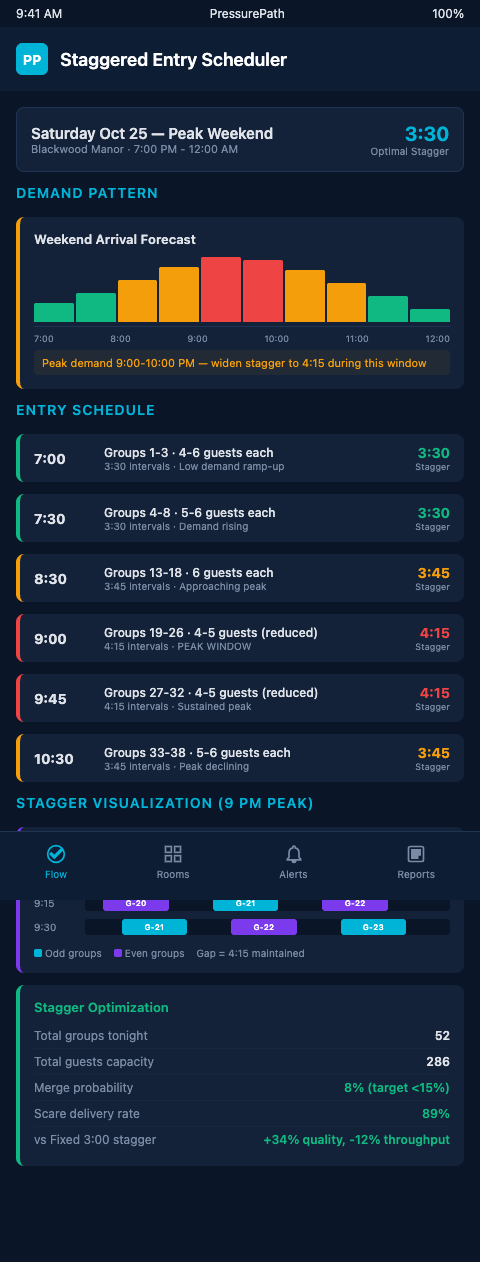
PressurePath models this across every room simultaneously. The peak-night warning signs that flash during simulation — compressed groups in specific corridors at specific crowd volumes — tell you exactly where your current stagger interval fails and what interval would preserve actor timing at 350, 400, and 450 ticket levels. The output is a tiered interval table: light crowd, moderate crowd, peak crowd, each with its own recommended stagger.
The pre-opening pressure check feeds that table directly. Before doors open, the model shows which room will be the first to accumulate pressure at tonight's ticket count and what batch interval prevents it from reaching actor-compression risk. That's the interval you use — not the one that felt right in week two.
Advanced Entry Staggering: Parallel Booking and Variable Intervals
Standard staggered entry uses a fixed interval throughout the night. Variable-interval staggering adjusts the release window based on real-time interior density — releasing the next group when the previous group has cleared the slowest room, rather than on a fixed timer. This is operationally more demanding but produces significantly better actor timing preservation on nights where crowd behavior is uneven.
Little Box Office's research on timed entry ticketing shows venues distributing visitors evenly cut peak-density spikes and shorten wait times — but "evenly" means matching interior capacity, not just spreading admission across the night. Variable intervals get closer to that ideal than fixed intervals on peak Saturdays.
For attractions offering parallel booking — multiple experience types with separate entry points — staggered entry must account for the possibility that parallel groups converge inside the attraction. A booking system that staggers each entry type independently can still create interior density spikes if both streams funnel into a shared corridor at the same time.
Wave-staggered entry principles from children's museum design offer a useful cross-context framework here: releasing groups in timed waves with a density ceiling per wave rather than a fixed count per slot. Applied to haunts, this means the entry stagger interval expands automatically when interior density readings exceed the safe threshold for the next room — groups hold at the gate rather than entering a compromised zone.
Brushfire's timed entry tips recommend adding buffer intervals between waves and using real-time monitoring to adjust. For haunted attractions, that real-time monitoring feeds back into the stagger interval directly: when the pacing model shows compression building in Rooms 4-6, the entry gate widens the batch interval without a manager needing to calculate it manually.
The operational goal on peak weekends isn't to process 450 people as fast as possible through the entry gate. It's to protect each actor's strike zone from the first group to the last. Stagger intervals designed from interior flow constraints — rather than gate preferences — are what make that possible at full capacity.
One practical refinement worth implementing before opening night: pair each stagger tier with a defined group-size cap. A 10-minute stagger interval at 420 tickets works for groups averaging 8 people, but the same interval breaks down when a pre-sold party booking sends a 14-person group into the attraction at 9:05 PM. Building a group-cap rule into the booking layer — groups above 10 people either split or receive a widened entry interval automatically — prevents a single oversized batch from absorbing the spacing buffer your stagger interval was designed to provide.
At 450 tickets on a peak Saturday, that cap rule typically prevents 3-5 interior compression events per night, each of which would otherwise compromise actor timing across two to three rooms downstream. The rule lives in the booking system; the stagger interval lives in the floor manager's cue sheet; the pacing model validates both against the same room-by-room density forecast before doors open.
Build Your Peak Interval Table Before Opening Night
The interval table isn't a single number. It's a schedule: 8-minute stagger at 275 tickets, 10-minute stagger at 350, 12-minute stagger at 420, 14-minute stagger at 475 — each tier tied to specific room-by-room density forecasts and each calibrated to the slowest corridor's transit time at that ticket volume. When your floor manager walks in Friday afternoon and sees 398 tickets confirmed, they activate the 10-minute tier without consulting the operator. When Saturday's ticket count hits 451 by 7:30 PM, the 14-minute tier activates automatically and the briefing deck updates the compression thresholds each zone actor is watching for. That's operational infrastructure, not nightly improvisation — and it's what turns stagger interval design from a gut estimate into a repeatable playbook across 40 peak nights.
PressurePath calculates the stagger intervals that preserve actor timing at each ticket volume tier your haunted attraction will run this season. The model identifies your slowest rooms, your pinch-point accumulation rate, and the batch size that keeps group spacing intact from entry to exit. Join the waitlist and arrive at opening night with a tiered interval table instead of a gut estimate.