Why Your 200-Seat Immersive Show Can't Use Proscenium Logic
The Director Who Blocked a 200-Seat Immersive Show Like a Play
The director came from 15 years of proscenium work. The 200-seat immersive production was their first non-proscenium commission. They blocked Act 2's climactic scene assuming the full audience would be in the warehouse's main hall — because in a proscenium show, the full audience is always exactly where it's supposed to be. On opening night, 94 viewers were in the main hall. 68 were in the adjoining industrial corridor following a secondary performer. 38 were in the basement kitchen watching a domestic scene they'd decided was more interesting.
The climactic scene was designed for 200. It received 94. The director's arc — three months of rehearsal, a precisely blocked ensemble sequence, a specific emotional covenant with the audience — collapsed at the moment it was most needed.
This is not a story about a bad director. The blocking of the climactic scene was strong — the ensemble sequence, the sightlines, the staging all worked for 94 viewers. The failure was a single proscenium assumption: that the director controls audience position by controlling the stage. At 200 seats in a non-proscenium venue, audience position is controlled by the venue's pressure architecture — the pull values of competing scenes, the corridor routing to the main hall, the cue-exit timing of the preceding scenes that were supposed to deliver 200 viewers to the main hall in time for the climax. None of those variables had been modeled. The director had been rehearsing the climactic scene in isolation, at full cast, without any simulation of how the 200-seat pressure network would distribute the audience before the scene opened.
Punchdrunk's five-story warehouse model makes proscenium-derived blocking inapplicable. At 200 seats across a multi-story venue, the audience is never where proscenium logic predicts it will be, because proscenium logic has no model for voluntary audience routing. The Drama Teacher's analysis of promenade staging is precise on this point: promenade staging fundamentally inverts proscenium logic by mobilizing the audience, replacing the fixed-audience/moving-action model with a fixed-action/moving-audience model.
The Grand View Research projection of 26.3% CAGR for the immersive entertainment market reflects rapid adoption of non-proscenium formats. The productions entering this market with proscenium-trained directors face a specific failure mode that is structurally invisible until opening night.
The Five Ways Proscenium Logic Fails at 200 Seats
Sightline assumptions collapse. Proscenium blocking designs for a specific sightline geometry — the audience is in front, the stage is elevated, the sightlines are calculable from the seating plan. At 200 seats in a non-proscenium space, there is no sightline geometry. There are 200 individual viewer positions distributed across a three-dimensional space, each with a different angle, distance, and occlusion profile. Blocking that produces clean sightlines for a proscenium house produces sightline failures for the majority of viewers in a warehouse or promenade format.
Blocking arc integrity depends on density assumptions. Every scene in a proscenium show is blocked for 200 viewers in the house. Every scene in a 200-seat immersive show is blocked for a density assumption that may or may not be accurate at performance time. Directors who don't model audience pressure distribution before rehearsal are blocking scenes for an audience count they have no mechanism to guarantee.
Cue timing designed for passive audiences fails with active ones. Proscenium cue timing assumes the audience is stationary. Scene transitions fire on technical cues and the audience waits. In a 200-seat immersive show, the audience is in motion during scene transitions. Cues designed for a passive audience produce timing failures when the moving audience has not reached the next scene's location when the cue fires.
The corridor is not backstage — it is the second stage. Proscenium logic treats everything except the stage as backstage or front-of-house. In a non-proscenium immersive show, every corridor is a performance and a routing mechanism simultaneously. Directors who don't design their corridors as actively as their scenes lose control of audience distribution in the transition windows.
Ensemble coordination assumes co-location. Proscenium ensemble scenes work because all performers are on the same stage. In a 200-seat immersive show, ensemble coordination across multi-room scenes requires precision timing that has no analogue in proscenium blocking — and that precision timing fails when audience pressure has not distributed performers' witness groups correctly.
Interval timing assumes passive audience return. Proscenium intervals work on a simple schedule: the house lights come up, the audience leaves to the lobby, the house lights warn, the audience returns to their seats. In a 200-seat immersive show, interval management is a redistribution event — it is the opportunity to reset audience pressure across the venue before Act 2. Directors with proscenium training often treat intervals as simple breaks rather than redistribution mechanisms, and Act 2 opens with the same uneven distribution that Act 1 ended with.
Site-specific staging fundamentally requires abandoning proscenium-derived sightline assumptions — the JHUP Theatre Topics analysis is a structural argument, not a stylistic preference. At 200 seats in a non-proscenium venue, the sightline and density assumptions built into proscenium blocking logic create predictable failures across all five dimensions above.
PressurePath models 200-seat immersive productions specifically because the pressure dynamics at 200 seats are qualitatively different from smaller immersive work. The simulation identifies the scenes where proscenium-logic blocking assumptions will produce density failures, and outputs the non-proscenium pacing adjustments that account for voluntary audience routing, corridor transit time, and distributed sightline requirements.
The 200-seat threshold is significant beyond scale: it is the audience size at which the law-of-large-numbers begins to work against the director. In a 30-seat promenade production, even without flow modeling, the relatively small audience tends to distribute more evenly across a smaller venue — there are not enough viewers to simultaneously pack one room and starve two others. At 200 seats, the same unmanaged distribution produces massive density failures because 200 viewers following pull signals without routing design concentrate at 2–3 dominant scenes while 6–8 other scenes receive single-digit counts. The canonical Wikipedia reference on blocking defines blocking as the precise staging of actor movements — at 200 seats, the director must extend that definition to include the precise staging of audience movements, or the actor's blocking becomes a performance for whoever happened to be in the room.
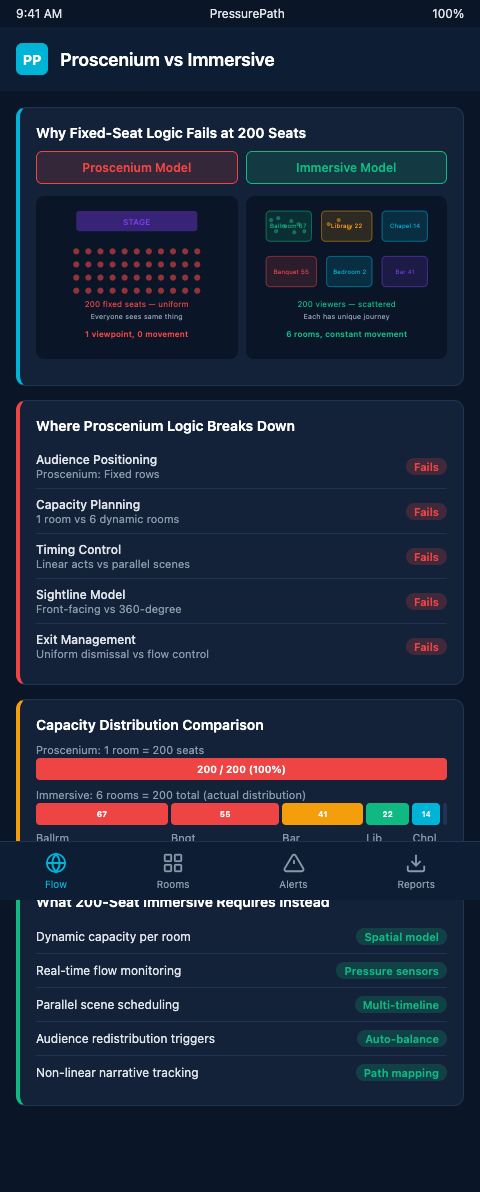
The pressurized-water framework makes the failure mode visible: a 200-seat immersive venue is a pipe network with 200 units of pressure that the director must route deliberately. Proscenium logic assumes all 200 units are in one chamber. Non-proscenium reality distributes those 200 units across 8–12 chambers according to pull values, corridor resistance, and cue-exit timing. The director who doesn't model that distribution is producing a show for an audience that won't be where the blocking needs them.
Gensler's analysis of static single-use proscenium venues notes that these formats are becoming obsolete as immersive formats scale — which means the production industry is moving toward formats where spatial pacing discipline is non-negotiable. The spatial blocking foundations for non-linear theater post covers the non-proscenium blocking fundamentals that replace proscenium logic at 200 seats. For productions where corridor design fails to route the audience to the right scenes, the queue-free scene entry workflow provides the corridor management system that supports voluntary routing at scale. The same structural shift away from fixed-location logic appears in haunted attraction design: the first haunt flow model built room by room operates on the same non-proscenium principle that each room must be designed to pull the audience through deliberately, not assume it will arrive.
The Non-Proscenium Production Checklist
Directors transitioning from proscenium to 200-seat immersive work need four structural substitutions:
Replace sightline geometry with sightline density ceilings per scene. Replace passive audience timing assumptions with flow-modeled transit times. Replace backstage corridor logic with active corridor staging. Replace ensemble co-location assumptions with distributed scene coordination timing.
The most common proscenium reflex that survives into immersive productions is the rehearsal structure. Proscenium rehearsals build scenes in isolation and integrate them through run-throughs. Immersive rehearsals must integrate audience flow from the first run-through, because the scenes cannot be validated in isolation — a scene that works with 12 viewers in a private rehearsal may fail with 35 viewers on opening night because the blocking was optimized for the rehearsal density, not the performance density. Rehearsing individual scenes without modeling their projected density is equivalent to rehearsing a proscenium scene in a room that's the wrong size.
PressurePath's 200-seat simulation includes a rehearsal mode that specifies the viewer count for each scene at each rehearsal stage: early rehearsals might simulate 30% density, technical rehearsals 60%, dress rehearsals 90%, and opening week 100%. Directors using this mode develop blocking that is density-aware from the first rehearsal rather than discovering density failures at full-capacity performances.
PressurePath's non-proscenium simulation mode provides a blocking arc integrity score that measures how consistently your show's flow model delivers the audience count each scene requires, accounting for voluntary routing, corridor transit, and competing pull sources. A production with a blocking arc integrity score above 85 is delivering its intended audience distribution more than 85% of the time.
The Rise of Immersive Experiences in 2025 analysis from Spantech confirms that scale challenges at large-format immersive productions require new pacing logic — the industry is recognizing what proscenium-trained directors are discovering in tech week. Immersive theater companies preparing for their first 200-seat or larger non-proscenium production: join the PressurePath waitlist and build your non-proscenium flow model before the first blocking rehearsal.