Building Your Haunt's First Flow Model Room by Room
The Design Decision That Cannot Be Undone in October
A haunted attraction designer who discovered mid-season that the transition corridor between Clown Alley and the Butcher Room was 8 inches too narrow described it this way: "We knew it felt tight, but we thought guests would just move through faster. Instead, every group stacked there. The Butcher Room actor was performing to eight people instead of four for half the night."
The corridor was 46 inches wide. The original design called for 54 inches. The difference was a construction cost savings of a few hundred dollars made during a budget review in August. The cost in missed scares across a 3-week run was incalculable — and unrecoverable.
Building a haunt flow model room by room before finalizing your design prevents exactly this failure. The model does not replace the creative design process — it validates the creative design against the physics of crowd movement before you cut lumber and pour concrete. Every corridor width, every chamber threshold position, every actor strike zone clearance is testable in the model before it becomes permanent.
Horror experience designers emphasize a 3-4 minute suspense cycle per experience zone — an arousal-build, a scare peak, and a decompression beat that resets guests before the next zone. A room-by-room flow model must honor that cadence. If your chamber geometry or dispatch interval does not allow the decompression beat to complete before the next group enters, the suspense cycle breaks for every group that follows. The model catches this in September.
Building the First Flow Model: The Pipe-by-Pipe Approach
The pressurized-water-in-pipes metaphor is the right mental model for first-time flow mapping. Your haunt is not a series of rooms — it is a pressure system. The entry gate is the pump. The corridors are pipes. Each chamber is a segment with a specific diameter (effective width) and a pressure tolerance (maximum working density). Your flow model maps the system before guests enter it.
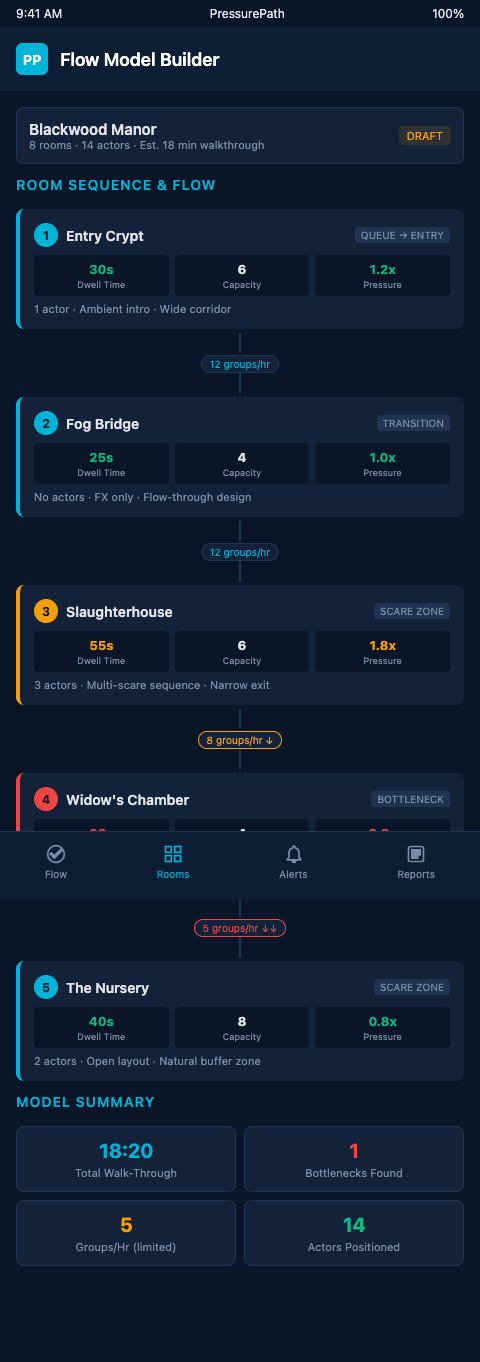
Start at the entry and work forward room by room. For each segment, you need four measurements: usable floor area, minimum corridor width, designed dwell time (how long a correctly-spaced group occupies this space), and exit clearance (the distance between this room's exit and the next room's actor position or threshold).
The flow-density relationship in crowd dynamics shows that each room has a capacity ceiling beyond which throughput collapses. That ceiling is not the room's total square footage divided by a standard occupancy factor — it is the effective throughput rate, which accounts for dwell time, exit clearance, and the behavioral dynamics of scared people moving through constrained spaces. Scared guests move differently than neutral pedestrians. They stop, cluster, reach back for partners, and hesitate at thresholds. Your flow model needs to account for that behavioral modifier.
Agent-based pedestrian simulators like Pathfinder model individual guest navigation through constrained paths, allowing you to test corridor and threshold configurations before physical construction. MassMotion provides 3D density validation that shows you not just the average density in each room but the peak density at the threshold point — where pile-ups actually occur. Both tools generate the room-by-room throughput data your flow model needs.
PressurePath integrates this room-by-room data into a peak-night pressure simulation. You define each room's parameters, set your dispatch interval and ticketing schedule, and the simulation produces a per-room, per-minute density forecast for your heaviest expected night. The model shows you which rooms will exceed functional scare density thresholds and at what time — before a single guest has ever walked through.
Haunt design practitioners document this approach as the standard for professional haunt design: building flow maps room by room to set dispatch intervals and identify sightline breaks before construction finalizes those variables. The room-by-room model is not optional for a serious haunt — it is the specification document that governs every downstream design decision.
The cusp-catastrophe crowd jam model adds mathematical urgency: small density increases cause abrupt jam-state transitions — not gradual degradation but sudden collapse. Your haunt's flow will not gradually worsen as density approaches the ceiling; it will collapse abruptly when it crosses a specific threshold. Building the model room by room identifies where that threshold is for each room before you discover it empirically on peak Saturday night.
Walk-through capacity myths compound the problem for designers who skip the room-by-room model — without knowing each room's individual throughput ceiling, the total walk-through time estimate is meaningless for capacity planning, and the first peak night will produce densities the designer did not anticipate.
Advanced Tactics: What the Model Reveals That Blueprints Cannot
A room-by-room flow model reveals three categories of design problems that standard architectural blueprints cannot identify.
Cumulative delay compounding. A blueprint shows that Chamber 3 has a 45-second actor reset time and Chamber 4 has a 15-second threshold clearance. The blueprint does not show you that at 400-person queue density, the combined delay from Chamber 3's reset time and the Clown Alley exit bottleneck will push Chamber 4's effective interval to 4.5 minutes — double what Chamber 5's actor was briefed on. The flow model shows cumulative delay propagation across the full chain, not just individual room parameters.
Actor position conflict zones. Some scare position layouts create geometric conflicts: the actor's strike path intersects with the exit corridor used by the previous group's tail when groups arrive at designed intervals. This conflict is invisible on a blueprint — it only appears when you model the simultaneous position of actor and exiting group in real time. The room-by-room model catches these conflicts and suggests actor position adjustments before the physical set is built.
Decompression room placement. Pedestrian speed-flow-density research shows that groups need decompression space after high-arousal chambers before their arousal state resets sufficiently for the next scare to work at full effectiveness. Your flow model identifies the arousal-state distribution across your room sequence and flags locations where a designed decompression beat — even a 30-second atmospheric transition corridor — would preserve the effectiveness of the subsequent scare.
Chamber sequencing for progressive arousal. Your room-by-room model should map not just density thresholds but arousal state transitions. A high-intensity Clown Alley should never feed directly into another high-intensity chamber — the arousal state from the first scare will either amplify or collide with the second depending on how much recovery time the transition provides. The model helps you sequence your highest-intensity chambers with adequate atmospheric transitions between them, ensuring that each successive scare lands on an audience that has recovered enough to be frightened again rather than one that is still processing the previous beat.
A first flow map for a multi-room attraction built from similar design principles shows how first flow map multi-room practitioners layer individual room parameters into a system-level throughput model — the method translates directly from escape room to haunt contexts.
Pressure-release rooms and fear state management represent the design solution the flow model identifies as needed — once you know which chambers are accumulating excess pressure, you know where to place the pressure-release architecture.
Build the Map Before the First Nail Goes In
The room-by-room flow model is a September tool, not an October fix. It costs nothing to adjust a corridor width in a model. It costs significant time and money to adjust it in a finished set. It costs you a season to leave it as-is and watch your Butcher Room actor perform to eight people all night.
There is a specific decision point at which the flow model has maximum leverage: before construction finalizes your corridor widths and chamber thresholds. That point is usually 6-8 weeks before your opening night target. Every week past that point, the cost of a design change rises and the willingness to implement it drops. Build the model as early as the chamber layouts are defined — even rough dimensions give you enough data to identify the bottlenecks that will matter most.
For haunted attraction designers on their first build, the model also functions as a stakeholder communication tool. When you can show an investor or a venue owner a peak-night density simulation that predicts exactly which corridor will exceed LOS D at 9:45 PM, the conversation about widening that corridor from 44 to 54 inches becomes concrete instead of intuitive. Flow data defends design decisions better than instinct does, especially with stakeholders who have not managed peak-night crowds before.
PressurePath gives haunted attraction designers a room-by-room pressure simulation that converts your chamber dimensions and dispatch plan into a peak-night density map. Build the model before the design is finalized. Use it to defend every corridor width and every chamber threshold position against the crowd physics that will test them when the queue hits 400.
Your scares are designed. Now model the flow that will either deliver them or destroy them. The corridor width you model today is the one your Butcher Room actor will thank you for on peak Saturday. Join the waitlist to build your room-by-room pressure simulation before construction locks in geometry you cannot unbuild in October.