Designing Pressure-Release Rooms That Protect the Fear State
What Happens When Fear Collapses Before the Scare Fires
At a professional haunted walk-through on a 380-ticket Saturday, the Asylum Corridor actor held her cue for 30 seconds past the mark. The group entering her zone was still carrying the energy of the previous scare — moving fast, talking loudly, physically compressed — and she knew from experience that a compressed, aroused group doesn't give her the silent anticipation she needs for the scare to land. She held. The group passed without a scare. The floor manager logged a missed beat.
What she didn't know was that the missed beat wasn't her fault — it was a design failure. There was no pressure-release room between the Clown Alley sequence and her Asylum Corridor zone. The two high-intensity rooms ran back to back with a 15-foot dark corridor connecting them. On light nights, the corridor was enough. On a 380-ticket Saturday, groups exited Clown Alley already compressed and stayed that way through the corridor because there was no space for the group to slow, spread, and re-enter a receptive fear state.
According to Horror Escapes LA's analysis of immersive horror design, effective designers build 3-4 minute suspense cycles ending in decompression. Without release valves, fear doesn't reset — it collapses into numbed overstimulation. The Asylum Corridor actor was trying to manufacture the fear state that a decompression zone should have created.
Crowd crush research from Risk Frontiers puts the structural risk in sharper terms: without pressure-release points, crowd compression exceeds 8-10 people per square meter and panic becomes probable. That's a fire marshal problem, not just a scare quality problem. Decompression zone design simultaneously protects the fear state and controls the safety risk.
Positioning and Sizing Pressure-Release Rooms From the Flow Model
The intuitive approach to decompression zone design is to place them after the highest-intensity scare chambers — after the Clown Alley climax, after the Butcher Room finale. That's directionally correct but positionally imprecise. The question isn't "after which scare" — it's "at what point in the crowd flow does group density exceed the safe strike zone threshold for the next actor."
Those two answers are often different. On light nights, placing a decompression zone after each high-intensity room is sufficient — the corridors between rooms provide passive relief time. On peak nights, compression builds upstream before the high-intensity room, meaning groups arrive at the scare chamber already compressed from a pinch-point two rooms back. A decompression zone placed after the scare does nothing for the fear state that was already degraded before the scare fired.
Think of the crowd as pressurized fluid: when water flows through a narrow pipe into a wider chamber, pressure drops and flow normalizes. But if the pressure has been building since three pipe-lengths upstream, the chamber needs to be large enough and positioned precisely enough to fully dissipate that accumulated pressure — not just give it somewhere to go. A decompression zone that's too small, or positioned one room too late, doesn't clear the pressure before the next scare zone.
The first haunt flow model gives designers the tool to find the correct positioning. When you map each room's transit time and group density at peak ticket volume, you can identify exactly where compression accumulates and at what room number the fear state will have degraded without intervention. That's the room before which the decompression zone needs to be placed.
Immersive storytelling research from Taylor & Francis confirms the design principle: pacing through contrast rooms — high-stimulation followed by decompression — sustains audience engagement. The mechanism is psychologically reliable. The design challenge is ensuring the decompression room is long enough and slow enough for a compressed group to actually spread and reset, not just pass through.
Fruin's crowd flow levels of service model provides the measurement framework: at above 2-3 people per square meter, pedestrian flow degrades and group autonomy collapses. A decompression zone needs to receive groups at that density and drop them below it before they exit into the next scare chamber. That means the room's usable floor area must be sufficient to drop density below 2 people per square meter for a typical group size — not just provide physical space that gets bypassed when groups move quickly.
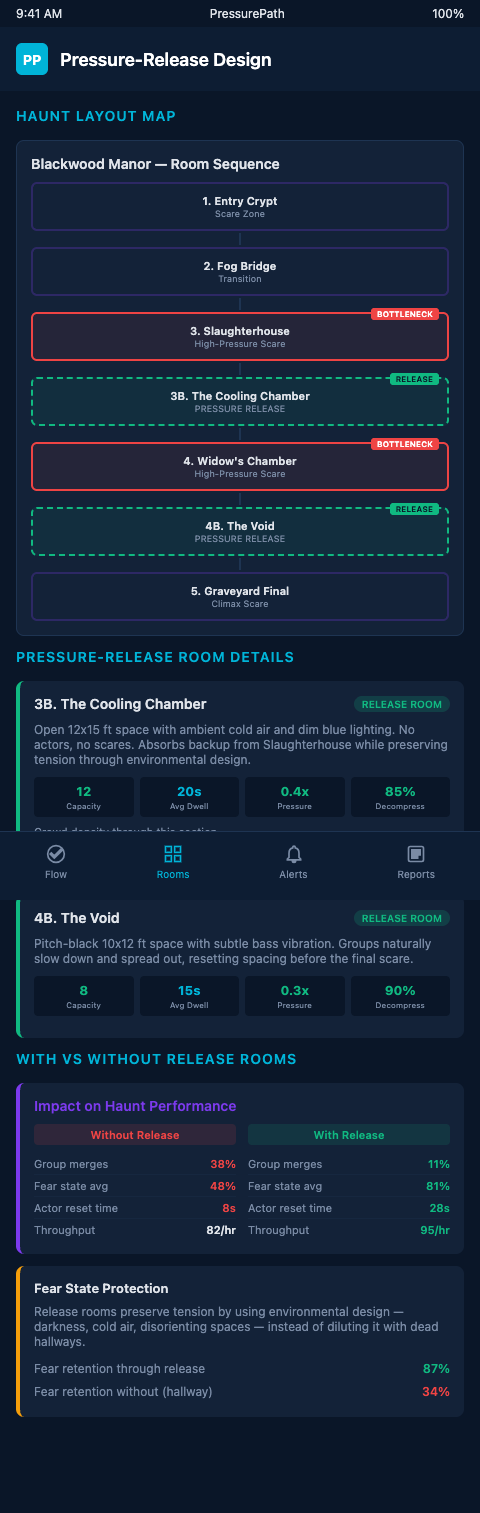
PressurePath models this directly. The simulation runs peak-density scenarios and shows which rooms are receiving groups above the safe density threshold, which decompression zones are achieving the required density reduction, and where the current floor plan leaves fear-state degradation unaddressed. The output includes specific recommendations: widen this corridor by 8 feet, extend this decompression zone by 30 seconds of dwell time, or add a slow-path option to split group flow before entering the next scare chamber.
Advanced Design: Variable Decompression and Magnet Relief Mechanics
Standard pressure-release rooms are static — a fixed space between two scare chambers. Advanced design uses variable decompression: rooms with multiple slow-path options, actor-free zones with ambient audio that extend dwell time for compressed groups without blocking flow for well-spaced groups.
UCF's Immersive Experience Design program trains designers to use decompression zones as core structural elements — not afterthoughts. The program's approach positions decompression as a design constraint that shapes the full floor plan, not a room added between scares when space allows.
Magnet scene techniques from immersive theater offer a specific tool: high-interest elements placed inside decompression zones that draw groups to slow down and spread naturally. In a haunt, this could be a display case with detailed props, a brief actor performance that doesn't require spacing, or a sound design element that rewards stopping. The magnet effect converts groups that would rush through a corridor into groups that naturally decompresses — without any staffing requirement.
Museum design psychology research from RWS Global confirms that visitors naturally slow at lower-stimulus spaces, and decompression zones reset attention for the next high-stimulation sequence. Designing those lower-stimulus spaces with deliberate interest elements — not just empty corridors — increases dwell time without friction and produces better fear state recovery than passive hallways.
The dark ride effect lessons also apply: theme park dark ride designers use speed variations and lighting transitions to manipulate group pacing between scenes. The same principles translate to walk-through haunt design — gradual sensory transitions in decompression zones that lower physiological arousal before the next scare sequence, rather than abrupt room changes that leave groups in a degraded reactive state.
Fire marshal density threshold alerts become relevant here as well. If a decompression zone is sized correctly for average crowd behavior but undersized for the 450-person peak-night scenario, the model should flag it before opening — not after the fire inspector does.
Variable decompression also interacts with actor scheduling in ways the static model misses. When a decompression zone runs actor-free for 90% of the night but adds a shadow performer during the 8:45-9:45 PM surge window — just to extend group dwell by 15 seconds through a subtle environmental cue — the zone effectively doubles its compression-absorption capacity without any floor plan change. The cost is 60 minutes of performer coverage at a single position. The benefit is preserved fear state in two downstream scare chambers across the peak compression window.
For a 450-ticket Saturday, that trade-off is usually positive, and the pacing model is what identifies which specific 60 minutes matter. Running the simulation across four hypothetical shadow-performer placements — Room 5, Room 7, Room 9, and Room 11 — typically reveals that one position contributes 70-80% of the total density relief, and that's where the staffing investment goes.
Design Your Decompression Zones From the Density Model Outward
The room you cannot afford to misplace is the one whose decompression capacity is already marginal at 350 tickets. At 450, that room's undersizing becomes the mechanism that collapses fear state across every downstream chamber. The correction window is pre-construction, not pre-season — and the only tool that identifies which room is marginal before a single guest walks through is a density model run against your full floor plan at the peak ticket volume you plan to sell. That output is not an architectural suggestion. It is a specification that governs whether your Clown Alley actor performs to compressed crowds or isolated victims for the full October run.
For most 14-chamber haunts, the marginal room is rarely the one the designer suspected — it is usually the second or third decompression zone in the sequence, where cumulative upstream pressure converts an apparently adequate dimension into a functional undersize during the 9:15 PM surge window.
PressurePath shows haunted attraction designers where their current floor plan allows fear state to collapse under peak crowd density, and what decompression zone dimensions and positioning would recover it. Stop discovering your pressure-release rooms are in the wrong place at 9:30 PM on a sold-out Saturday. Join the waitlist and run the simulation before you finalize next season's floor plan.