The Dark Ride Effect: Workflow Lessons for Walk-Throughs
The Problem Dark Rides Solved That Haunted Walk-Throughs Haven't
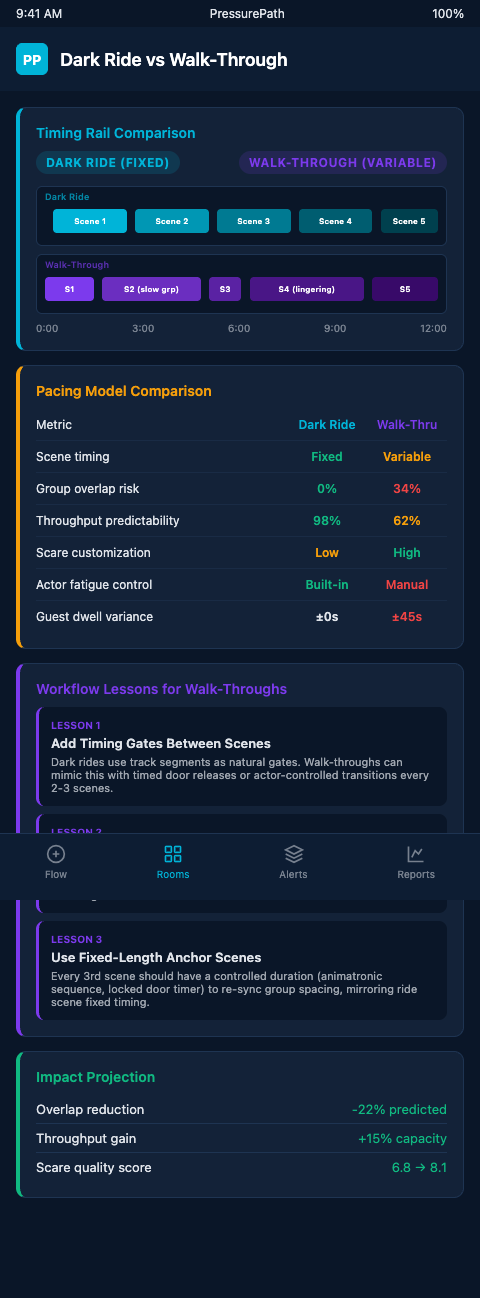
On Halloween night at a regional theme park, the haunted mansion-style dark ride processes 2,400 guests in four hours without a single actor timing failure. Every scene fires on cue, every transition lands at the right moment, and peak-density arrival rates don't change the experience quality for the 2,400th guest versus the first. Three attractions away, a walk-through haunted experience with the same themed content and a similar floor plan runs 600 guests in four hours with 15 logged scare misses, two group merge incidents, and an actor in the final corridor who held her beat four consecutive times waiting for clean spacing.
The difference isn't talent or theming. It's the vehicle. Dark rides control the speed, spacing, and load of every guest group because they sit in ride vehicles that move on a fixed system. Walk-throughs give guests autonomous movement — and autonomous guests compress, slow, stop, and merge in ways that collapse every actor timing assumption built into the production design.
Imagineering walk-through attraction analysis from Themed Attraction describes the core challenge: Disney Imagineers treat walk-throughs as dark rides without vehicles, meaning the path is the ride system and guest movement through that path must be choreographed as precisely as a vehicle dispatch interval. The failure mode when that choreography breaks down is exactly what the walk-through operator experienced: actor timing failures and group compression that the dark ride version of the same attraction never encounters.
Translating Dark Ride Operations Discipline Into Walk-Through Workflows
Dark rides maintain scare-quality consistency through four operational mechanisms: dispatch intervals, load management, throughput optimization, and scene trigger timing. Walk-through haunts can implement analogues of all four — but the analogue requires deliberate design rather than installing a vehicle system.
Dispatch intervals in dark rides are fixed: each vehicle departs on a set schedule regardless of the previous vehicle's position. In walk-through haunts, the batch interval is the dispatch interval equivalent — but it's vulnerable to variance in the way vehicle dispatches aren't. A slow group in Room 3 extends the "interval" between when the next group reaches Room 4, effectively compressing dispatch spacing downstream. The dark ride equivalent would be vehicles bunching up at a slow scene — which the vehicle system prevents by controlling speed. In a walk-through, interval maintenance requires active management at the pinch-points where variance accumulates.
Theme park capacity management research from INFORMS shows that theme parks use dispatch intervals and batch-loading to maintain throughput in timed attractions. The key finding for walk-through operators: dispatch discipline at the entry point only maintains spacing if transit time variance across the attraction is low. Where transit variance is high — in rooms where group behavior is most unpredictable — walk-throughs need the equivalent of a "speed control" mechanism: active pacing at that specific room, not just at the entry gate.
Load management in dark rides is the process of filling each vehicle to its designed capacity, neither under nor over. Dark ride Omnimover systems reviewed in Wikipedia maximize throughput by eliminating dead-load-time gaps — vehicles run continuously and nearly every seat is filled. For walk-throughs, load management means batch composition: the size and composition of each group released at each dispatch interval. A six-person group with similar walking speeds moves through a room predictably. A twelve-person group with two slow members and a phone-checking teenager has radically different transit time variance. Managing batch composition — releasing groups with similar expected speeds — reduces the variance that drives compression.
Throughput optimization is where the dark ride revenue model from Nola HQ is most directly applicable: every delayed dispatch or empty seat is lost revenue. For walk-through haunts, the equivalent is the missed scare from an over-compressed group — that's not just a quality failure, it's a throughput failure. A group that receives no meaningful scare in Room 7 because of compression either complains (reputation loss) or was simply processed without the value the operator promised (effective revenue loss on that portion of the experience). Throughput optimization in the dark ride sense — maximizing the fraction of groups that receive quality scares — is the walk-through operator's equivalent of maximizing vehicle occupancy.
Scene trigger timing in dark rides uses position sensors: the vehicle's location triggers each scene element automatically. In walk-throughs, actor cues replace position sensors — but the triggering logic should work the same way. The scare should fire when the group is in the right position and the right spacing state, not on elapsed time. PressurePath's pressure-release room engineering implements this as density-threshold triggering: the actor fires when upstream density is below the compression threshold, equivalent to a dark ride vehicle being in the correct position.
The pressurized-water model connects all four mechanisms: when crowd flow is treated as pressurized fluid, the dark ride's vehicle system is the pressure regulator — it controls flow rate at every point along the pipe. Walk-through haunts lack that mechanical regulator and must use operational controls (dispatch intervals, batch management, re-spacing protocols) to achieve the same pressure regulation.
RWS Global's analysis of theme park flow design applied to immersive entertainment shows that theme park flow design principles are being applied across immersive entertainment broadly. The operational workflow discipline that makes dark rides consistent is transferable — the challenge is adapting it to the autonomous-movement constraint of walk-through formats.
Advanced Application: Queue Design as Pacing Infrastructure
Dark rides don't just manage flow inside the attraction — they manage it starting in the queue. Disney's queue-as-experience design model from Talking About Design shows that every movement before the ride vehicle loads is intentionally paced: the queue is designed to control visitor flow rate, group formation, and entry timing before guests reach the load platform. The queue is pacing infrastructure, not just a waiting space.
Walk-through haunted attractions typically treat the queue as a holding area — a place people wait until they're called in batches. The dark ride lesson is that the queue is the first point at which group formation and dispatch spacing can be engineered. Maze-style queues control group composition by naturally separating guests into smaller clusters. Timed entry slots pre-form groups at the right size for the batch interval. Queue content — actors, ambient experiences, lore — controls the emotional state guests carry into the first scare zone.
Queuing theory M/G/1 modeling from Governors State University provides the mathematical basis: the relationship between arrival rate, service time, and system capacity determines whether walk-through throughput meets the dark ride benchmark. For a walk-through targeting 600 guests in four hours, the arrival rate must be matched to the room-by-room service time distribution — and the queue is where that matching happens before guests enter the attraction.
Audience redirection and blocking notation from immersive theater offers another cross-discipline technique: using positioned actors, environmental cues, and deliberate blocking to steer audience movement at specific points. Applied to walk-through haunts, this is the non-mechanical speed control that compensates for the absence of a ride vehicle — deliberate design of every corridor and transition space to control group speed and spacing rather than leaving it to guest autonomy.
Corn maze queue engineering applies the same principle in open-field format: when there's no physical corridor to control speed, path design, junction geometry, and checkpoint placement become the flow control infrastructure. The dark ride lesson is that the infrastructure starts at entry and runs through to exit — the queue is not separate from the experience; it's the first scene in the pacing model.
PressurePath models the full walk-through as a dark ride dispatch system: entry batches are dispatch events, each room is a scene with a defined service time, and the output is whether the dispatch interval maintains actor timing windows from the first room to the last. When it doesn't, the model identifies the specific rooms where the dark ride's speed-control equivalent needs to be added — active pacing interventions, re-spacing hold points, or batch composition adjustments that recover the dispatch discipline the vehicle system provides for free.
Apply Dark Ride Operations Discipline to Your Walk-Through Season
The dark ride's defining operational advantage is not the vehicle itself but the discipline the vehicle enforces. Every dispatch interval fires on schedule, every scene triggers on position, every load matches designed capacity — not because the ride system is smart, but because the physical infrastructure removes the variables that autonomous movement introduces. Walk-through haunts operate in the opposite environment: every variable is alive, every group moves at its own pace, every scare fires at actor discretion. Closing the operational gap is not about installing a conveyance — it is about building the pacing model, batch composition rules, and dispatch schedule that give the walk-through operator the same control levers the ride system provides mechanically.
That model is a pre-season build, not a peak-night scramble. For a 14-chamber walk-through running 420 tickets on peak Saturday, the dispatch schedule has to be calibrated to the slowest room's service time under peak-density behavior. The batch composition rule — groups of 6-8 with matched walking speeds — enforces the load management discipline. The scene trigger protocol — actor cues fired on upstream density reading rather than elapsed time — replaces the position sensor. None of these are new ideas in the haunt industry. All of them become operationally executable when the pacing model provides the underlying room-by-room throughput calculation that ties them together.
PressurePath gives haunted attraction designers the operational model that dark rides run mechanically — dispatch intervals, scene trigger timing, and throughput optimization — translated into walk-through workflow tools that work without ride vehicles. Join the waitlist and build the operations discipline that turns your peak-night walk-through into a system that delivers consistent scares from the 6th group to the 60th.