Building Audience Redirection Into Your Blocking Notation
What the Script Does Not Say
The blocking script for Scene 4 reads: "ELENA crosses to the writing desk DSL, picks up the envelope, reads." It says this in five lines of clean shorthand that any SM in any production could parse in seconds. It does not say: "Approximately 22 audience members should be positioned in the northwest quadrant of the room. If more than 35 are present, the corridor light shift should redirect the overflow toward Scene 6. If the northeast corner has fewer than 6 viewers, the actor at the window should increase physical amplitude to draw corridor passers toward the scene."
All of that information exists — it is in the director's tech notes, the usher protocol document, the SM's running sheet annotations. But it is not in the blocking script. It is not in the document that travels with the production, that ASMs inherit when they join a company, that directors reference during rehearsal. It is institutional knowledge distributed across four different documents, three people's memories, and a set of performance annotations that may or may not have been updated after the last major blocking revision.
Blocking (stage) — Wikipedia documents that current blocking shorthand captures actor movement with precision and has no standard symbols for audience routing. The notation system was designed for proscenium theater, where audience position is fixed and requires no direction. In non-proscenium and promenade work, that gap in notation is a structural documentation failure.
Blocking Notation Systems (Humanities LibreTexts) documents four established blocking notation systems, none of which addresses audience movement as a notatable element. The notation vocabulary simply does not exist — which means every immersive production reinvents its own convention, and that convention rarely survives a personnel change.
The Psychology of the Audience (HowlRound) argues that directors working with audience movement as a compositional element need notation for audience state — where viewers are positioned, how they are oriented, what they are attending to — not just actor blocking. The directorial intent is spatial; the notation should be spatial.
A Notation System for Audience Redirection
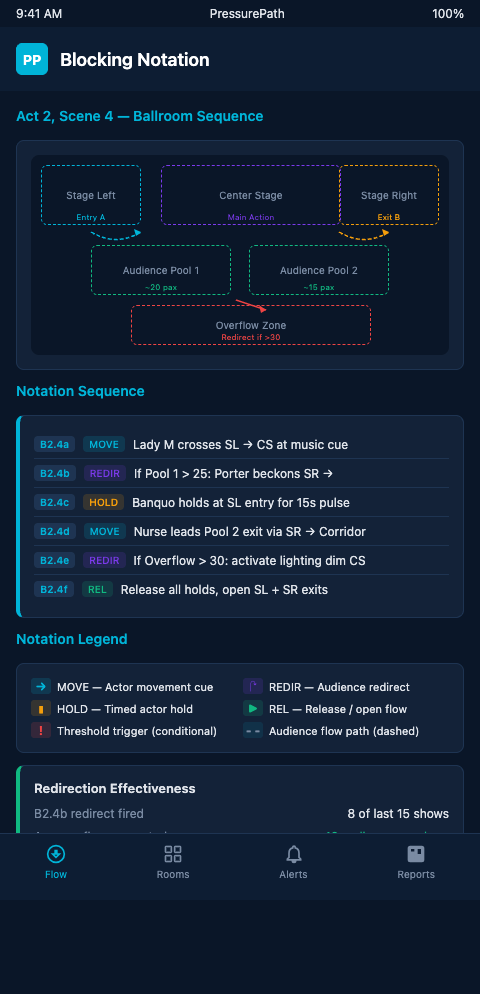
A blocking notation system that incorporates audience movement and redirection needs three symbol classes: expected audience distribution, redirection triggers, and redirection instructions.
Expected audience distribution annotates each scene block with a spatial description of where the audience should be positioned relative to the action. This can be as simple as a compass-quadrant annotation — "Audience: N/NW 18-22, S/SE 6-10" — or as detailed as a zone diagram drawn alongside the standard blocking marks. The critical requirement is that it uses the same spatial reference system as the actor blocking: if actor blocking uses the standard nine-position grid (DSL, DSC, DSR, CSL, CS, CSR, USL, USC, USR), audience distribution annotations use the same grid.
Think of the annotated blocking script as a flow map of the scene's pressurized system. Just as PressurePath models audience mass as pressurized fluid moving through the pipe network of the venue, the blocking notation captures the intended pressure state at each moment — how many viewers should be at which nodes, and what the distribution looks like under nominal conditions versus under drift conditions.
Redirection triggers are conditions written into the blocking notation at the moments where distribution failure is most likely to occur. These draw on the same pressure thresholds that the flow model generates: if the expected distribution annotation says "N/NW 18-22" and the actual occupancy at that zone crosses 35, the trigger condition is met. The notation symbol for a trigger can be borrowed from existing theatrical conventions — a bracketed conditional, similar to how optional cues are written in QLab — adapted to reference audience position rather than technical state.
Redirection instructions are the actions to take when a trigger fires. Laban Movement Analysis — Wikipedia provides vocabulary for describing directional spatial qualities that translates into practical notation: "corridor light shift toward Scene 6 entry" can be notated as a directional LMA effort-quality symbol combined with a scene reference. The exact symbols matter less than the system's consistency and its legibility to the SM team that will implement the instructions live.
The system's consistency requirement is the most important design constraint. A notation system that the director uses differently from the ASM, or that the calling SM interprets differently from the deck supervisors, creates ambiguity that costs time to resolve during running calls. The correct implementation path is a one-hour notation workshop with the full stage management team before tech, establishing shared meanings for every symbol in the system. That investment pays back immediately when the first redirection instruction is executed correctly on night one because every person in the chain read the same symbol the same way.
Dark Ride — Wikipedia documents that dark ride storyboarding notation includes guest viewpoint alongside performer cues — a direct precedent for treating audience position as a notatable production element. The dark ride format uses a split-panel notation: performer action on one axis, guest experience and viewpoint on the other. An immersive theater blocking script can adopt the same format, splitting each scene block into actor blocking (existing notation) and audience routing (new notation layer).
Practical Dramaturgy for Immersive Practitioners (U of Houston) proposes frameworks for spatial sequencing in immersive work — the audience notation system described here operationalizes those frameworks into production documentation.
Advanced Tactics: Maintaining Notation Across Blocking Revisions
A notation system is only as useful as its maintenance discipline. Actor blocking in a long-running immersive production changes — scenes get cut, transitions get redesigned, actor pathways shift. Each change to the actor blocking potentially changes the audience distribution targets and the redirection trigger conditions. If the audience notation layer is not updated alongside the actor blocking, the notation document becomes misleading within weeks of implementation.
The maintenance burden is the most common failure point for audience notation systems. Productions implement the system during tech with good discipline, then a blocking revision in week two updates three scenes' actor notation without updating the corresponding audience distribution annotations. The SM now has a notation document that describes accurate actor positions and outdated audience targets — a combination that is worse than no notation, because the outdated annotations suggest protocols that no longer apply to the revised blocking.
PressurePath addresses this by treating audience distribution targets as derived from the blocking state rather than as independently authored annotations. When an actor's position in a scene changes, PressurePath re-runs the scene's flow simulation and generates updated audience distribution targets automatically. The SM receives a notification that the scene's notation layer has been updated, reviews the changes, and either accepts them or modifies them based on rehearsal observation. The maintenance discipline becomes reactive — review and confirm when prompted — rather than proactive, which is the maintenance burden that fails in long-running productions.
The non-linear blocking approach identifies how non-linear staging complicates the maintenance challenge: in non-linear work, scenes run in different orders across performances, which means audience distribution targets vary by sequence. The notation system must accommodate sequence-dependent distribution targets, not just fixed spatial positions.
Wayfinding Signage Best Practices (Mappedin) establishes that environmental wayfinding principles translate into notation symbols for audience redirection — the spatial vocabulary of wayfinding design (directional arrow conventions, threshold markers, zone identifiers) provides a ready-made symbol set for blocking notation that any SM team can learn without specialized training.
PressurePath exports audience distribution targets and redirection trigger conditions in a format designed to paste into standard blocking script templates. When a scene's actor blocking is revised, the PressurePath simulation re-runs and generates updated audience distribution annotations — keeping the notation layer synchronized with the production's current state rather than requiring manual updates after each revision.
The mid-show cue adjustments protocol depends on the notation system for its trigger conditions: the actor's extension signal fires when the audience distribution annotation's trigger threshold is crossed. And the dark ride lessons from attraction design confirm that guest-viewpoint notation in the production document is standard practice in high-throughput spatial experiences — immersive theater is adopting that standard from an adjacent industry that solved the same documentation problem decades earlier.
Add the Notation Layer During Tech
Audience redirection notation is most efficiently added to the blocking script during tech, when blocking choices are being made and the flow model is being calibrated simultaneously. Productions that attempt to annotate audience routing into an existing blocking script mid-run are working from memory and approximation rather than from documented directorial intent.
The tech-week annotation sequence is straightforward. During the first paper tech, the director walks each scene block and the SM annotates the expected audience distribution alongside the actor blocking. During the first dry tech, the SM validates the annotations against the physical venue — confirming that the audience distribution targets are achievable given the actual room geometry. During the first preview, the SM observes how closely the actual distribution matches the annotations and adjusts the notation to reflect the measured reality. By the second preview, the notation layer is validated against live performance data and ready to drive the mid-show redirect protocols that depend on it.
The investment in tech-week annotation pays back on every subsequent performance in two ways. First, the SM no longer relies on memory for audience distribution expectations — the notation is the reference. Second, when new stage managers or assistant SMs rotate into the production, they inherit a documented understanding of the show's audience architecture rather than having to build that understanding through weeks of observation. The notation is institutional knowledge preserved in the document that every running call already uses.
One caveat worth noting: notation that is added during tech but never referenced during running calls becomes decorative rather than functional. The SM must actually consult the audience distribution annotations during performance — not just glance past them — for the notation to serve its operational purpose. Directors who implement the notation layer should confirm during tech that the SM is reading the annotations aloud at least once per scene during the run-through, establishing the habit before opening night.
Immersive theater directors and SMs building promenade or site-specific productions with active audience routing need a notation system that documents audience movement with the same precision as actor blocking — not improvised annotations in margins. Join the PressurePath waitlist for audience distribution notation tools built to integrate with immersive theater blocking workflows.