Fundamentals of Spatial Blocking for Non-Linear Theater
The Blocking Notation That Didn't Survive Contact With the Audience
The director had filled three notebooks with blocking notation. Every actor's position in every scene, every cross and counter-cross, every sightline reference — a year of preparation for a six-show promenade production in a converted warehouse. On the first preview, the audience moved through the space and within 20 minutes, 40% of the blocking notation was inapplicable. Not because the actors failed to execute it, but because the blocking was designed for an audience in specific positions that the promenade format could not guarantee.
The notation assumed the audience would be where blocking logic required them to be. Non-linear theater makes no such guarantee. The audience is in motion, self-routing, and distributing across the space according to pull values, corridor resistance, and individual curiosity — none of which were inputs to the blocking system the director had built.
Nick Kaye's foundational analysis of site-specific performance establishes the core principle: spatial blocking in non-linear work follows spatial rather than narrative logic. The primary blocking instrument is not the actor's position relative to the audience but the space's structure relative to the audience's movement. Space is not the container for the action — it is the action's first medium.
Stanislavski's director-centered blocking system is the canonical reference for how blocking notation works in conventional theater. Its core assumption — that the director controls the audience's position by controlling the stage — is inverted in non-linear work. In a promenade production, the director controls the audience's position by controlling the space's pull values and routing mechanisms, not by placing actors in specific stage positions.
The Four Principles of Spatial Blocking
Principle 1: Space is the primary blocking instrument. In Stanislavski-derived blocking, the actor's movement is primary and the space is secondary — the stage is a neutral platform for the actor's physicality. In spatial blocking, the reverse applies. The space's configuration — the corridor width, the scene room's approach angle, the sightline exposure from the corridor — determines where the audience will be when the scene begins. The actor's blocking is designed within those spatial constraints, not despite them.
Oxford TORCH's analysis of RSC spatial dramaturgy frames this as spatial dramaturgy encoding power and movement as primary blocking tools. The director's vocabulary in non-linear work is spatial: room relationship, corridor direction, sightline exposure, approach distance. Actor movement is a secondary instrument used to reinforce or redirect the spatial logic.
Principle 2: Blocking arc integrity requires density modeling. A spatial blocking arc assigns specific scenes to specific audience density ranges. The arc is not a sequence of scenes the audience will experience — it is a sequence of density targets that the blocking design must produce. Scene 5 requires 14–20 viewers. Scene 8 requires 6–10 viewers. Scene 11 requires 25–32 viewers. The blocking arc's integrity depends on delivering those densities, which requires a pressure flow model that the conventional blocking notation cannot produce.
PressurePath's blocking arc integrity scoring measures the percentage of performances in which every scene in the arc receives its target density range. A score of 90 means that 90% of performances across the run deliver every scene within its target range. The pressurized-water-in-pipes model generates this score by simulating audience pressure distribution across the full venue network for each performance configuration.
Principle 3: Corridor design is scene design. In non-linear blocking, a corridor between scenes is not a backstage passage — it is a staging area, a routing mechanism, and a pressure regulation system. The corridor's length, width, lighting level, sound design, and performer presence determine how long audiences spend in transit, which of two adjacent scenes they route toward, and at what rate they arrive at the next scene's inlet. Choreographic strategies for managing performer-audience spatial relationships apply in corridor design as much as in scene design: the corridor is a choreographic space that shapes audience movement as deliberately as the scene room itself.
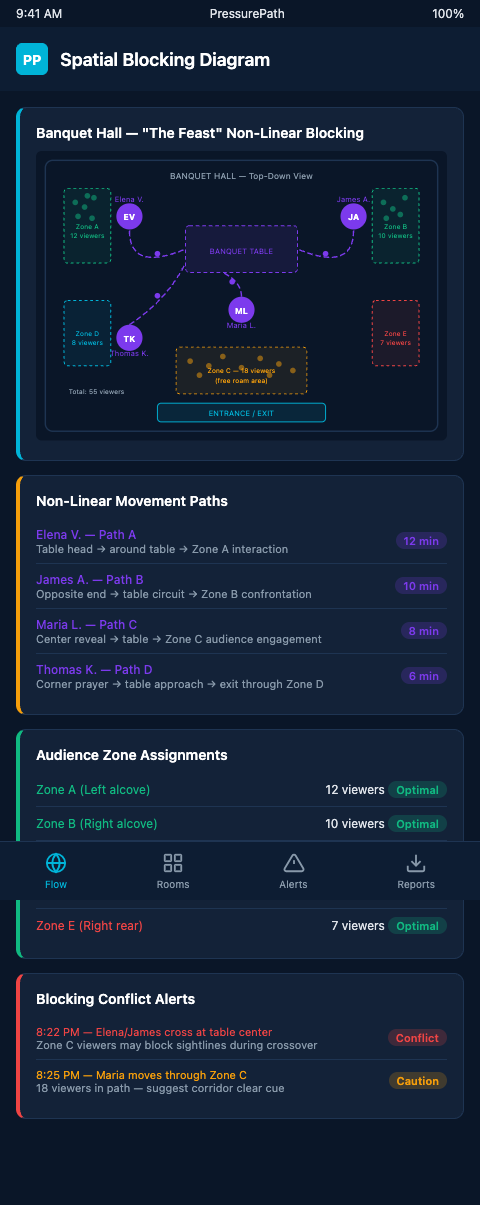
Principle 4: Non-linear blocking notation must include audience flow parameters. Conventional blocking notation records actor positions, movements, and stage directions. Spatial blocking notation for non-linear work must additionally record: scene density targets, corridor routing intentions, cue-exit timing, and adjacent scene pull values. Without these parameters, the notation is an incomplete record — it describes the actor's performance but not the spatial architecture that delivers the audience who will receive it.
Sarah Rubidge's framework for choreographic space as a transient spatiotemporal network provides the theoretical basis for this expanded notation model: the performance space in non-linear work is not a fixed container but a dynamic network of relationships that changes as the audience moves through it. Notation that captures only actor positions misses the network dynamics that determine whether the blocking arc is received.
The pressurized-water-in-pipes framework PressurePath uses is the spatial blocking director's operational model for principles 2 and 4. Each scene room is a pressure chamber. The inlet is the corridor connection from the preceding scene. The outlet is the cue-exit timing that releases viewers toward the next scene. The capacity ceiling is the sightline density ceiling. The pressure flow rate is the audience transit speed through the corridor. When you have these four parameters for every scene in the production, you have the inputs to a spatial blocking model that predicts whether your blocking arc will be received — before the first audience enters the space.
Directors building their first spatial blocking notation system should start with a three-column document: left column contains the conventional blocking notation (actor positions and movements), center column contains the density target and sightline ceiling for the scene, right column contains the cue-exit timing and corridor routing intent. This expanded notation format captures both the performance and the spatial architecture simultaneously, and it serves as the input document for PressurePath's simulation.
Exhibition design circulation checklists from Taylor & Francis developed for multi-room spatial experiences provide a practical checklist framework for non-linear blocking notation: entry visibility, corridor directionality, scene accessibility from approach corridors, and competing pull sources in the approach environment. This checklist applied at each scene in the production produces a spatial audit that identifies blocking vulnerability before the audience enters the space.
The gamified, spatially choreographed experiences documented as a dominant growth format in Blooloop's 2024 immersive trends analysis are exactly the non-linear formats that require spatial blocking discipline. Productions entering this format without spatial pacing foundations are producing work that will underperform relative to the standard the market is moving toward.
For directors moving from the conceptual framework of spatial blocking to the scale-specific challenges of large non-proscenium productions, the non-proscenium staging analysis for 200-seat immersive shows covers the structural failures that emerge when spatial blocking principles are not applied at scale. When the blocking notation needs to incorporate audience routing into its formal structure, the blocking notation system for audience redirection provides the notation framework for capturing corridor routing and density targets alongside actor positions. The station spacing and educational throughput analysis from museum exhibit design applies the same spatial blocking principles to a different venue type — the parallel is instructive because museum circulation design solved many of the same multi-room routing problems that immersive theater is encountering now.
Starting the Spatial Blocking Practice
Directors transitioning to spatial blocking from conventional theater should begin with three exercises before their first rehearsal. First, walk the venue without blocking notation and record where you stop, why you stop, and what you see — this maps the venue's natural pull values. Second, assign density targets to every scene before you assign actor positions — the density targets are constraints that the actor positions must serve, not consequences of the actor positions. Third, identify the three corridors in the venue where audience routing is most likely to fail and design those corridors as actively as the three most important scenes.
A common calibration failure in first spatial blocking attempts is over-engineering pull values. Directors who have just learned the pressure framework often assign precise numerical pull values (6.3, 7.8) to scenes based on intuition, producing false precision in the flow model. In practice, pull values should be assigned in broad categories — low (1–3), medium (4–6), high (7–9) — and refined after the first full-cast walkthrough. The walkthrough invariably reveals that two scenes the director rated as high-pull are actually medium-pull in the physical space, and one corridor the director ignored is a high-pull attractor because of an architectural feature they hadn't anticipated.
The gamified, spatially choreographed experiences documented as a dominant growth format by Blooloop share the same spatial blocking fundamentals described here. The spatial blocking practice is not more complex than conventional blocking — it is differently structured, with spatial flow as the first instrument rather than the last consideration.
PressurePath's spatial blocking mode accepts these three inputs — venue pull values, scene density targets, corridor routing intentions — and converts them into the full venue pressure model, the blocking arc integrity score, and the cue-exit schedule that delivers your density targets.
Immersive theater directors building their first non-linear production or their first spatially choreographed experience: join the PressurePath waitlist for immersive theater companies and build your spatial blocking model before you enter the rehearsal room.