Fundamentals of Station Spacing for Educational Throughput
Why the 15-Foot Gap Killed the Learning Sequence
A children's museum in the Pacific Northwest designed its new science wing with seven learning stations spaced at equal intervals across the floor. The design team used available square footage and aesthetic spacing guidelines. Station 1 was an arrival exhibit that captured the school wave immediately. Station 2, 15 feet away, received 70% contact. Station 3, another 15 feet, received 40%. By station 5, at 60 feet from entry, contact had dropped to 8%.
The content quality improved as students moved deeper into the wing—station 5 was the most pedagogically rich exhibit in the room. But the wave dynamics meant that almost no child reached it at full engagement. The 15-foot spacing was wrong for this wave size and entry density. At 30 kids entering simultaneously, the wave reformed too quickly between stations, rebuilding forward momentum before the spacing forced deceleration.
This is a station spacing failure. The floor plan looked balanced on paper. The throughput was not. The equal-interval spacing assumption treats all visitors as independent travelers who make individual decisions about each station. It fails for 30-kid school waves because those groups make collective decisions, and the collective decision to "keep moving" rebuilds faster than 15 feet of corridor allows.
The result—high contact at early stations, near-zero contact at late stations—is the single most common throughput failure pattern in children's museum science wings. It's also one of the most fixable, because spacing can be adjusted without changing any exhibit's content or physical design.
The Physics of Wave Reformation and Station Spacing
When a 30-kid school wave stops at a station, it fragments into a cluster. Some children engage. Others orbit the cluster. A few drift forward. After 60–90 seconds, the forward drift reaches a critical mass—typically 5–7 children—and the cluster's peer contagion dynamics flip from "stay" to "move." The wave reforms and the momentum builds again for the next station. The behavioral basis for these reformation dynamics is covered in child pacing fundamentals.
The spacing question is: how far must the next station be for the wave to arrive there at reduced momentum rather than peak forward pressure?
Beverly Serrell's sweep rate benchmarks establish that visitors move at 200–400 square feet per minute in museum spaces. For a 30-kid school wave, the high end of that range applies during free movement between stations—children move faster than adults. At 400 sq ft/min in a 12-foot-wide corridor, the wave covers 33 linear feet per minute. A 15-foot inter-station gap is covered in under 30 seconds—before the reformation cycle is complete and before the wave has decelerated.
Effective station spacing for educational throughput requires placing the next station at least 40–50 linear feet from the previous one, in a corridor of standard museum width, to allow the reformation cycle to complete before the wave's leading edge arrives at the new exhibit. Museum exhibition design standards recommend 30–50 square feet per visitor and 1.2–1.5 meter circulation widths as the baselines that prevent circulation collapse—but those standards are designed for normal visitor density, not 30-kid burst arrivals.
Quinn Evans' research on museum visitor flow finds that offering three thematic branches from a central hub is empirically superior to a linear grid for managing visitor flow. For school waves, a hub-and-spoke layout with 40–50 feet of corridor from the hub to each spoke station naturally produces wave deceleration at each station entry without requiring physical barriers. The distance itself does the pacing work.
PressurePath's Spacing Calculation Framework
PressurePath calculates optimal inter-station spacing for each floor plan based on three inputs: wave density (number of children in the school group), entry pattern (single-point versus multi-point atrium entry), and target dwell time per station (derived from the learning goals associated with each exhibit).
The pressurized-fluid model translates directly: a wave of 30 kids is a high-pressure burst that maintains velocity until it encounters sufficient back-pressure to decelerate. That back-pressure comes from distance (the wave loses momentum over space), from station width (a wide frontage absorbs enough of the wave to change the group's velocity), or from physical redirection (a partition that forces a turn, adding distance even in a compact floor plan).
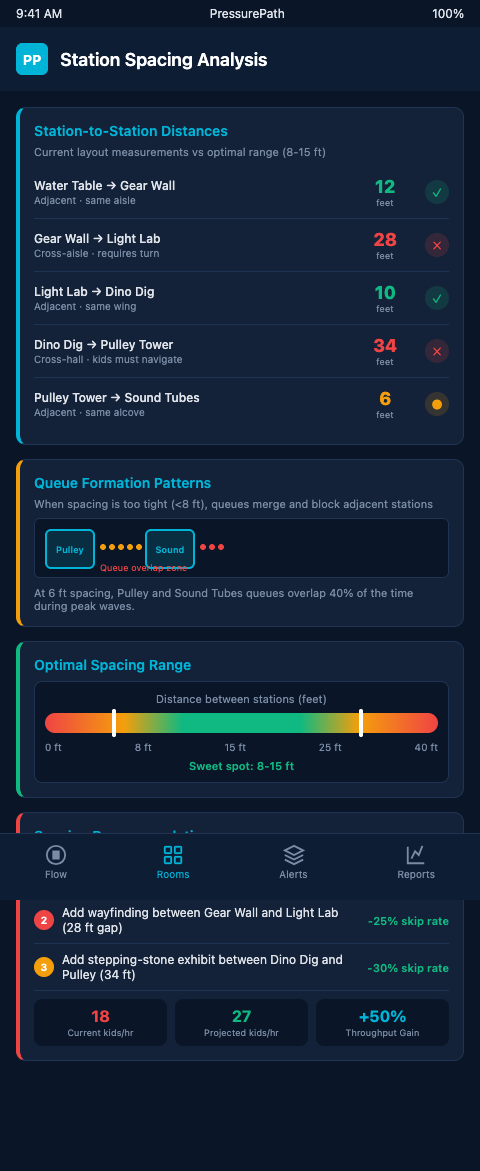
For a standard 30-kid third-grade wave with a 4-minute target dwell time per station, PressurePath's spacing model produces minimum and maximum inter-station distances: minimum spacing prevents the wave from arriving at peak pressure; maximum spacing prevents the reformed wave from achieving sufficient density to trigger a spontaneous stop. The target zone is typically 35–55 linear feet in a standard 12-foot-wide corridor.
Family interaction research in Visitor Studies found that three learning behavior measures are poorly correlated with each other—meaning a single spacing error in the sequence can eliminate the expected learning engagement for that station, even if all adjacent stations perform well. One gap that's too short breaks the reformation cycle and sends the wave through the following station at high pressure before it has recovered from the previous one. One gap that's too long allows the wave to re-concentrate into a high-density burst by the time it reaches the next station.
Educational throughput research from STEM Education Journal establishes that genuine learning transfer requires spaced, sequenced engagement—not just physical presence near multiple exhibits. The spacing component in that research refers to time between learning events, but the physical spacing of stations is the mechanism that creates temporal spacing in a field trip context. Correct physical spacing is what makes the temporal spacing between learning events achievable for a 30-kid school wave.
Occupancy data integration research demonstrates that combining occupancy sensors with dwell time data enables per-station throughput optimization. PressurePath integrates that sensor layer to validate spacing calculations against observed wave behavior and refine the model for your specific floor geometry.
The Child-Specific Spacing Adjustments
Adult visitor spacing models underestimate the bypass risk for school groups because they assume self-directed, variable-pace movement. Child groups move with coordinated wave dynamics that make spacing requirements more critical and less tolerant of approximation. A spacing that produces 80% contact from adult visitors may produce 20% contact from a 30-kid school wave in the same floor plan.
AAM exhibit design guidelines for children specify that spacing must account for child body size, reach, and social cluster radius. A social cluster of third-graders requires 48–60 square feet minimum for the cluster itself—wider than adult standards—because children group more physically and occupy more horizontal space relative to their height. Station approach zones for school groups should be sized to the cluster, not to individual visitor standards.
Age calibration matters as well. Third-graders (age 8–9) have a wave reformation cycle of 60–75 seconds and a deceleration distance of approximately 40–45 feet at standard sweep rates. Fifth-graders (age 10–11) have a longer reformation cycle of 80–100 seconds and need slightly less spacing because their self-regulation is better developed. PressurePath's spacing calculator accepts grade-level as an input and adjusts minimum inter-station distances accordingly.
The floor plan's corridor geometry also affects spacing requirements. A straight corridor allows the wave to maintain maximum velocity between stations—longer spacing needed. A corridor with a 90-degree turn between stations adds effective distance without adding floor space, because the turn forces a velocity reduction that extends the reformation window. This is why serpentine and hub-and-spoke layouts consistently outperform straight-corridor floor plans for school-wave throughput, even when the raw distances are similar.
The peer contagion speed and behavioral contagion thresholds that govern wave reformation timing are the behavioral basis for the spacing calculations. The physics follows directly from those behavioral parameters, and understanding why children reform into waves faster than adults helps explain why the spacing requirements are so much larger.
For stations that already carry high bypass risk due to footprint variables, the exhibit footprint bypass risk analysis shows how footprint-driven bypass compounds with spacing-driven bypass when both problems occur at the same station. Fixing spacing alone doesn't resolve footprint problems—both variables require attention for high-priority learning stations.
The safety throttle dynamics from ticketed attraction venues—covered in preventing safety throttles in haunted attractions—address the same throughput ceiling problem from a capacity management perspective. When groups arrive faster than spacing can accommodate, the system backs up in ways that designer expectations don't predict. The same compounding failure mode applies to children's museum floor plans that receive multiple school buses within a short arrival window.
Applying Spacing Fundamentals to Your Current Floor Plan
For most children's museums, station spacing was set during initial design and has not been revisited since. The floor plan exists, the stations are fixed, and a full redesign isn't available. In that context, spacing optimization takes a different form: not moving stations, but adding spacing elements that extend the effective distance between high-traffic stations.
Corridor chicanes, transitional activity zones, and wayfinding elements that require a directional change all add effective distance without changing station positions. A small interactive element in the corridor between stations 3 and 4—something low-threshold that doesn't demand a stop but creates a small velocity reduction—can extend the effective spacing by 15–20 feet without any construction. PressurePath models these secondary spacing interventions and predicts their effect on wave velocity at each station entry.
The ultimate goal of station spacing optimization is educational throughput: the number of learning goal activations per school group visit. That number is maximized when wave velocity at each station entry is in the deceleration zone—low enough that stops are likely, high enough that the wave doesn't arrive in exit-mode and refuse to engage regardless of the station's quality.
Children's museum exhibit designers who want to run a spacing analysis on their current floor plan can join the PressurePath waitlist. We'll model the wave reformation dynamics for your specific floor geometry and identify which inter-station gaps are producing throughput collapse—before the next field trip day reveals them through empty evaluation forms.