How Your Exhibit's Footprint Decides Bypass Risk
The Exhibit Nobody Planned to Bypass
At 10:22 AM, the 30-kid wave from Jefferson Elementary entered the east wing. The geology exhibit—4 feet wide, oriented parallel to the main corridor, positioned 3 feet off the circulation path on the left—received zero contact from the group. The exhibit directly across the corridor—8 feet wide, oriented perpendicular to the main path, with its interactive surface facing oncoming traffic—received 23 stops.
Same wing. Same wave. Same field trip day. One exhibit received 77% contact. The other received 0%. The content quality of both exhibits was rated equally by the museum's educational team. The difference was purely physical: footprint dimensions, orientation, and distance from the primary circulation path.
That's the footprint-bypass relationship, and it operates independently of content, funding, or educational priority. A museum can invest equally in two exhibits, position them in the same wing, and produce contact rate differences of 70+ percentage points—purely because of footprint decisions that nobody analyzed as pacing variables when the floor plan was designed.
The geology exhibit's bypass wasn't a content failure. It was a geometry failure. The footprint placed it in bypass shadow before the first school bus arrived. Every field trip day since installation has confirmed that shadow, and the post-visit surveys consistently show that the geology exhibit is one of the least-remembered stations from field trips—not because children didn't find it interesting, but because children never stopped there. Museum floor mapping is the diagnostic foundation that makes these geometry failures visible before they persist across a full field trip season.
How Footprint Variables Determine Bypass Risk
Four physical variables predict a station's bypass risk for a 30-kid school wave.
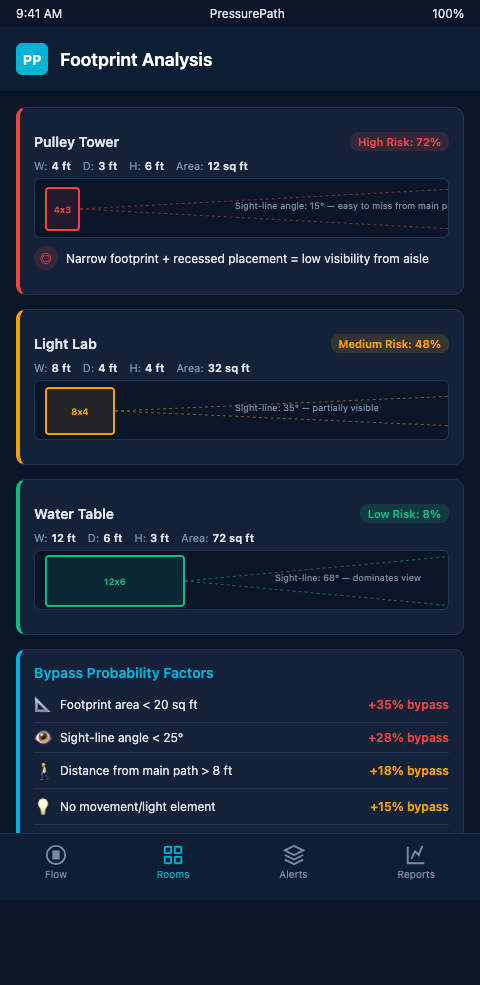
Frontage width. A station's frontage is the width of its interactive surface facing the circulation path. AAM guidelines on designing exhibitions for children establish that child body size and reach dictate spatial footprint requirements for engagement—a child interactive surface needs at least 18–24 inches of personal space per participant. A station with 4 feet of frontage can accommodate two children simultaneously. Under a 30-kid wave moving at standard sweep rate, a 2-participant capacity station captures approximately 6–8% of the group before the queue dynamic forces the rest to bypass.
Compare that to an 8-foot frontage station: four to six simultaneous participants, enough to absorb the wave's leading edge and create a visible cluster that pulls subsequent children via peer contagion. The frontage difference between 4 feet and 8 feet can change bypass rate by 40–50 percentage points, without changing anything else about the exhibit.
Orientation to the circulation path. Research on spatial layout and visitor paths shows that elongated layouts and complex turns increase cognitive load and raise bypass probability. A station oriented parallel to the main corridor asks visitors to step sideways off their path of travel—a high-resistance ask for a moving wave. A station oriented perpendicular to the corridor, with its face presenting to oncoming foot traffic, sits in the natural visual field of an approaching group and requires no deviation to begin engaging. The child's first contact with the station is in their line of travel, not a deliberate turn.
Distance from the primary flow path. Visitor path choice and wayfinding research consistently finds that station visibility from the entry point is the strongest predictor of whether a visitor stops. For a 30-kid wave in high-momentum flow, the effective engagement radius for a station is approximately 6–8 feet from the primary circulation path. A station positioned 10+ feet off the path requires a deliberate turn, which a wave in motion does not generate without an active redirect. A 12-foot setback is functionally equivalent to placing the station in a separate room for bypass risk purposes.
Approach geometry. Child grouping behavior research documents that school-age children in waves require at least 36–48 square feet of approach space per cluster to decelerate and form a stop. A station positioned at the end of a corridor dead-end creates natural deceleration geometry—the wave has nowhere to go but the exhibit. A station positioned mid-corridor with open bypass lanes on both sides experiences maximum bypass pressure because the wave has three options (left bypass, right bypass, or stop) and the stop requires the highest behavioral effort.
PressurePath's Footprint Risk Scoring
PressurePath treats every station as a node in the floor plan's pressure network and assigns each node a bypass risk score based on its footprint variables. That score predicts the fraction of a 30-kid wave that will bypass the station under normal field trip conditions.
The pressurized-fluid model is direct here: water under pressure flows around obstacles unless the pipe geometry forces it through a specific channel. A station with low frontage, parallel orientation, and 12-foot setback from the primary path is an obstacle the fluid flows around. A station with wide frontage, perpendicular orientation, and direct placement on the circulation path creates a forced channel—the wave must engage because the geometry leaves no other route.
Barrier placement research for museum exhibits demonstrates that physical barriers function as bypass-prevention tools by forcing routing through target zones. Rope partitions, low walls, and floor-level guide elements can compensate for footprint deficits—a 4-foot-wide station with a rope partition creating a choke point at its approach can receive higher contact rates than an 8-foot station with open bypass lanes. They're less effective than native footprint design, but they can convert a high-bypass station into a moderate-contact one without a full renovation.
Visitor flow sensor data provides real-time occupancy and bypass-risk scoring by footprint zone. When combined with PressurePath's pressure model, sensor data validates the footprint risk scores against actual wave behavior and identifies cases where the model under- or overestimates bypass due to factors like exhibit sound, lighting, or chaperone positioning on a given day.
Compensating for High-Bypass Footprints
Not every exhibit can be repositioned or expanded. When a high-bypass footprint is fixed by existing infrastructure, three compensating strategies can reduce bypass without physical renovation.
First, signal amplification: adding a large-format visual or audio element above the station that's visible from the primary circulation path before the station itself is visible. A 4-foot-wide geology exhibit with a 6-foot overhead display showing a volcanic eruption becomes visible from 30+ feet and generates approach interest before the wave reaches the bypass decision point.
Second, approach channeling: adding floor markers, low barriers, or directional lighting between the primary circulation path and the station entry. These create a soft funnel that reduces the physical effort required to step off the main corridor and approach the exhibit. Even a 12-inch-high rope line from the corridor to the station entry can increase contact rates by 15–25% by making the approach path feel designated rather than optional.
Third, staffing the approach: a docent or chaperone positioned at the point where the main corridor runs closest to the station—not at the station itself, but at the divergence point where the wave makes its bypass decision. That position intercepts the wave before it has committed to bypass, rather than attempting to redirect it after the decision.
Each of these three compensating strategies operates on a different part of the bypass mechanism: signal amplification addresses the visibility problem that makes high-setback stations invisible to the wave, approach channeling reduces the physical effort of entering a parallel-oriented station, and staffing the approach overrides the social momentum dynamic that keeps the wave moving past. For a station with multiple footprint deficits—low frontage, parallel orientation, and high setback—all three compensating strategies applied together can move a 5% contact rate into the 40–60% range without a single exhibit modification.
The spacing relationships between stations that define the wave's deceleration and reformation cycles are covered in station spacing for educational throughput, which explains how inter-station gaps interact with footprint variables to compound or offset bypass risk.
Non-linear performance space designers work with similar footprint and orientation constraints when blocking audience movement through multi-zone environments—spatial blocking in non-linear theater covers how physical geometry forces or prevents audience engagement with narrative zones in ways that closely parallel the museum footprint problem.
When Footprint Redesign Isn't Possible
Not every museum can reposition exhibits or expand station frontage within budget or physical constraints. When a footprint redesign isn't feasible, the bypass risk score from PressurePath's analysis becomes a triage tool: which high-bypass stations carry the most critical learning goals, and which compensating interventions—signal amplification, approach channeling, staffing positions—are available for those specific nodes.
Prioritization matters. A high-bypass station that carries an ancillary learning goal is a different problem from a high-bypass station that is the centerpiece of an NSF grant evaluation. The triage framework allocates compensating interventions to the stations where bypass has the highest educational cost, not uniformly across all high-bypass nodes.
The objective is to make the wave's default path coincide with the learning sequence, not to fight wave physics with cultural expectations. A floor plan that accepts the wave's physical behavior and channels it through critical stations achieves higher learning contact rates than one that resists that behavior and hopes for the best.
Children's museum exhibit designers who want to score their current floor plan for footprint-based bypass risk can join the PressurePath waitlist. We'll run the analysis and identify the highest-priority stations for redesign or compensating intervention.