Fundamentals of Child-Pacing: What's Different About Kid Flow
Third-Graders Don't Flow Like Adults
Picture a docent watching the 10:15 AM school group from P.S. 142 enter the exhibit hall. By 10:17, the group has fragmented, re-cohered, fragmented again, and three kids are already back at the atrium entrance asking where the bathroom is. Two minutes of elapsed time, four distinct movement patterns, and no one has stopped at any station.
This is not chaotic behavior. It is the documented movement signature of school-age children in group settings—predictable, repeatable, and fundamentally different from adult visitor flow in ways that matter for exhibit design.
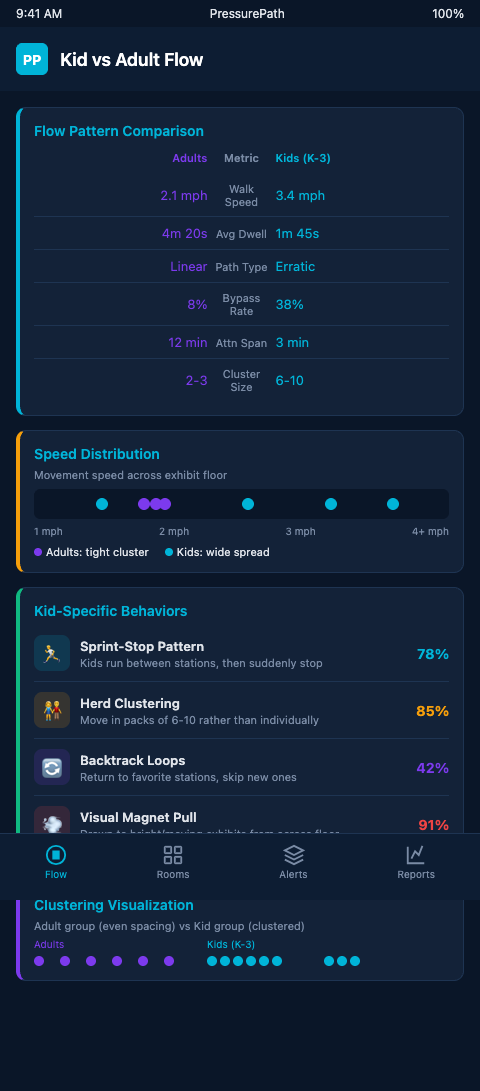
Adult visitors move through a museum as individuals or small clusters. They self-regulate pace, make deliberate choices about which exhibits to approach, and slow down organically when something catches interest. Child groups—especially the 30-kid waves that arrive on school buses—operate under a different physical logic. They enter as a cohesive social mass, they make collective movement decisions through peer contagion rather than individual preference, and they are subject to external time pressure from chaperones and bus schedules that adult visitors do not experience.
Research on grouping behavior among school-age children documents constant regrouping, speed variability, and coordinated wave movement that skips intervening elements. The wave is not composed of 30 independent navigators. It is a single social unit with emergent momentum, and that momentum is governed by peer dynamics more than by exhibit design.
The Three Structural Differences That Define Kid Flow
Behavioral contagion. Peer contagion research in child development shows that behavioral contagion among child peers causes rapid synchronized movement shifts. One child running becomes three running within seconds. One child stopping at a station generates a momentary cluster—but if the station doesn't capture that cluster within 10–15 seconds, the peer group's forward momentum overwhelms the stop and the wave continues. Adult visitors don't experience this dynamic. An adult stopping at a station holds the stop independently. A child stopping at a station is racing against the social clock.
This is where PressurePath's pressurized-fluid model becomes concrete: children behave like high-pressure bursts in a pipe system. Each burst carries forward kinetic energy. A station that doesn't create sufficient back-pressure to arrest that burst gets bypassed, regardless of its educational value. The back-pressure must be strong enough to overcome the peer contagion driving the wave forward—and it must act on the leading 6–8 children who are setting the pace, not just the stragglers.
Attention architecture. Research on sustained attention in children establishes that children's sustained attention is more task- and age-sensitive than adults, with third-graders showing consistent drop-off after 3–5 minutes on non-novel stimuli. This means a puzzle station with a two-minute warm-up period—common in interactive science exhibits—has already lost most of its audience before the payoff arrives.
Station design must account for immediate tactile feedback. The first touch should generate a visible, audible, or physical response within two seconds. That response holds the child through the cold-start period long enough for the deeper content to engage. Without that immediate response, the child's attention budget is spent on the initiation problem, not the learning content, and peer contagion pulls them away before the station delivers its value.
Adult-imposed time pressure. ASTC teacher survey data identifies bus schedules and tight time windows as the primary structural driver of rushed visits. The chaperone-to-child ratio compounds this: NAAEE research finds "guard stance" is the most observed chaperone behavior at 36%, with "walking past exhibits" at 31%. Chaperones are physically moving the wave forward, not into stations. A chaperone standing 20 feet ahead of the wave, facing backward and gesturing forward, is a forward momentum signal that children obey more reliably than any exhibit's invitation to stop.
Parent-child interaction research in children's museums shows that child-initiated versus adult-directed exploration produces different flow and dwell patterns—child-initiated exploration produces longer, deeper stops. But child initiation requires a space free from forward momentum. A chaperone-managed wave doesn't produce that space unless the chaperone is specifically positioned and scripted to create it.
How Kid Flow Differs Across School Group Types
Not all school waves are identical. A 30-kid third-grade group from P.S. 142 moves differently than a 30-kid sixth-grade group from a suburban district, which moves differently than a mixed K–3 group. Age affects both the peer contagion speed and the attention architecture, making age-calibrated design a meaningful variable in bypass risk.
Third-graders (approximately 8–9 years old) operate at peak peer contagion speed—behavioral synchronization happens in 3–5 seconds. Their attention windows are 2–4 minutes on moderate-complexity tasks. Sixth-graders have longer attention windows (4–8 minutes) and slower contagion dynamics, which means they're more likely to hold a stop at a puzzle station once initiated, but also harder to initiate because the social permission threshold is higher.
Group composition also affects flow. A group with a high ratio of chaperones (1:5 or better) moves more slowly and stops more frequently than a group with minimal adult coverage. But without choreography—specific station-level positioning instructions—additional chaperones often amplify the guard-stance problem rather than reducing it. More adults in guard stance means more forward momentum signals, not fewer bypass events. The grade-level variance here also interacts with station spacing for educational throughput, because different wave reformation cycles require different inter-station gap calculations.
The wave structure itself matters: some 30-kid groups arrive as a tight cohort, all within 20 feet of each other. Others string out over 50–70 feet due to variable walking speed. The tight cohort creates higher bypass pressure because the wave's mass is concentrated. The strung-out group disperses pressure along the corridor, which can actually increase station contact—but it also creates a herding dynamic where chaperones try to compress the group, which rebuilds the pressure burst at each collection point.
Designing for Kid Flow Rather Than Against It
The error most children's museum floor plans make is optimizing for adult visitor behavior—dispersed arrival, self-directed exploration, variable dwell time. That model fails for field trip groups because the structural inputs are entirely different.
Designing for kid flow means accepting that the wave will move with behavioral contagion dynamics and building the floor plan to redirect that energy rather than resist it. Three design implications follow from the structural differences above.
First, create early wins. The wave needs a capture point within the first 30 feet of entry that converts forward momentum into a cluster without losing the group. This is not your most important exhibit—it's your highest-energy exhibit, positioned to absorb the first-contact burst. The early win station doesn't need to be pedagogically deep. It needs to convert wave momentum into cluster dynamics, after which the peer contagion works in favor of sustained stops rather than forward movement.
Second, space stations to match wave reformation time. After a cluster disperses from an early-capture exhibit, the wave reforms for 60–90 seconds before the next burst. Station spacing should place the next exhibit at the end of that reformation period—close enough that the reformed wave naturally arrives without a deliberate turn. Too close, and the wave arrives still partially dispersed and doesn't generate a full cluster. Too far, and the wave rebuilds maximum momentum before reaching the station.
Third, support chaperone choreography as a flow tool rather than a crowd management function. A chaperone positioned at a station entry 30 seconds before the wave arrives converts that station from optional to mandatory in the children's social logic. The exhibit becomes the place the adult is standing, and peer contagion does the rest.
The myths around walk-through times and capacity in other attraction types map directly to this problem—walk-through capacity models in haunted attractions reveal why measured throughput numbers almost never match designed expectations when groups move as social units rather than individuals. The discrepancy between expected and actual throughput is structurally similar to the discrepancy between expected and actual station contact in a children's museum.
The spacing mechanics that turn these behavioral principles into physical distances—the calculation framework that converts wave reformation timing into minimum and maximum inter-station gaps—are directly downstream from understanding the child flow model itself.
The Sensor Layer for Kid Flow Monitoring
People counter technology applied to museum settings achieves 99.9% accuracy in tracking child-group movement across time-pressured visits. Combined with dwell time per station, that data produces a real-time picture of where the wave is, where it's collapsing, and which stations are currently sitting in bypass shadow.
PressurePath integrates that sensor layer into the simulation model, allowing exhibit designers to compare predicted wave behavior against observed movement during actual field trip days. The gap between prediction and observation identifies where the floor plan's assumptions about kid flow are wrong—and what specific design intervention would close that gap.
Getting kid flow right starts with acknowledging that it isn't adult visitor flow with extra energy. It's a categorically different pacing challenge, governed by peer contagion, compressed attention windows, and adult-imposed time pressure—all of which can be modeled, predicted, and designed for once you accept them as the actual inputs.
Children's museum exhibit designers building or renovating floor plans for school-group traffic should request early access to PressurePath's kid flow modeling module. The first simulation is free, and the results typically identify at least one station redesign that would convert consistent bypass into documented engagement.