Building Actor Cues That Respond to Real-Time Group Spacing
The Cue That Fires Into a Crowded Strike Zone
A scare actor in the Graveyard Tunnel section of a mid-scale haunt had a well-rehearsed cue sequence: wait for the first person to reach the third tombstone, hold for two beats, rise from the ground on the left side. At 200 tickets, it worked every night. At 350 tickets, the "first person to reach the third tombstone" was the fourth person in a six-person group that was still compressed from the previous room. The actor's 6-foot strike zone had two additional people in it before he completed the rise. The scare scared nobody and put the actor physically closer to three guests than the safety protocol allowed.
Actor Safety in the New World (HAN) establishes the arm's-length rule as the defining constraint: actor strike zones require specific spacing gaps to function safely. When that gap isn't present, the cue system has failed — not the actor. A cue built on elapsed time or positional triggers doesn't account for the density state of the group; it accounts only for the location of the first person, which is the wrong input on a peak night.
Horror Industry Association research on scare techniques confirms what experienced actors already know: skilled scare actors adapt timing to group spacing, holding or advancing their beat based on whether the group is spread or compressed. That's tacit expertise. The challenge for haunted attraction designers is converting that tacit expertise into a cue system that works for every actor in every zone, not just the veterans.
Designing Cue Systems That Read Group Spacing
The gap between current actor cue systems and what peak-density nights require is a sensor problem: cues fire based on information the actor can observe (a person's position) when what matters is information the actor can't reliably assess in real time (group density relative to strike zone threshold). Building responsive cues means bridging that gap with a signal that carries density information to the actor before the group arrives.
The pressurized-water-in-pipes framework applies directly here. Upstream density isn't visible from inside a scare chamber — but it's predictable from the flow model. When 400 people are moving through a haunt with a known bottleneck at the Clown Alley corridor, the actor in the next zone downstream can be given a density signal derived from the upstream measurement rather than waiting to discover the problem when a compressed group arrives in their strike zone.
MDPI research on computer vision-based audience analysis shows that CV-based audience analysis enables dynamic content triggering in live events. That's the high-tech implementation: cameras at key pinch-points detect group density and feed signals to downstream actors. IoT sensor platforms reviewed by Neoma AI provide a practical version of this — sensor arrays that detect real-time group-gap data and can trigger actor-ready signals at defined thresholds.
The practical implementation for most haunts doesn't require CV or IoT infrastructure. It requires a simpler cue structure: a spacing signal that tells the actor whether the incoming group is above or below the safe density threshold for their strike zone. That signal can come from a runner, a radio call, a light system, or a floor monitor with a density read from the previous room. The key is that the cue fires on spacing state, not time elapsed.
QLab's audio trigger cookbook demonstrates the threshold-based monitoring principle in theatrical cue systems: a sensor reading fires a cue when it crosses a defined threshold. Applied to haunts, the "sensor" is upstream density and the "cue" is the actor signal. When upstream density crosses the compression threshold, the actor receives a hold signal rather than a fire signal.
Building on the 20-actor scare timing workflow covered earlier, responsive actor cues are the real-time execution layer of the larger coordination system. The workflow establishes which zones are density-sensitive and what threshold triggers a timing adjustment; the cue system delivers that adjustment to the individual actor in real time.
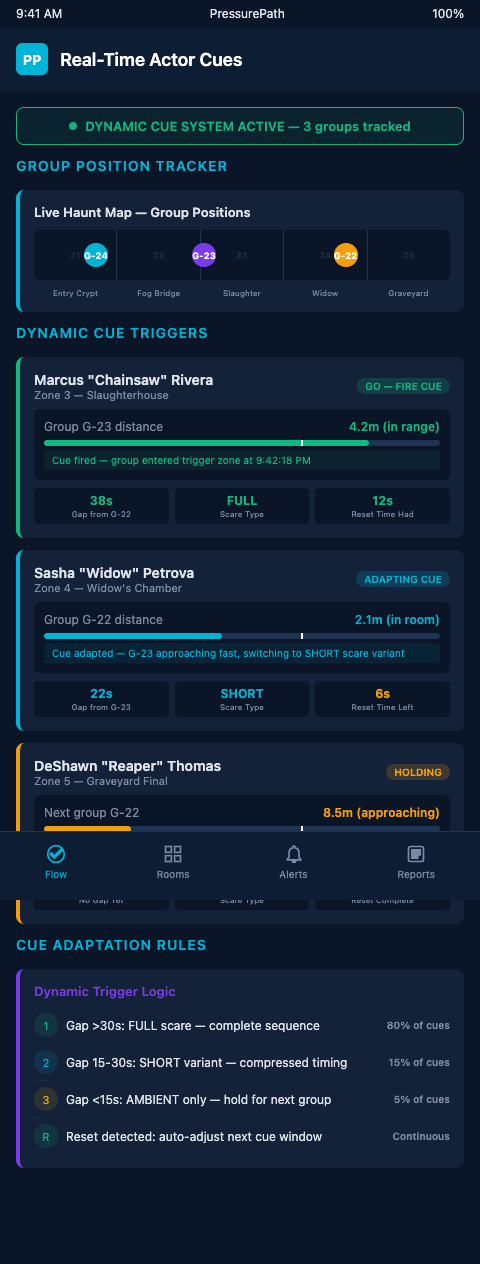
PressurePath integrates these layers: the pre-season flow model identifies which zones will experience spacing compression at which ticket volumes, and the live monitoring output provides the zone-specific density reading that feeds the cue signal. The actor doesn't need to assess spacing — they receive a signal calibrated to tonight's crowd state.
Advanced Cue Protocols: Chaperone Scripting and Group-State Handoffs
Responsive actor cues work best when they're complemented by a group-state handoff system — a signal that travels with the group from zone to zone rather than requiring each actor to receive a fresh density read independently. The simplest version is a chaperone script: a front-of-group guide whose behavior signals group state to each actor they pass.
If the chaperone walks at normal pace and the group is well-spaced, each actor receives an implicit "fire normal" signal. If the chaperone slows, stops, or raises a hand signal, actors receive a "hold" or "adjust" prompt. This converts the chaperone from a compliance tool into a live cue carrier — reducing the sensor infrastructure required while preserving per-zone responsiveness.
VizioSense's crowd density monitoring research identifies 4 people per square meter as the high-risk threshold used in public spaces to trigger flow interventions. For haunted attractions, that threshold maps directly to the actor strike zone failure condition: above 4 per square meter, most actors lose the minimum separation their scare requires. Building the chaperone cue protocol around that numeric threshold gives floor managers a concrete trigger rather than a subjective "looks too crowded."
CuePilot's real-time synchronization approach for multi-performer coordination in live production offers the technology-enabled version of this: a cue system that updates all performers simultaneously when a condition changes, rather than requiring individual radio calls per zone. Adapted for haunts, this means a density threshold breach in Room 3 triggers hold signals across Rooms 4, 5, and 6 simultaneously — protecting the full downstream sequence rather than just the next zone.
The actor timing basics foundation established for flow-constrained haunts applies here: an actor who understands why their timing window changes under peak density can adapt their beat in response to a cue signal. An actor who only knows their fixed beat will be confused by a hold signal. Training actors on the density-timing relationship makes the cue system operationally effective, not just technically functional.
Museum magnet station design principles offer a cross-context technique: slow-pass elements placed before scare zones that give actors a density-correction window. When a group pauses at a pre-scare element, their spacing naturally increases — the actor receives a compressed group and has extra time to let it spread before firing. This doesn't replace a density-responsive cue, but it reduces the frequency of spacing failures by building natural deceleration into the guest path.
Give Every Actor the Same Density Information the Floor Manager Has
The information asymmetry between floor managers and individual actors is the operational gap most 20-actor haunts never close. The floor manager watches the radio, the ticket count, and the monitor feeds — they have real-time density awareness. The Room 7 actor has the same awareness only during the 30 seconds between groups and must infer upstream conditions from the visible shape of the incoming batch. That inference is where scares die. At 420 tickets on a peak Saturday, the gap between Room 7's knowledge and the floor manager's knowledge can cost 4-6 missed beats per hour during the 9:00-10:30 PM surge window — and each missed beat ripples through the downstream sequence for two additional rooms before the actors there fully recover their timing rhythm.
Closing the gap doesn't require a camera system or a custom sensor array. It requires that every actor receive the same density signal the floor manager is already reading, delivered at the same cadence, and calibrated to that actor's specific strike zone threshold. A 4-person-per-square-meter trigger at Room 3 fires a hold signal to Rooms 4, 5, and 6 simultaneously. A clear reading at Room 3 fires a normal signal. The signal itself is simple. The pre-season calibration — what threshold each zone uses, which upstream rooms feed each downstream actor's density state — is what PressurePath builds from your flow model.
PressurePath delivers real-time group spacing signals per zone so every actor in your haunted attraction fires on crowd-state data, not fixed elapsed time. Stop letting peak-night density degrade scares one missed beat at a time. Join the waitlist and bring responsive actor cues into your peak weekend operations this season.