Why Your Dead Rooms Happen: A Spatial Pacing Primer for Directors
When the Stage Manager Reports Zero Count
Fifteen minutes into the second act of an immersive production, the stage manager's headset crackles: Room 7 has zero viewers. The botanical scene — the one with the confession monologue the director spent four rehearsals on — is playing to an empty room while Room 4 is so packed the actor has retreated to the wall. That's a dead room. Not a room that's quiet or intimate. A room where no one goes.
Dead rooms appear in virtually every multi-room immersive production that hasn't modeled audience flow before rehearsal. Research on place schema theory from Bilkent University explains why: audiences cluster in rooms that feel spatially familiar — larger, better-lit, with recognizable social configurations — and avoid rooms that feel peripheral, narrow, or poorly connected to the rooms they just left. The director designing Room 7 as an intimate confessional space has inadvertently created a low-pull node in a network where Room 4's ballroom-scale staging generates overwhelming pressure that keeps viewers locked in place.
Gensler's analysis of immersive venue design notes that fluid audience distribution across intimate and gathering spaces must be anticipated in the architectural design phase — not corrected in the rehearsal phase. When directors discover dead rooms in tech week, the correction options are blunt: add a performer to the dead room, install a sound attractor at the entrance, or restructure the cue-exit timing in upstream scenes. All three are expensive interventions made against an opening-night deadline.
The Spatial Pacing Framework Directors Need
Spatial pacing is the discipline of designing audience flow between scene rooms as deliberately as blocking designs actor movement within them. The pressure-pipe model makes this concrete: each room in your venue is a chamber in a pipe network. Audience mass is pressurized water. Every scene generates a pressure value — high-status action, proximity to entrances, visual magnetism — that determines how strongly it draws viewers from adjacent corridors.
Dead rooms happen at the end of low-pressure chains. Room 7 sits two turns off the main corridor, preceded by Room 6 which has a strong performance beat that nobody exits during the scene. Room 7's inlet receives almost no audience pressure because Room 6 is holding it all. The HowlRound analysis of choreographing attention in spatial-relational practices frames this as a choreographic failure: when spatial directors don't use environmental tools to guide attention across zones, audience pressure follows the path of least resistance rather than the director's arc.
PressurePath models your venue as a pressure network before you block a single scene. You input the room layout, the corridor connections, and the relative pull values of each scene. The simulation outputs a heat map of predicted audience distribution at each timestamp in the show. Dead rooms appear in the heat map as low-pressure zones before any performer has stepped into them. The platform then identifies the upstream scene whose cue-exit adjustment, or the corridor modification whose friction reduction, would route audience pressure into Room 7 in time for the confession monologue.
The quantitative visitor distribution modeling developed for museum dead-zone diagnosis uses the same pressure-gradient logic: rooms that receive low traffic share a spatial signature — they sit downstream of high-pull nodes with insufficient pressure routing between them. In immersive theater, the corrective intervention is a directed cue-exit in the high-pull upstream scene that fires before the upstream scene reaches its climax, releasing audience pressure into the corridor network with enough lead time for viewers to reach Room 7.
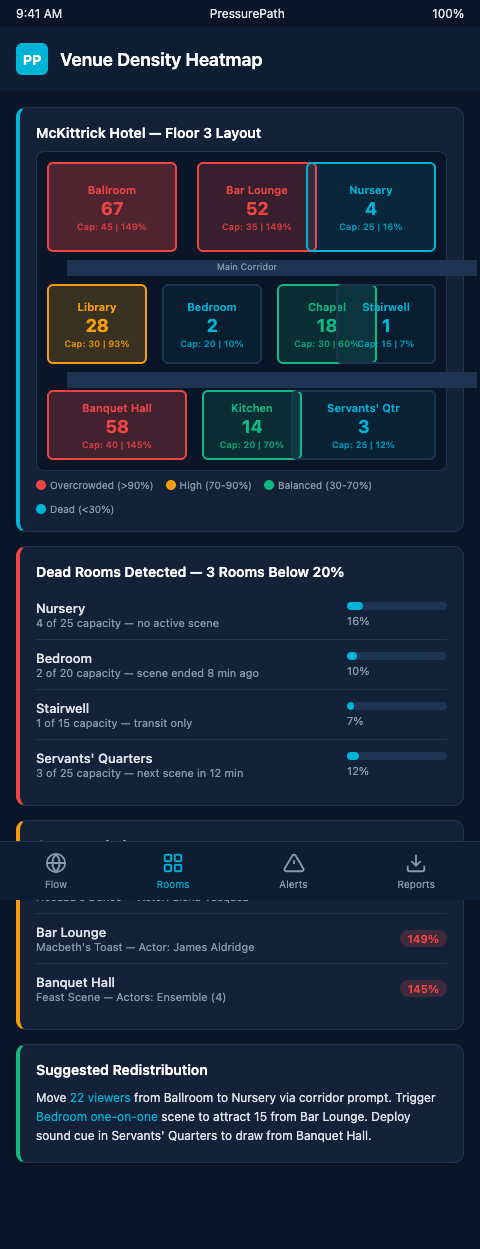
Four spatial pacing principles guide dead room prevention:
Inlet visibility. A dead room's entrance must be visible from the corridor where audiences leave the upstream scene. If viewers exiting Room 6 cannot see Room 7's doorway within their first three steps into the corridor, the room is architecturally dead regardless of what's happening inside it.
Cue-exit lead time. The upstream scene's cue exit should fire at the build phase, not the climax. Audiences released at the climax stay through the emotional peak and then wander — they don't follow a route. Audiences released during the build phase remain in motion and are directable.
Corridor resistance calibration. The corridor between Rooms 6 and 7 needs enough friction to hold viewers briefly — a performance beat, a prop installation, a sound design element — but not so much friction that viewers stop moving entirely and create a new pressure node in the corridor itself.
Sightline bait. A partial sightline into Room 7 from the corridor — a glimpse of the actor, a fragment of sound — creates pull that supplements the push from Room 6's cue exit. The Adam Alston analysis of venue layout and participation patterns documents how spatial design politics determine participation density: rooms that offer sightline access from approach corridors consistently outperform rooms that reveal themselves only after entry.
Dead rooms also cluster by show phase. In the first 20 minutes, dead rooms tend to appear at the venue's spatial periphery — rooms far from the entrance cluster that requires the most deliberate routing to reach. In the middle third of the show, dead rooms shift: they are now rooms adjacent to the high-pull scenes that are drawing maximum density, because the pressure differential between the high-pull scene and its neighbors creates a pull shadow — a zone of low pressure behind the high-density chamber. In the final third, dead rooms reappear at rooms whose performance beats are complete but whose exits haven't been clearly communicated, leaving residual viewers in completed scenes rather than routing them toward the closing sequence.
PressurePath's phase-based dead room analysis maps these three distinct patterns separately, because the intervention for a peripheral dead room (inlet visibility enhancement) is different from the intervention for a pull shadow dead room (cue-exit timing in the adjacent high-pull scene) and different again from a residual dead room (clear physical exit staging and corridor lighting). Applying the wrong intervention wastes production resources and often creates secondary pacing problems.
For directors building their first systematic flow analysis, the packed scene detection method provides the complementary diagnostic — identifying which rooms are overcrowded so the director can map the pressure flow from overcrowded source to starved destination. The pressure pipe model for group flow applied in escape room franchises uses the same hydraulic logic in a slightly different venue configuration, and the mapping methodology transfers directly to immersive theater. Once you understand the network topology, the director flow map step-by-step process shows how to translate spatial pacing principles into a working pre-rehearsal document.
From Primer to Production Tool
The spatial pacing primer for directors ultimately resolves into a single discipline shift: designing the audience's journey through the venue with the same intentionality as designing the actor's journey through the blocking arc. When both journeys are designed together — when the actor's cue exit is tied to the audience's pressure distribution — dead rooms cease to be a tech week discovery and become a pre-rehearsal design parameter.
Dead rooms are not a mystery. They are predictable outputs of a network where pressure routing has never been designed. The spatial pacing primer for directors resolves into three actionable outputs: a venue flow map with pressure values per scene, a cue-exit schedule driven by upstream scene lead times, and a corridor friction plan that guides rather than blocks audience movement.
Two secondary dead room triggers are worth flagging for directors working with larger ensembles. First, multi-performer scene designs where two or more actors share the same room concentrate pull in a single location, doubling the pressure differential between that room and its neighbors. The net effect is that every room adjacent to a multi-performer scene becomes a dead room candidate unless the cue-exit schedule actively redirects pressure from the multi-performer chamber before its scene peaks. Second, scene rooms with multiple entrances are not protected from dead room status — they can receive too little pressure through both entrances simultaneously if the corridor connections from each are routed from the same upstream source. A room with two corridors both connected to the multi-performer scene's exit is not doubly served; it is served by a single pressure source, split across two inlets.
The stage manager's role in dead room management shifts when the production uses a flow model. Rather than calling dead room observations reactively on headset, the stage manager monitors the flow model's deviation alerts proactively. When Scene 6's exit count shows 4 viewers exiting in a 10-minute window against an expected 11, the model flags an upstream hold condition in Scene 5. The stage manager has the intervention — fire Scene 5's cue exit early — before Room 7 drops below its minimum viable count.
Unmanaged audience flow creates production design failures — the Cornell ILR analysis is unambiguous on this point. The difference between a production with dead rooms and one without is not artistic vision or performer quality. It is the presence or absence of a spatial pacing model built before the first technical rehearsal.
PressurePath provides the simulation layer that converts your venue map and blocking arc into a pressure routing plan. The dead room your stage manager reports in tech week is the same dead room PressurePath's heat map flags in the pre-rehearsal simulation — before you've scheduled a single run-through. Immersive theater companies that want to stop losing scenes to audience drift and dead room formation: join the waitlist and bring spatial pacing discipline to your next production before rehearsals begin.