The Director's Guide to First Flow Maps for Immersive Venues
The Document That Doesn't Exist in Most Productions
Ask a first-time immersive director for their venue's flow map and you'll usually get a confused look followed by the floor plan. The floor plan shows rooms and corridors. The flow map shows which rooms audiences actually move through, at what density, at what timestamps, and via which corridor connections. It is a different document — and in most first-time immersive productions, it doesn't exist.
This is the structural gap that produces dead rooms, packed scenes, and blocking arc failures in the first week of previews. The director has a blocking notation for every scene. The stage manager has a call sheet for every cue. Nobody has a document that shows how audience pressure flows between scenes from the moment the doors open to the final curtain call.
The Grand View Research immersive theater market report values the sector at $20.7 billion in 2024, growing at 26.9% CAGR. Productions that can demonstrate consistent pacing control across multi-night runs differentiate themselves from the majority that treat audience flow as an unmanageable variable. The flow map is the discipline tool that makes that consistency achievable.
Site-specific directors approach space mapping as a precondition of staging, not an afterthought. The flow map is the spatial director's pre-rehearsal instrument — the document that translates the venue's architecture into a pressure network before a single actor takes a position.
The absence of a flow map has a compounding effect on the rest of the production documentation. Without one, the blocking notation is written as if the audience were a fixed constant, the call sheet schedules cues as if audience position were invariant, and the stage manager's running script contains no density reference against which to judge whether a scene is receiving the audience the director intended. Every downstream document inherits the gap. When a problem surfaces in tech week, none of the available documents contain the data needed to diagnose it — because that data was never captured in the first place.
Directors who have built a flow map once describe it as the document that changes how they read every other production document. A call sheet entry that previously read as "Scene 4, Library, 9:47 PM" now reads as "Scene 4, Library, 9:47 PM, expected 22 viewers from Scene 3's cue-exit release." The flow map retroactively populates the missing density column in every document the production uses.
Building the First Flow Map Step by Step
Step 1: Map the venue as a pressure network. Start with the floor plan. Label each scene room as a node and each corridor connection as an edge. Assign a relative pull value to each node based on the scene content: high-status performance, large spatial volume, proximity to the main entrance, and visual magnetism all increase pull value. A scene with a solo performer in a small room at the end of a long corridor has a low pull value unless the corridor uses strong directional routing toward it.
Step 2: Define your blocking arc density targets. For each scene, at each major timestamp in the show, define the target audience density. These are not aspirational numbers — they are the operational requirements of the blocking arc. If Scene 4's confession requires 20–28 viewers for the actor's performance logic to function correctly, that range is the density target. If Scene 7 functions as an intimate encounter for 4–8 viewers, that ceiling is structural to the scene's intent.
Step 3: Model the pressure flow. Using the density targets and the pull values, trace the projected audience distribution at each timestamp. This is where PressurePath's simulation becomes the primary tool: the platform takes your venue map, your scene pull values, and your cue-exit schedule and outputs the projected density per room at each timestamp. The output is your first flow map.
The pressure-pipe model underlying this simulation treats each corridor as a pipe with resistance determined by its width, length, and installed design elements. A wide, short corridor with a performer positioned at the scene room entrance has low resistance — audience pressure flows freely. A narrow, long corridor with no design elements and a competing room entrance halfway down has high resistance — audience pressure accumulates in the corridor rather than reaching the target scene.
Visibility graph analysis of how spatial layout shapes natural movement paths provides the quantitative framework for assigning resistance values to corridors: corridor segments with high spatial integration (visible from many other points in the venue) generate lower resistance than corridor segments with low integration (visible only from their immediate endpoints). Mapping your venue's integration values before assigning resistance gives the flow model a spatial-science foundation rather than an intuition-based approximation.
Step 4: Identify dead rooms and collapse risks. The first flow map will show at least one dead room and at least one packed scene. That is expected — it is the reason for building the flow map before rehearsal. The dead room will be at the end of a low-resistance chain from a high-pull scene. The packed scene will be the high-pull scene itself, receiving more pressure than its sightline ceiling allows.
Identifying dead rooms and collapse risks from the flow map requires understanding that these are paired phenomena, not independent problems. Every packed scene in a venue has at least one corresponding dead room — the room that is starved of pressure because the packed scene is holding it. When PressurePath flags a packed scene, the platform simultaneously identifies the dead room chain downstream, because the intervention that relieves the packed scene must route its released pressure somewhere specific. Routing packed scene pressure into an already adequately-filled room creates a second packed scene; routing it into the identified dead room resolves both problems simultaneously. Directors who treat packed scenes and dead rooms as separate problems often create a new dead room when they fix a packed scene and vice versa.
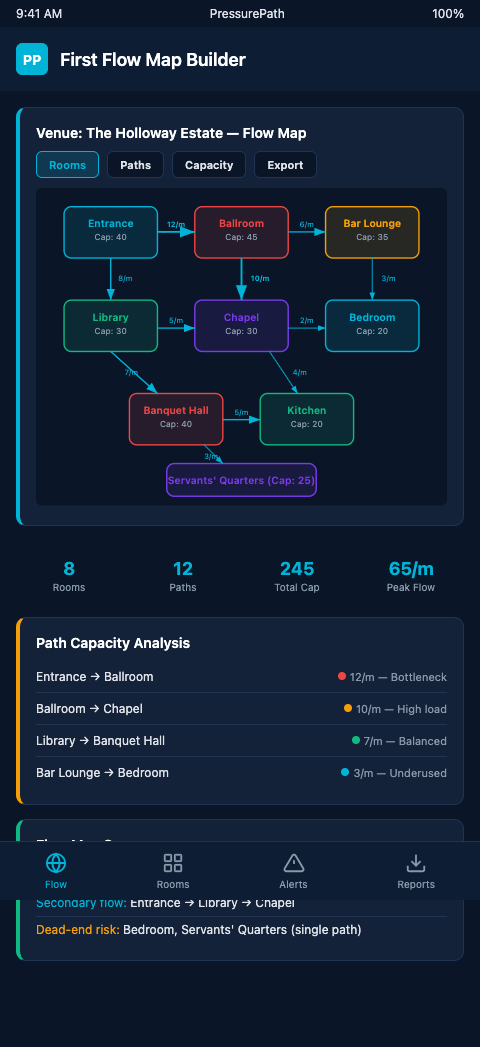
Step 5: Adjust cue-exit timing and corridor design. PressurePath's cue exit re-timing tool presents the adjustments that resolve the dead room and the packed scene simultaneously. The most common resolution involves moving the packed scene's cue exit 90–120 seconds earlier and increasing corridor resistance between the packed scene and the competing dead-end rooms.
Step 6: Validate the map with a walkthrough. Before the first rehearsal, walk the venue with your flow map and test the routing assumptions physically. Walk the route from Scene 3's exit to Scene 4's entrance and time the transit. Identify every competing sight line along that route — every open door, every visible performer position, every light source — and assess whether the corridor design's routing signals are stronger than the competing pulls. Adjust pull values and corridor resistance in the flow map based on the walkthrough findings. A flow map built from floor plan analysis alone will consistently underestimate corridor resistance in venues with irregular geometry or multiple competing visual attractors along the approach route.
Corridor layout creates natural movement corridors that directors can use as flow map anchors — the spatial science of natural movement shows that corridor alignment with the venue's primary axis of movement produces 40–60% higher transit rates than corridors perpendicular to that axis. Directors who understand this use it to position high-priority scene rooms along the natural movement axis and lower-priority rooms off it, with corridor design friction calibrated to pull the right proportion of viewers off-axis.
The spatial pacing concepts in the dead rooms primer provide the theoretical foundation for the pull value and resistance assignments that make the flow map accurate rather than approximate. When you're ready to convert the flow map into the full simulation, the first audience pacing model guide walks through the scene-by-scene model building process. The first flow map methodology uses the same five-step structure in a venue with different scene pull dynamics, and the comparative analysis is useful for directors building flow maps for immersive shows with game-adjacent mechanics.
From Flow Map to Blocking Discipline
A flow map without a cue-exit schedule is a diagnostic without a treatment. The flow map identifies where audience pressure will fail your blocking arc; the cue-exit schedule is the intervention plan. Together they constitute the spatial pacing discipline that separates productions with consistent audience distribution from productions that discover their density problems in tech week.
First-time flow map builders commonly make two mistakes that undermine the map's accuracy. The first is treating pull values as static throughout the show. In reality, pull values change across the performance: a scene with a strong opening beat has a high pull value at the start of the show that diminishes once most of the audience has seen it, while a scene with a slow build accumulates pull value as word spreads through the audience network. Flow maps that use single static pull values produce density projections that are accurate in the first act and progressively less accurate in subsequent acts.
The second common mistake is ignoring venue-specific multipliers for social behavior. In productions with audiences who know each other — corporate events, community theater — audience members cluster together and are less likely to separate and follow different scene routes. In productions with strangers — public ticketed runs — audiences are more willing to separate and follow individual curiosity. These behavioral differences affect the distribution model: stranger audiences produce more even distributions across scene rooms, while socially connected audiences produce tighter clusters around the scenes their social group collectively chooses.
PressurePath's computational framework generates both documents from the same simulation run. The output is a venue-specific flow map, a scene-by-scene cue-exit schedule, and a corridor design brief — the three documents a first-time immersive director needs before rehearsals begin.
The practical dramaturgy guide from the University of Houston frames spatial blocking notation as a precondition of immersive dramaturgy — the director who builds the flow map before the first rehearsal is doing dramaturgy in the fullest sense: designing how the story moves through space rather than simply how actors move through it.
Immersive theater directors producing their first multi-room show or their first show at a new venue: join the PressurePath waitlist for immersive theater companies. Build your flow map before you block your first scene.