Building Your First Audience Pacing Model Scene by Scene
The Night the Model Would Have Caught It
Scene 7 needs 14–18 viewers for the soliloquy to work. On night 12, it received 7. The director watched the headset report come in: Room 7, current count 7. The stage manager had nothing to offer — they knew the room was light but the show had been running for 11 nights and this was the first time it had dropped this low. Without a pacing model, there was no way to identify whether the shortfall came from Scene 5's cue exit timing, Scene 3's unexpectedly long hold, or a corridor routing change the stage manager had made in week two. The scene ran at 7. The soliloquy didn't work.
An audience pacing model would have identified the deviation at Scene 5 before the pressure deficit reached Scene 7. It would have flagged that Scene 5 was holding viewers 40 seconds longer than the model's expected release time, and that the downstream pressure through Scene 6 into Scene 7 was therefore below target. The stage manager would have had a specific intervention — fire Scene 5's cue exit at the model's scheduled time — rather than watching the count arrive and having no diagnostic tool available.
The retrospective analysis of night 12 — using the model to reconstruct what happened — is also valuable. By inputting the actual timing data from that night against the flow model's projections, the director and stage manager can identify exactly where the pressure chain diverged from the plan. In this case, the analysis reveals that the corridor routing change made in week two had increased resistance between Scene 6 and Scene 7's inlet by approximately 35%, meaning Scene 6 was holding viewers longer than modeled throughout the run. Night 12's unusually low count was the result of that accumulated resistance combining with a slightly longer Scene 5. The corridor modification is reversed, and Scene 7's counts recover to target.
Research on designing audience agency in immersive theater from ISLS provides the conceptual framework: scene-by-scene agency parameters that control audience distribution can be designed deliberately, which means they can be modeled. The model is not a constraint on audience freedom — it is a predictive tool that tells the director whether their cue-exit schedule will deliver the density distribution the blocking arc requires.
Sleep No More's room-by-room design logic is the most studied example of scene pacing in immersive theater. The McKittrick Hotel's five floors are a spatial pacing system — each room's scale, content, and corridor connections create a specific pull value that routes audiences through the building. Building a scene-by-scene pacing model for a new production means applying the same design logic explicitly rather than relying on intuitive spatial decisions.
Building the Scene-by-Scene Model
The scene-by-scene audience pacing model has four components: a scene inventory, a cue-exit schedule, a pressure flow calculation, and a deviation detection threshold.
Scene inventory. For each scene in your production, document: room dimensions, sightline ceiling (maximum viewers before sightline degradation), target density range (minimum and maximum viewers for the blocking arc to function), scene duration (start and end timestamp), and relative pull value (1–10 scale based on performance status, spatial volume, and corridor visibility).
Cue-exit schedule. For each scene, document: cue-exit timestamp (when the cue fires to begin releasing viewers), expected release rate (viewers per minute leaving the scene), and primary destination (which room receives the majority of released viewers based on corridor routing).
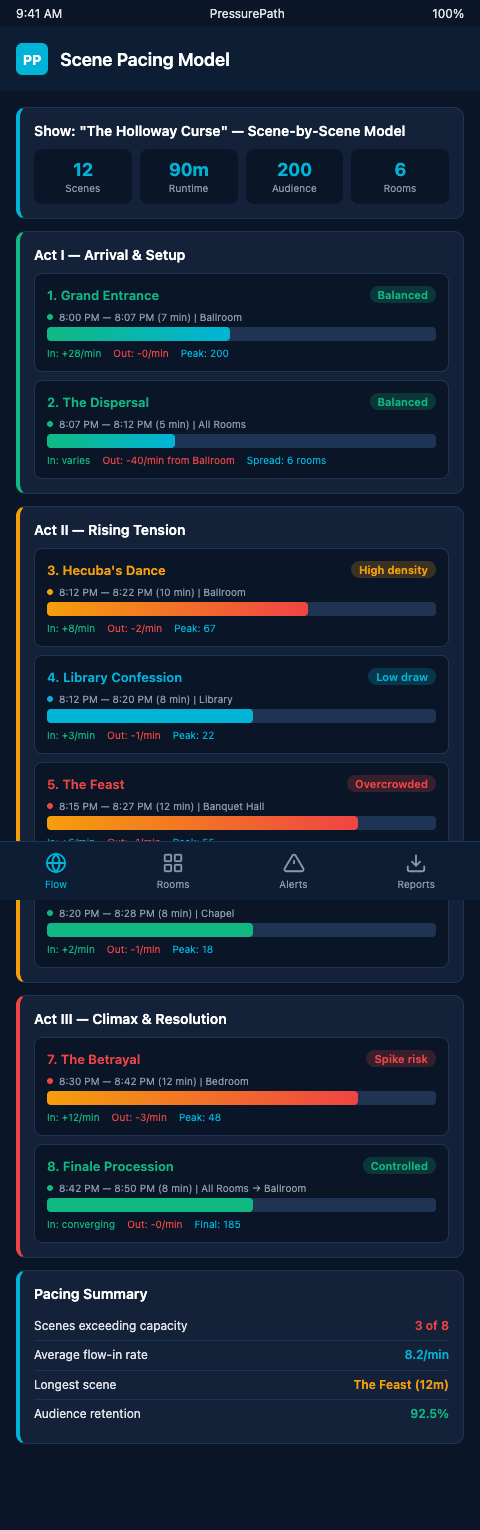
Pressure flow calculation. For each scene, at each major timestamp, calculate the expected audience count based on inlet pressure (viewers arriving from upstream scenes) minus outlet pressure (viewers released by cue exit) plus retention (viewers staying from the previous timestamp). This is the pressurized-water-in-pipes calculation: pressure in minus pressure out equals chamber density. PressurePath automates this calculation across the full venue network and the full show duration, producing the projected density per room at each timestamp.
Per-room dwell-time modeling from Jönköping University visitor flow analytics provides the methodological foundation for dwell-time parameters that make the pressure flow calculation accurate. Scenes with high pull values have longer average dwell times — viewers stay longer than the cue-exit schedule anticipates. The model must account for this: high-pull scenes need earlier cue exits than their duration might suggest, because the effective dwell time exceeds the nominal scene length.
Deviation detection threshold. Set a threshold for each scene: the percentage deviation from the target density that triggers a stage manager alert. A scene with a target density of 18 viewers and a ±20% threshold triggers an alert when the count drops below 14 or rises above 22. The alert fires during the scene before the deviation becomes irreversible.
Pressure flow calculation in practice. For a concrete example: Scene 5 has a pull value of 7, a scene duration of 12 minutes, a cue-exit at minute 9 that releases viewers at 2 per minute, and an inlet receiving viewers from Scene 3 at 1.5 per minute starting at minute 6. Scene 5 is expected to open with 8 viewers (from early arrivals), peak at 14 viewers at minute 8, and release to 10 viewers by minute 12.
Scene 6, downstream from Scene 5, opens when Scene 5's cue exit fires at minute 9 and expects to receive 8 viewers in the first 3 minutes of its opening. If Scene 5's cue exit fires at minute 11 instead of minute 9 — a common drift caused by an actor extending a line — Scene 6 opens with 4 viewers instead of 8, and the first 3 minutes of Scene 6's blocking arc are under-witnessed. The model catches this 2-minute cue-exit drift as a 4-viewer shortfall in Scene 6.
Scene-density optimization modeling showing how per-room capacity ceilings prevent cascade crowding demonstrates the downstream benefit of per-scene ceiling constraints: when each scene is held below its sightline ceiling, the pressure overflow that would cascade into adjacent rooms is redirected through the cue-exit mechanism instead. Without the ceiling constraint, packed scenes create downstream dead rooms through a cascade effect that a pacing model with proper deviation thresholds prevents.
The director flow map provides the venue-level pressure network that feeds the scene-by-scene model. The flow map defines the node pull values and corridor resistance values; the pacing model converts those parameters into scene-by-scene density projections. Once you have the model built, the call sheet modeling approach integrates the pacing model with the production's existing call sheet workflow so stage managers can use deviation alerts without adding a separate monitoring system. The pacing leak reading fundamentals from escape room franchise management cover the diagnostic process for identifying which specific cue exit or corridor design element is the source of a pressure shortfall — the same diagnostic method applies when a Scene 7 count comes in at 7 instead of 14.
Running and Calibrating the Model
A first audience pacing model will be inaccurate. That is expected. The purpose of the first model is not to achieve prediction accuracy — it is to establish a baseline that night-over-night performance data will calibrate.
After each performance, compare the projected density at each timestamp to the actual count reported by the stage manager or occupancy sensors. Systematic deviations — Scene 7 always running 4–6 viewers below target on Fridays — reveal structural pacing issues rather than random variation. Structural deviations point to specific model parameters that need adjustment: a cue-exit time that is consistently late, a corridor with higher-than-modeled resistance, or a scene pull value that is lower than the intuitive estimate.
Two calibration principles guide the model's improvement over the run. First, calibrate parameters in isolation: when multiple model parameters are inaccurate simultaneously, adjusting them together makes it impossible to know which adjustment resolved which deviation. Adjust one parameter per calibration cycle and measure its effect before adjusting the next. Second, distinguish calibration from redesign: when a scene consistently deviates from its target by more than 30%, the issue is likely not a model parameter but a structural design problem — an incorrect pull value assumption, a corridor with fundamentally different resistance than modeled, or a scene whose performance logic is producing longer or shorter dwell times than the blocking analysis predicted. These structural issues require design interventions rather than parameter adjustments.
The structural framework for technology-mediated audience pacing from ACM CHI provides a design space framework for technology-assisted audience pacing that maps directly onto the calibration process: the framework identifies which audience pacing variables are technology-detectable, which are judgment-based, and which require design-level changes when they consistently deviate from intent.
The 24.23% CAGR of the immersive entertainment market tied to repeat-visit models means productions that achieve pacing consistency across multi-night runs have a competitive advantage in the repeat-audience segment. A calibrated pacing model is what produces that consistency.
PressurePath's scene-by-scene modeling tools allow directors and stage managers to build, simulate, and calibrate the full pacing model before opening night — and to run deviation detection alerts during the show that give the stage manager the specific intervention they need when a scene count deviates. Immersive theater companies planning productions with complex multi-room blocking arcs: join the waitlist and build your first audience pacing model before the first technical rehearsal.