Reading the Room: Detecting Packed Scenes Before They Collapse
Three Minutes Before the Scene Breaks
The actor is performing the trial scene and something is wrong. Not catastrophically wrong yet — but the body language has shifted. The actor's range of movement has compressed from the full 20-foot blocking arc to a tight 6-foot zone near the back wall. Forty-one viewers have crammed into a room designed for 22. The actor can't reach the downstage blocking position the scene requires because the audience has filled it.
This is the early middle of packed scene collapse. The late stage arrives two minutes later when viewers in the back begin leaving because they can't see, the actor loses eye contact with the witnesses they need for the scene's emotional logic, and the blocking arc disintegrates. By the time the stage manager calls the situation on headset, the scene is already over as the director designed it.
Research on predictable audience clustering patterns from Bilkent shows that these situations are not random. Audiences cluster around high-status scenes following consistent behavioral patterns — entry timing, room orientation, proximity to performers — that produce the same density distribution every night in productions without flow management. The pattern is predictable, which means it is detectable before it becomes a collapse.
HowlRound's analysis of immersive theater definition frames the core tension precisely: audience freedom is the genre's defining feature, but unmanaged audience freedom produces density failures that destroy the director's control of the arc. Detecting packed scenes before they collapse requires building detection into the production architecture rather than relying on real-time headset calls.
Detection Frameworks for Packed Scene Identification
The challenge of packed scene detection is that it must happen in advance — not when the scene is breaking, but in the planning and modeling phase, and then again as a live signal during performance. PressurePath operates at both levels.
At the planning level, the simulation models audience pressure flow through your venue using the pressurized-water-in-pipes framework. Each scene room is a chamber with an inlet rate, a capacity ceiling, and an outlet timing determined by cue exits. When the simulation projects a scene receiving 40 viewers against a sightline ceiling of 22, it flags the scene as collapse-risk before the first rehearsal. The stage manager and director see the projected density at each timestamp and can make cue-exit timing adjustments in the model before they become emergency interventions in performance.
At the planning level, the simulation also identifies which scenes are structurally collapse-prone versus which are incidentally overcrowded. A structurally collapse-prone scene is one where the venue topology routes disproportionate audience pressure regardless of cue-exit timing — a scene at the convergence of two major corridors, or a scene immediately adjacent to the main entrance, or a scene that follows the highest-pull scene in Act 1. These structural overcrowding sources require design-level interventions: corridor routing changes, doorway repositioning, or scene re-sequencing. Incidentally overcrowded scenes — those receiving excess pressure from a single upstream cue-exit failure — require only timing adjustments. Distinguishing between these two categories before rehearsal prevents directors from applying timing fixes to structural problems and design changes to timing problems.
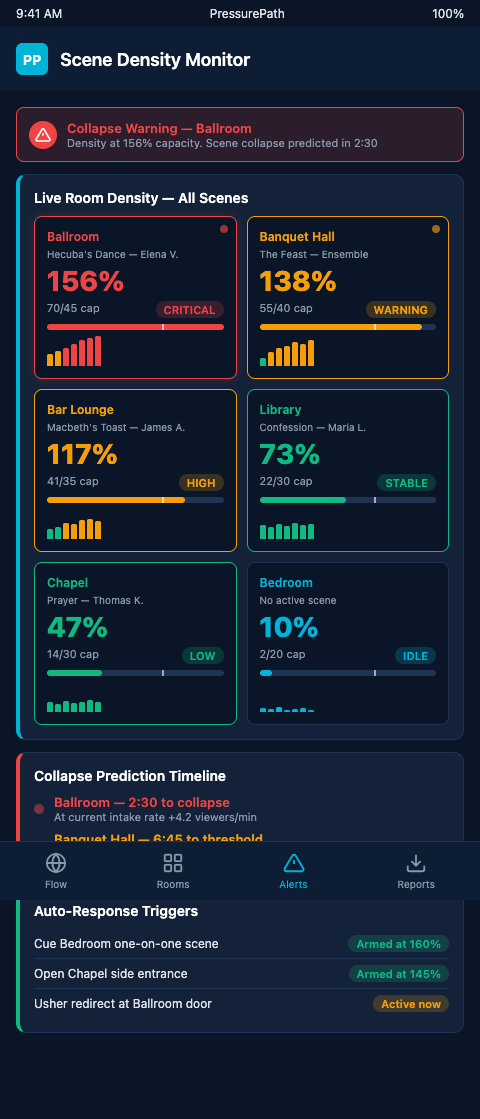
LiDAR-based spatial AI crowd management systems from Outsight provide the live detection layer: real-time heatmaps and automated density threshold alerts give stage managers a room-by-room count during the show. When Room 4 hits 85% of its sightline ceiling, the alert fires 4–6 minutes before the collapse begins, giving the stage manager time to activate a diversion — a performer appears in the corridor, a sound design element draws viewers toward the adjacent room, or the scene's cue exit fires slightly early.
The Gini coefficient approach to measuring uneven visitor density developed for museum visitor distribution analysis maps directly onto immersive theater packed scene detection. A Gini coefficient near 1.0 means extreme density concentration — one or two rooms are receiving nearly all audience traffic while others sit empty. A coefficient near 0 means uniform distribution. Productions with healthy spatial pacing typically run Gini coefficients between 0.3 and 0.5 during peak scenes. Coefficients above 0.7 signal an imminent packed scene collapse.
The pedestrian density threshold research from GMU establishes specific density thresholds at which pedestrian flow transitions from free movement to constrained movement to crowd pressure. In immersive theater rooms, the transition from free movement to constrained movement typically occurs at approximately 0.5 persons per square meter — well below the fire code maximum. Blocking arcs designed around this fluid movement threshold rather than the physical capacity limit produce scenes where audiences can maintain the voluntary repositioning that sightline-seeking requires.
Five behavioral signals that appear before a packed scene collapses:
Actor range compression. When audience density pushes past the sightline ceiling, actors stop moving to their full blocking positions because those positions are occupied by viewers. The performance contracts toward the back wall — a visible signal that a stage manager monitoring the room can detect within the first 60 seconds of compression.
Corridor backup. Viewers arriving from upstream scenes who cannot enter the packed room stack in the corridor outside. A stage manager observing the entry corridor sees a queue forming — a direct indicator that the room's inlet is overloaded.
Viewer repositioning. Viewers who have entered the room and lost their sightline begin lateral movement — stepping sideways, rotating, attempting to find a gap. Repositioning behavior is observable and distinguishable from the normal stillness of an engaged audience.
Head-turn density. Low-cost head-movement tracking as a proxy for crowding-induced disengagement shows elevated head-turn rates when viewers are blocked from their sightlines. Stage managers can train themselves to read this signal visually without instrumentation.
IoT density threshold alerts. IoT overhead sensors in theme park and venue contexts have demonstrated the ability to reduce crowd bottlenecks by 45% through automated threshold alerts. The same sensor infrastructure deployed in immersive theater venues gives stage managers the data feed they need before the collapse sequence is underway.
One additional detection approach worth noting for productions in early development is the shadow performance. Before the production opens, run a full-capacity walkthrough where production staff simulates the audience by distributing themselves across the venue according to the flow model's projected densities. The stage manager calls the density at each room at each timestamp while the performers run the full show. This walkthrough reveals which scenes receive fewer or more observers than the flow model projects, calibrating the model before the first paying audience. Shadow performances cost less than a single night of audience flow failures discovered in tech week.
For the spatial framework that explains why these pack situations develop — what creates the pressure gradient between a high-density scene and the rooms around it — the dead rooms primer covers the upstream conditions that produce both packed scenes and dead rooms simultaneously in the same venue. The tools that provide continuous density visibility during a run are the same ones covered in the scene density tracking tools framework, which pairs with this detection approach. The same peak-density warning infrastructure used in high-attendance attraction contexts translates directly here: peak-night surge warning signs in haunted attractions are structurally identical to the packed scene signals described above, with the same 4–6 minute detection window before collapse.
From Detection to Intervention
Detecting a packed scene 4–6 minutes before collapse gives a production the intervention window it needs. The three most effective interventions at that window are: early cue-exit in the packed scene (fires before the climax to begin releasing viewers), corridor activation (a performer or design element creates pull toward the adjacent room), and inlet restriction from upstream (a stage manager or performer positioned at the entry corridor meters the inflow rate).
PressurePath models the intervention options and their projected effect on density at each timestamp. When the simulation shows Scene 4 reaching its sightline ceiling 12 minutes into Act 2, it presents the three intervention options with projected outcome timelines: which adjustment restores Scene 4 to 85% capacity within 3 minutes, which restores it more slowly but has no downstream effects, and which creates a second-order pressure problem in Scene 5.
The stage manager's cognitive load during a packed scene intervention is significant. Without a pre-modeled intervention plan, the stage manager must simultaneously assess the density reading, identify the source of excess pressure, select an intervention, communicate it to relevant performers, and monitor the effect — all in a 4-to-6-minute window. With PressurePath's pre-modeled intervention plans, the stage manager is executing a documented protocol rather than improvising a solution. Each packed scene in the flow model has an associated intervention card: the trigger threshold, the specific intervention, the performer or design element to activate, and the expected resolution timeline. The reduction in real-time cognitive load is measurable in both intervention accuracy and response speed.
Packed scene detection across a multi-night run also reveals patterns that single-night observation cannot. A scene that packed on Friday but not Thursday shares a structural cause — likely an upstream cue that fires later on Fridays because of a different cast configuration or because of show-length variability. Comparing the Friday density record against the Thursday record in the flow model identifies the divergence point within minutes, producing a targeted cue-exit adjustment for the following Friday rather than a general pacing review.
Stage managers who have worked with PressurePath's packed scene detection layer before opening night know exactly which intervention to activate — and when — before the collapse sequence begins. Directors interested in building this detection infrastructure into their next immersive production: join the waitlist for immersive theater companies and model your packed scenes before tech week.