Safety Inspection Prep: How Flow Data Cuts Violation Risk
What Fire Marshals Actually Look at When They Walk Your Haunt
A fire marshal inspecting a haunted attraction in Virginia cited three violations in pre-season inspection: blocked egress path at Room 11 exit, occupant load documentation that didn't account for peak density conditions, and insufficient evidence that the operator had modeled crowd flow through the special amusement assembly occupancy. The owner had run the haunt for six seasons without a citation. The change was a new inspector who applied the full NFPA 101 special-amusement provisions rather than the lighter check the previous inspector had run.
The violations weren't about physical conditions — the exits weren't actually blocked, and the occupant load was technically correct. They were about documentation: the operator couldn't demonstrate, with numerical evidence, that they had calculated interior density at peak conditions and verified that it remained within assembly-occupancy egress requirements across all exit paths.
NFPA 1 code requirements for haunted houses per the NFPA blog establishes that haunted houses must comply with assembly-occupancy egress rules. QRFS's comprehensive breakdown of IBC/NFPA requirements for haunted houses details the special-amusement-building category and its documentation requirements. The Fairfax County fire marshal guideline for haunted house inspections makes the documentation requirement explicit: density and flow plans showing occupant load and egress capacity are required for inspection.
The pattern cited by WMOK reporting on haunted house safety inspections is consistent: state fire marshals check for blocked egress and crowd density controls before the season opens. Operators who can't show numerical density controls — not just physical configurations — are increasingly receiving citations.
Building the Flow Documentation File That Satisfies Inspection
Flow data for inspection purposes isn't the same as actor timing data. Fire marshals don't care whether your Butcher Room actor has a clean strike zone. They care whether your occupant load at peak conditions produces density that exceeds NFPA assembly-occupancy limits, whether your egress paths can accommodate that peak occupant load within the required egress travel time, and whether the operator has documented both calculations in advance.
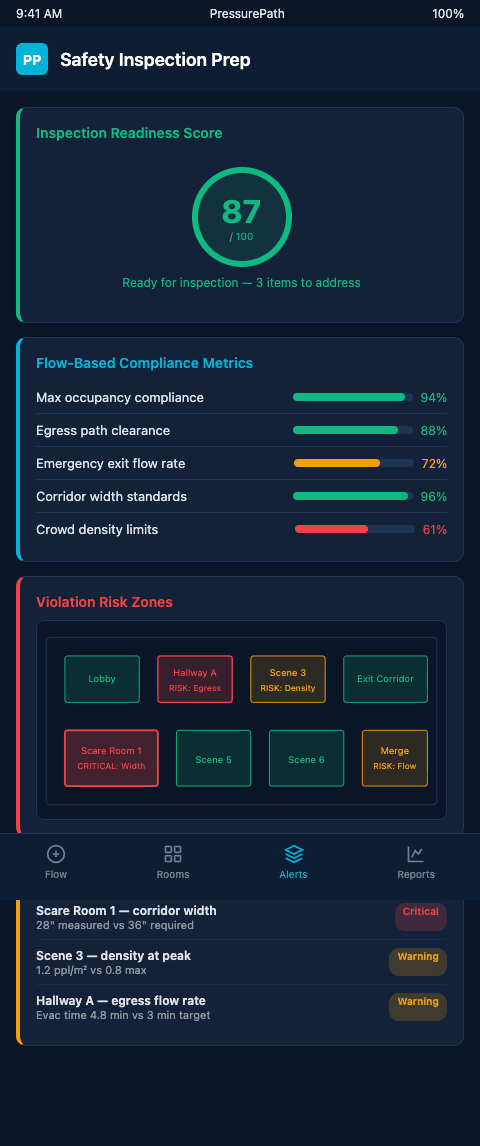
The pressurized-water model that PressurePath uses for actor timing serves the safety inspection case with the same data. When crowd flow is modeled as a fluid through pipes, the output includes per-room density at peak ticket load — exactly the occupant-load-per-square-meter calculation that inspectors require. The difference is framing: the same density number that tells an actor their strike zone is compromised also tells a fire marshal whether the egress path from that room is adequate for the occupant load.
University of Maryland/ESSR life safety guidelines for haunted houses require documentation that includes floor plans with occupant-flow paths and density calculations. The specific requirement is not just a floor plan — it's a floor plan annotated with expected density per section at peak capacity. That annotation is the output of a pacing model applied to the floor plan.
Building the inspection file from flow data requires three document types. First, the annotated floor plan: each room and corridor marked with peak-capacity occupant density, calculated from the pacing model at maximum ticket volume. This directly addresses the occupant load documentation gap cited in Virginia. Second, egress flow calculations: for each exit path, the expected occupant flow rate at peak density and the time required to clear the assembly to safe capacity. Third, the operational control evidence: the batch interval and stagger system that prevents the attraction from simultaneously reaching peak occupant load across all rooms. This is where the pacing model's simulation output — showing that staggered entry prevents simultaneous peak density across all zones — provides evidence that the operator has an active control mechanism, not just a static floor plan.
Telgian's inspection preparation guidance confirms that organized flow documentation produces faster inspections and less-stringent re-inspections. Inspectors respond to operators who clearly understand their density conditions; they escalate scrutiny for operators who seem unaware of peak-load conditions inside their own attraction.
The safety throttle prevention work from earlier in the season is directly connected: the density controls built to protect actor timing — batch intervals, stagger adjustments, entry throttling — are the same controls that satisfy the inspector's requirement for documented crowd management. One model, two compliance uses.
HS Injury Law's analysis of haunted house liability makes the stakes clear: overcrowded exits are the primary liability trigger points, and documented flow controls provide legal protection. Flow documentation isn't just an inspection requirement — it's the evidence base for liability defense if an incident occurs during the season.
Advanced Prep: Cross-Season Data and Multi-Night Documentation
Single-night inspection prep is the minimum. Advanced inspection preparation builds a cross-season documentation archive that shows the inspector not just that you calculated density for pre-season review, but that you tracked density controls across 40 peak nights and maintained compliance throughout.
The 40 peak-nights breaking points dataset is the operational record that becomes the inspection archive. When every peak night's pacing model output is logged — batch intervals used, maximum density reached per zone, any threshold breaches and the corrections applied — the inspection documentation is built as a byproduct of normal operations rather than assembled under deadline pressure before the inspector arrives.
This cross-season record serves two purposes. For re-inspection, it shows a continuous compliance history rather than a single pre-season snapshot — inspectors give significantly more latitude to operators who demonstrate consistent monitoring. For multi-year operations, it provides the trend data needed to identify which rooms are approaching density limits as ticket sales grow, allowing preventive renovation rather than reactive citation response.
Field trip day audit principles from children's museum design offer a parallel framework: systematic peak-day documentation that accumulates into an operational evidence base. For museums, field trip days are the peak-load events that stress capacity systems most severely; for haunted attractions, peak Saturdays play the same role. Systematic documentation during those peak events produces the inspection-ready archive that ad-hoc preparation cannot replicate.
The practical workflow: PressurePath exports an inspection-formatted density report at the end of each peak night. The report includes maximum density reached per zone, the batch interval in use, any threshold alerts triggered, and the corrective actions taken. Accumulated across 40 nights, that archive addresses every documentation criterion that fire marshals apply — not just the pre-season floor plan requirement.
A concrete archive structure worth building from week one: per-night PDF export containing the peak density reading for each of your 14 chambers, the batch interval schedule with clock-time transitions, the ticket count scanned, and a signed operator attestation that density thresholds were monitored throughout the operating window. File those 40 reports in a single folder organized by date. When the inspector arrives for the following season's pre-opening review, the folder becomes the answer to every documentation question they raise — and inspectors who see a 40-night compliance archive rather than a single pre-season floor plan consistently approach the inspection as a verification exercise rather than a discovery exercise. That shift in posture is the documentation dividend of systematic operational recording, and it is what separates operators who pass re-inspection routinely from operators who renegotiate their occupant load interpretation every year.
Build Your Inspection Archive Before the Inspector Schedules the Visit
The inspection archive is the single piece of infrastructure most haunted attraction operators build at the wrong moment — after receiving a citation rather than before the inspection is scheduled. Building it in advance is operationally cheaper and compliance-stronger. For a 40 peak-night season, the archive is 40 PDF exports of roughly two pages each — total preparation effort is minutes per night when the pacing model generates the report automatically, or hours per night when the data is reconstructed manually from scratch. The difference between those two workflows is the difference between passing re-inspection with latitude and defending an occupant load interpretation against a skeptical inspector. Build the archive from night one of the season, file each report as it generates, and the pre-opening inspection for next season becomes a conversation about the existing documentation rather than a scramble to assemble it.
PressurePath generates fire marshal-ready density documentation as a direct output of the pacing model haunted attraction designers use for actor timing. Stop building your inspection file from scratch every season. Join the waitlist and get the flow data format that satisfies occupant load documentation requirements before pre-season inspection is scheduled.