When to Split Audiences: Flow Thresholds for Multi-Track Shows
The Company That Split Too Late
A 14-scene immersive production in a converted warehouse ran at 140 audience members for its first six months. The show was designed for 90. The producers had added bodies to cover rising rent costs, and the stage management team had adapted — adding ushers, adjusting cue timing, compressing the opening scene distribution. By month four, the SM was describing Act 3 as "controlled chaos." By month six, two Act 2 scenes were running at double their sightline ceilings consistently, and the director had requested that the producers cap attendance. They hadn't.
At month seven, the producers agreed to split the audience into two tracks: Track A through the north wing, Track B through the south wing, with scenes designed to converge at the finale. The split required 6 weeks of additional production design, 3 weeks of rehearsal, and reopened at a higher ticket price. The production recovered. But the six months of degraded experience had already generated a review record that the split couldn't erase.
Splitting audiences enables personalized-path experiences (Making Immersive: Creating Audience Journeys, IEN) — but that potential is only realized when the split is structurally motivated, designed intentionally, and implemented at the right moment rather than as a crisis response.
The Density Threshold That Triggers the Split Decision
The fluid dynamics research is clear about when crowd flow breaks down. Density thresholds of 3-4 persons per square meter create congestion; above 5 ppm² flow becomes unstable (Flow Rates, Densities and the Maths, InCrowd Safety) — these are the physical parameters that translate directly to immersive theater scene rooms and corridors. A scene room of 50 square meters with a sightline design target of 25 viewers is operating at 0.5 ppm² — well within stable flow. Add 50 more audience members routed toward it and the density hits 1.5 ppm². Add 100 more and certain corridor approaches will breach the 3-4 ppm² congestion threshold during transition moments.
The split threshold in PressurePath's model is defined not by total audience count but by scene-level density events. A density event occurs when a scene room or corridor exceeds its stable flow threshold for more than 3 minutes during a performance. Research identifies density thresholds at which crowd flow breaks down and splitting becomes necessary (Self-Organized Pedestrian Crowd Dynamics, INFORMS) — the empirical threshold at which individual audience member behavior shifts from independent to herding behavior sits in the 1.5-2.0 ppm² range for indoor environments. Below this, audience members navigate independently. Above it, they follow each other.
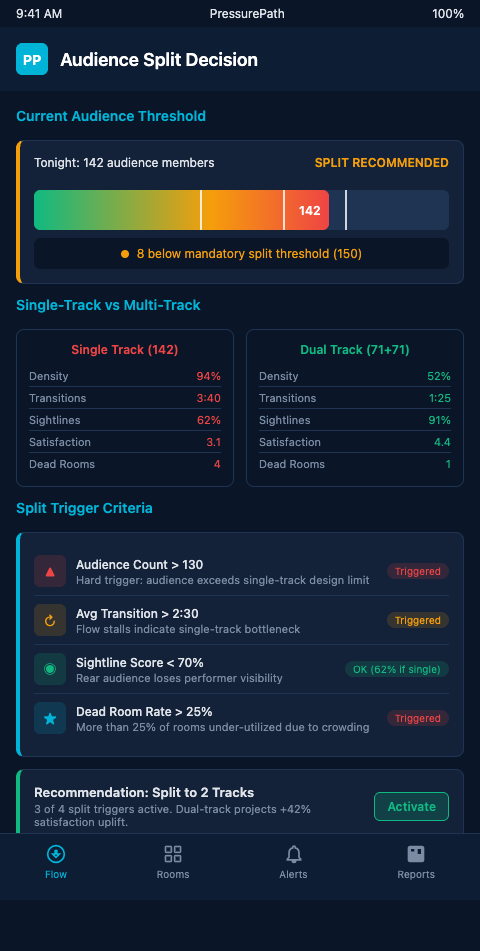
The rule: when the production simulation shows that more than 2 scenes per act will exceed the herding threshold in more than 40% of simulated performances at the current capacity, the single-track format has reached its structural limit. That's the split trigger.
This threshold is precise enough to be actionable: it doesn't say "the show feels crowded." It says "at 160 audience members with your current corridor geometry, Acts 2 and 3 will each have three scenes breaching 2.0 ppm² in 47% of simulated configurations. The single-track format cannot sustain this capacity without systematic blocking arc degradation." Cross-format comparison with second-path flow thresholds in haunted attractions shows the same split-decision methodology applied to a higher-throughput, shorter-arc format.
PressurePath generates this threshold analysis from the venue geometry, scene room dimensions, corridor widths, and current capacity. The output is a capacity-vs-density-event chart that shows exactly where the single-track limit sits — and how far below it the production is currently operating.
Tests of thresholds for when directed routing improves outcomes in location-based immersive theater (Dynamic Location-Based Immersive Dance, ACM) provide empirical validation from a related format. The ACM research found that directed routing — equivalent to audience splitting — improved experience quality metrics when crowd density exceeded the herding threshold but actively degraded them at lower densities. This is the anti-over-splitting warning: splitting too early fragments an audience that was functioning well as a single group, which can undercut the collective energy that certain scenes depend on.
Organizers begin interventions at 75% of maximum density — the buffer-threshold principle (Festival Crowd Density, Ticket Fairy) — the equivalent buffer in immersive theater is running the split decision model at 75% of the simulated threshold, not 100%, to ensure the split is designed and rehearsed before the production hits structural failure.
Designing the Split: Track Architecture and Convergence
Once the threshold analysis justifies a split, the design decision is how to architect the two tracks. The SPH fluid dynamics simulation identifies pressure build-up zones for split placement decisions (SPH Crowds, ScienceDirect) — in practice, the split point should be placed at the highest-pressure node in the current single-track simulation: the scene or corridor where density events are most frequent and most severe.
Track A and Track B don't need to be mirror images. They need to be pressure-balanced: each track should have approximately equal total capacity absorption across its scenes, so that neither track becomes a default-heavy path. If Track A has two magnet scenes and Track B has one, audience members may resist Track B assignment, re-routing back to Track A and defeating the split's purpose.
The convergence point — where both tracks rejoin for the finale — requires special attention in PressurePath's analysis. The convergence is a pressure spike: two separate streams suddenly merging into a single corridor or room. Immersive show structures including multi-track formats (Structures, Immersology / Strange Bird) document the convergence challenge as a consistent design problem in multi-track shows. PressurePath models the convergence explicitly: given the two-track head counts and the convergence room dimensions, does the finale have room for both tracks simultaneously, or does it require a staggered arrival sequence?
The connection to promenade path simulations is that promenade formats are a soft version of multi-track splitting — they distribute audiences through self-selection rather than directed routing. When self-selection produces problematic distributions, directed split is the structural upgrade.
The scaling analysis from 80 to 400 audience members shows where the split threshold appears on the capacity growth curve: typically between 180 and 220 for a mid-size immersive venue, though the exact threshold depends on room dimensions and corridor geometry.
The threshold logic for split decisions is format-independent; the artistic stakes for the split are lower in haunted attractions but the operational consequences of splitting too late are higher due to throughput requirements.
Know Your Number Before the Density Problem Forces the Decision
The warehouse production that split at month seven paid six months of experience degradation to avoid a production design conversation at month two. The split was always coming — the venue geometry and the capacity target made it mathematically inevitable. PressurePath would have identified the threshold at week one and given the producers a specific capacity number above which a single-track format stops working.
There's also an operational sequencing argument for early threshold analysis. When the split decision is made mid-run under pressure, the production design process is compressed: the artistic team, the set designer, the lighting designer, and the stage manager are all working simultaneously under deadline to retrofit a show structure that was built as a single track. The results are often incoherent — a split that was grafted onto the show rather than integrated with it, where Track A feels like the real show and Track B feels like an afterthought.
When the threshold analysis happens in pre-production, the split is designed into the architecture from the start. Track A and Track B can share thematic coherence. The convergence point can be choreographed as a dramatic moment rather than a logistical necessity. The production designer can ensure that both tracks have equivalent production value, not just equivalent head-count targets. The stage manager can write a call sheet that manages two tracks natively rather than maintaining a single-track sheet with manual splitting instructions appended.
This is the core proposition of threshold analysis as a pre-production tool: it moves the split from a crisis response to a design decision, and design decisions produce better outcomes than crisis responses at every level of production quality.
Peer-reviewed theme-park queue management research (PMC) demonstrates how spatial analytics identify hot zones and routing patterns across complex venue flows — for immersive productions, these analytics not only identify where splitting is needed but validate whether the split, once implemented, is producing the expected distribution. Post-split PressurePath modeling should confirm that both tracks are operating within sightline ranges and that the convergence scene is receiving its intended population. The threshold analysis opens the inquiry; post-split validation closes it.
Immersive theater companies — directors, producers, and production designers — who are managing growing audience capacity or planning multi-phase runs should run the threshold analysis before capacity decisions are made, not after. Join the waitlist and apply for early access to PressurePath's beta program; bring your floor plan and your current capacity target and receive a split-threshold analysis before your next booking batch opens.
A closing note on the relationship between the split decision and the show's artistic identity. Some immersive directors resist the multi-track format because they believe it fragments the collective experience — that part of what makes an immersive show work is the shared spatial exploration among a single group, even a large one. This is a legitimate artistic position, and the threshold analysis respects it: the threshold is not a mandate to split, but a quantified description of the cost of not splitting at a given capacity.
A director who reviews the threshold analysis and decides that 50% of performances having three scenes above the herding threshold is an acceptable cost for maintaining the single-track format is making an informed artistic choice. A director who makes the same choice without the analysis is not making an artistic choice — she's making a guess that may not reflect the actual trade-off. PressurePath's contribution to immersive theater is not to make artistic decisions, but to ensure that when artistic decisions are made, they're made with an accurate picture of the structural consequences. The split threshold analysis is that picture, drawn from the physics of the venue rather than from intuition about what the show should feel like.