Scaling an Immersive Production From 80 to 400 Audience Members
The Scale-Up Moment That Breaks Most Immersive Shows
Opening night at 80 audience members, the Poisoning Monologue scene ran perfectly: 22 viewers standing within sightline range, blocking arc intact, cue exit timed to the minute. Six weeks later, producers added a second batch of tickets to match demand. The next performance had 210 people in the building — and only 11 made it to the monologue. The rest had pooled in the ballroom, the room with the widest door and the most ambient light. Nobody planned for this. Nobody modeled it.
This is the exact failure mode that Making Immersive Accessible (HowlRound) documented after Sleep No More expanded capacity: sightline walls emerged from density, reducing the show's designed intimacy even for audiences who found the right room. Adding bodies without adjusting the flow infrastructure doesn't preserve the experience — it degrades it structurally.
The Immersive Audience Report 2024 (IEN) found attendance up 80% over five years, with four out of five people who haven't attended an immersive show saying they'd like to. The pressure to scale is real. The infrastructure to do it safely is not standard practice.
What separates a production that survives scale-up from one that implodes is a model of audience behavior built before the extra tickets go on sale — not improvised walkie-talkie corrections after the house opens.
The scale-up failure mode is especially treacherous because it feels like a success story right up until the moment of collapse. Ticket demand is strong, reviews are good, producers see the financial case for adding capacity, and the director signs off because the rehearsal-scale version of the show worked beautifully. None of those signals predict that at 210 audience members, the voluntary routing dynamics shift from benign self-distribution to destructive clustering. The production that worked at 80 is not a scaled-down version of the production that needs to work at 210 — they are structurally different shows with different flow requirements, and treating them as the same show at different densities is the error that produces the scale-up collapse.
Directors who have been through one failed scale-up describe the experience as fundamentally disorienting. The actors are still excellent, the blocking is still rehearsed, the set is still the same. But the audience distribution has changed qualitatively, and the scenes that were anchored by specific viewer counts are now playing to mismatched populations. The fix is not more rehearsal or better blocking — it is a restructured flow architecture that accounts for the new density regime. Most productions discover this by spending two or three weeks of previews attempting the wrong fix before arriving at the correct one.
A Pressure-Flow Model for Audience Distribution
Open-world promenade forces route choice; scaling multiplies pathway congestion unpredictably (Together Here: Immersive Theatre, Trinity). That sentence is the core problem of immersive scale-up stated plainly. At 80 people, informal route habits work. At 400, every informal assumption produces a congestion event somewhere in the building.
The pressure-flow model treats your venue like a network of connected pipes. Each scene room has a pressure capacity — a maximum sightline-count that the director's blocking supports. Corridors and transition points act as valves or constrictions. When audience members behave like fluid under pressure, they always find the path of least resistance. If the ballroom door is wider than the library door, the ballroom fills regardless of what the script calls for.
PressurePath models this explicitly. Before you add 100 tickets to a run, you input each scene's sightline ceiling, the corridor width ratios between rooms, and the magnetic pull of each scene's visual and audio signature. The simulator then calculates expected head counts across a performance window and flags which scenes will fall below their blocking minimums or exceed their density ceilings.
At 80 audience members, many productions run in what engineers call an underpressurized state — rooms fill gradually, audience members self-distribute with enough slack that no scene becomes a dead room. Crossing 200 bodies tips the system into a pressurized state where individual choice magnifies into herd movement. Punchdrunk's spatial choreography: large crowd-drawing sequences and one-on-one must coexist (Immersive Theatre and Audience Experience, ResearchGate) — and managing that coexistence gets categorically harder at 400 because the crowd-drawing scenes pull so much harder.
The structural response has four components. First, pressure relief vents: secondary scenes or transitional spaces that draw audience members away from magnet scenes without dead-rooming. Second, valve timing: cue exit re-timing that staggers departures from high-density scenes so corridors don't flood simultaneously. Third, sightline density ceilings enforced by set design, not just headcount targets — if the set physically limits visibility above 30 bodies, that becomes your hard ceiling in the simulator. Fourth, blocking arc integrity scoring: a numerical measure of how well the spatial choreography holds across the distribution curve the simulator projects.
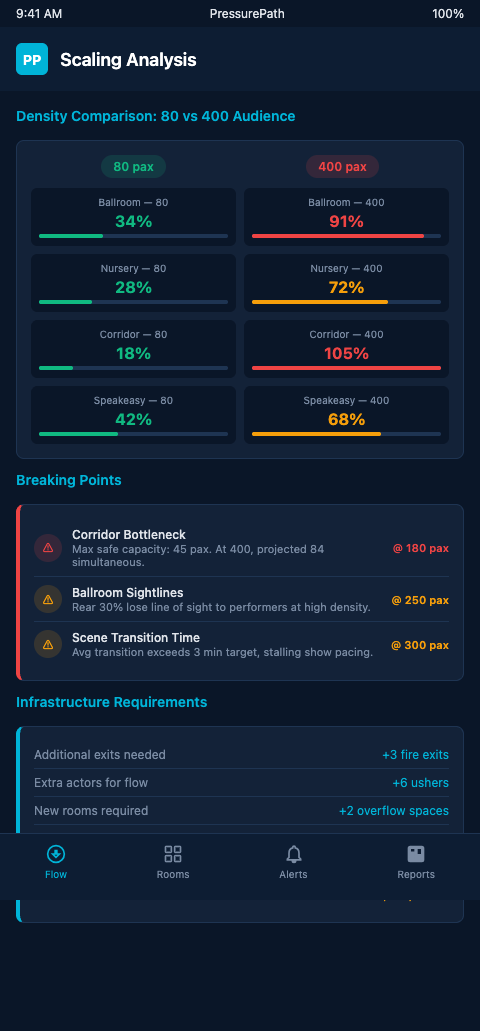
Digital twin simulations model expected crowd sizes, densities, bottlenecks before shows scale (Simulation Digital Twins, InControl) — this is the architectural analogy for what PressurePath does at the production level. The difference is that a digital twin for a venue handles physical bottlenecks, while PressurePath handles narrative bottlenecks: the moments where audience drift undermines the director's arc before the technical crew ever notices.
The Immersive Entertainment Industry Annual Report catalogued 755 new immersive shows in 2019. The vast majority of those productions never built a scaling model. They scaled by feel and discovered the problems in performance.
For productions aiming at 400, the model needs to be built at 80. Running PressurePath during the initial run captures baseline flow data — which scenes pull, which scenes repel, how corridor transitions actually behave with live bodies rather than floor plan estimates. That baseline becomes the calibration layer for the scale-up simulation.
The Immersive Entertainment Industry Annual Report documented the industry at $9.7B in valuation at the time of that report, with 755 new shows catalogued in a single year. Scale pressure existed before the pandemic and has only increased since. Directors at productions that opened to strong attendance now face questions their training never prepared them to answer quantitatively: how many is too many, and how do you know the answer before the show tells you with ruined performances?
One underappreciated dimension of the scale-up problem is cast behavior at scale. A performer who can draw audience members toward a scene at 80-person capacity — using eye contact, physicality, proximity invitations — loses most of that draw capability at 400. The performer is the same; the ratio of performer to potential audience has changed from roughly 1:8 to 1:80. This means the magnetic pull of performer-anchored scenes degrades with scale, and the pull of set-design-anchored scenes (audio signature, lighting gradient, visual spectacle) becomes proportionally more important. PressurePath accounts for this in its magnetic pull coefficient model: performer pull is weighted by the performer-to-audience ratio, while set-design pull is weighted by the physical signature magnitude independent of audience size.
From Simulation to Scale: Tactical Decisions
With a calibrated model, directors and stage managers gain tactical tools rather than reactive responses. The simulation identifies three categories of rooms at scale: stable rooms whose head counts hold within target range, volatile rooms that swing dramatically based on adjacent scene timing, and dead rooms that fall below minimum sightline counts regardless of initial distribution.
For volatile rooms, the tactical fix is usually cue exit re-timing — shifting when a high-draw scene ends its loudest, most visible moment. A 90-second stagger in cue timing can shift 15% of audience from a volatile room toward a stable one. PressurePath generates specific timing recommendations based on modeled flow rates, not rules of thumb.
For dead rooms, the fix is often set-design intervention: increase audio or visual signature strength to raise the room's magnetic pull coefficient. At scale, physical attraction matters more than soft guidance from ushers. A brightly lit room with music leaking into the corridor will draw more than a dark room that requires an usher to suggest it.
For touring productions considering scale, reading about touring flow standards alongside scale modeling helps, because the architectural constraints change venue to venue. What works at 400 in a warehouse may fail at 400 in a converted hotel.
The place-schema framework (Audience Behavior in Immersive Theatre, Tandfonline) explains why some of these problems are predictable: audiences build spatial expectations quickly, and at larger group sizes, those expectations converge into group behavior. The magnet effect of certain rooms grows non-linearly with total audience size.
Understanding the site-specific economics of capacity decisions is the other half of the scaling equation. Modeling flow without modeling revenue impact treats the problem as purely artistic — but scaling also means maximizing revenue per performance without degrading the experience that justifies the ticket price. Those two constraints need to be optimized together.
Cross-format comparison also helps: scaling pacing 4 to 12 rooms surfaces the same pressure dynamics in a tighter, competitive environment. The fluid-pressure logic translates directly.
A practical wrinkle for larger immersive productions: the relationship between capacity and blocking arc integrity is not linear. Moving from 80 to 160 typically produces manageable degradation because the show was designed with some distributional slack. Moving from 160 to 240 is often fine for the first two acts and catastrophic for Act 3 — because Act 3 scenes tend to be the most space-specific and least robust to overcrowding. Moving from 240 to 400 typically requires a fundamentally different show architecture: staged entry, formal audience routing structures, and probably a secondary track for certain scene loops.
Stage managers experienced in large immersive formats describe 200-250 as the threshold at which the production needs a dedicated flow coordinator — a person whose sole role is monitoring the pressure network in real time and adjusting usher positions, softening or amplifying scene cues, and flagging the SM when a scene is trending toward overflow or starvation. PressurePath gives that coordinator a dashboard rather than a walkie-talkie and instinct: real-time scenario projections based on the calibrated model, updated against live head-count reports.
Start Modeling Before the Extra Tickets Go On Sale
Productions that scale well share one habit: they run the flow simulation before the capacity decision, not after the first ruined performance. If your opening-run data shows the library scene underperforming its sightline target by 30%, that gap widens — not shrinks — at 400 audience members. Fix it in the model, adjust the cue sheet, then sell the tickets.
The pre-scale-up diagnostic checklist has four questions that every producer and director should answer before committing to a capacity increase. First, what is the blocking arc integrity score at the current capacity, and which specific scenes are already running at or below their sightline minimums? Second, at the proposed new capacity, which scenes does the flow simulation project to breach their density ceilings, and by how much? Third, what is the minimum set of interventions — cue exit re-timing, corridor design changes, magnet scene installation — needed to maintain the blocking arc integrity at the new capacity? Fourth, what is the cost and schedule of those interventions, and is there sufficient time to implement them before the new ticket batch goes on sale?
A production that can answer all four questions with specific numbers is making an informed capacity decision. A production that can only answer the first question — and guesses at the rest — is speculating with the audience experience as the wager. The simulation converts those speculations into quantified projections that producers can present to their artistic team and that directors can present to their producers. Shared quantified understanding is the prerequisite for a scale-up decision that both sides can commit to.
PressurePath works best when the artistic team treats flow data as a design input, not a post-mortem.
Immersive theater companies scaling their flagship productions: apply for early access to PressurePath and get a calibrated model built on your actual venue layout before committing to capacity targets.