Actor Injury Prevention Through Flow-Aware Scene Design
The Geometry Problem Behind Actor Injuries
On a busy peak night, a haunt actor working a jump-scare position in a 5-foot-wide corridor faces a predictable physics problem. The guest startles, recoils backward, and their arm swings into the actor's forward space — not as an attack, but as an involuntary defensive reflex. The actor takes a hit to the forearm, the shoulder, occasionally the face. The costume absorbs some of it. The actor's body absorbs the rest.
Actor Safety in Haunted Attractions (HAN) documents this pattern directly: startled guests regularly strike performers, and placing hands protectively is an actor adaptation to a systematic environmental hazard, not an adequate engineering solution. Haunted House Acting Is High-Risk Job (JackCentral) catalogs the broader injury profile: daily incidents from darkness collisions, harness burns, dehydration from costumes in enclosed spaces, and repeated physical contact from startled guests.
The pattern that connects most preventable contact injuries is this: they happen when groups arrive at the actor's position faster than the geometry allows the actor to clear. A scare that works safely at a 55-second spawn interval becomes a contact hazard at a 32-second interval because the actor's retreat path is occupied by the previous group's exit. The physics of the injury is a flow problem, not a training problem.
Haunting Comes with Hazards (UPNorthLive) reinforces this: injuries spike on high-density nights specifically when crowd pacing breaks down and guests start running in corridors. When guest movement patterns shift from walk to run, every actor's safe-zone geometry collapses because the assumed approach velocity is wrong.
Flow-Aware Scene Design: Engineering Safety Into the Geometry
The most effective actor injury prevention is not training — it is engineering. Theater Safety: Hierarchy of Controls (Entertaining Safety) establishes that engineering controls — scene geometry, sightlines, pathways — are more effective than procedural or administrative controls. OSHA Ergonomics — Control Hazards confirms that engineering controls are OSHA's preferred first-line intervention, and that redesigning spatial flow reduces musculoskeletal disorders and contact injuries more reliably than PPE or behavioral training.
Flow-aware scene design applies the pressurized-pipe mental model to actor safety. The pipe has a rated pressure. Beyond that pressure — the spawn interval at which groups begin arriving before the actor's retreat path is clear — the actor is in physical danger regardless of their training or reflexes. The engineering task is to define that pressure threshold for every actor position in the haunt, then design the scene geometry to ensure the actual spawn interval stays below it.
Four specific geometry changes reduce actor injury risk in a flow-aware design:
Extend sightline entry distance. The further the actor can see an incoming group before they arrive, the more time the actor has to complete their scare arc and clear the strike zone. Extending the approach corridor from 12 feet to 20 feet gives an actor 4 to 6 additional seconds of visual warning at a 4-foot-per-second walk pace. That 4 to 6 seconds is often the difference between a safe retreat and a contact event.
Add lateral retreat paths. Most contact injuries happen when the actor's only exit is forward through the same corridor the guest is occupying. A false wall with a cutout 18 inches behind the actor's scare position creates a lateral exit that takes the actor out of the guest's forward path entirely. PressurePath's actor strike zone simulation models this as a safe-zone polygon — the spatial region the actor can occupy during each phase of their scare arc without entering the guest's recoil trajectory.
Set spawn interval floors by actor position, not by room. A multi-actor room like a 20-person ensemble scene has multiple active strike zones with different reset requirements. Running a single spawn interval for the entire room means the actor with the tightest reset geometry is perpetually under-protected. Flow-aware design assigns a spawn interval floor to each actor position and derives the room's overall interval from the most constrained position. The 20-actor scare workflow implications of this approach are covered in 20-actor scare workflow design.
Model fatigue-adjusted safety margins. Introduction to Performing Arts Safety (UCOP) notes that "show must go on" culture overrides safety, and that time-pressure and fatigue compound physical risk. An actor who is physically fresh can absorb and respond to an unexpected guest trajectory. The same actor at hour three of a peak night has slower reflexes and higher contact vulnerability. PressurePath's fatigue modeling layer lets you overlay actor rotation schedules against density peaks to identify when your safety margins are at their thinnest.
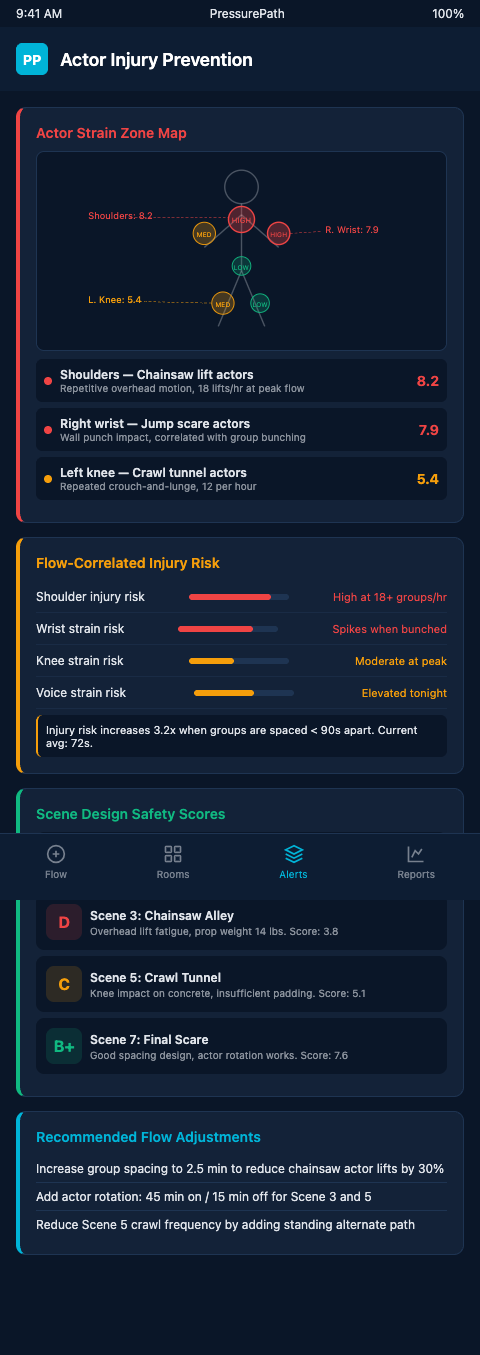
How to Enhance Haunt Actor Safety (Sithon) covers actor management software for incident logging and safety coordination — the operational layer that sits on top of the geometry engineering. PressurePath's flow model feeds the incident-tracking layer: when a scene's spawn interval exceeded its design floor during a logged incident, the simulation record shows exactly which upstream density event caused the overpressure.
Advanced Tactics: Multi-Scene Safety Integration
Flow-aware scene design is most powerful when it runs across the entire haunt rather than room by room. The reason: an injury-prevention geometry fix in Room 4 can create a flow restriction that increases density in Room 6 if the two rooms are not modeled together. Fixing one bottleneck without seeing the downstream effect is how "safety improvements" inadvertently increase injury risk elsewhere.
Real-time actor cue systems can close this gap. When an actor in Room 4 signals completion of their scare arc, the spawn timing system knows the room is clear and issues a release signal for the group waiting in the corridor. The linkage between real-time actor cues and group spacing covers how in-room completion signals feed the spawn interval calculation across the full walk-through.
The data integration between safety modeling and operations goes deeper than geometry. When PressurePath flags a scare position as operating above its safe spawn interval floor, that flag is actionable in two directions: it can trigger a gate-hold recommendation to restore spacing, or it can trigger an actor rotation to replace a fatigued performer before they lose the reflexes needed to clear their strike zone safely. The choice between those responses depends on whether the over-pressure condition is temporary — a bunching event from an upstream group slowing at a decision point — or structural — a ticket count that consistently produces intervals shorter than the floor.
Distinguishing those two causes before opening night requires running the flow model at your target ticket count and checking whether the fatigued-actor adjustment (slower retreat times, longer reset windows) changes the safety floor calculation materially. If a fresh actor has a safe floor of 44 seconds and a fatigued actor's effective floor is 54 seconds, that 10-second delta represents the operational window where the system is safe with fresh actors and unsafe with fatigued ones — the rotation schedule has to close that window.
For the children's venue context — where similar flow geometry principles apply to child-scale movement and different safety considerations — scaling flow data across 40-exhibit floors shows how exhibit designers use the same spatial safety modeling at a different scale and demographic.
The Role of Scene Geometry Documentation in Safety Continuity
Flow-aware scene design produces its maximum safety benefit when the geometry specifications are documented and carried forward each season. Most haunts rebuild set pieces annually, and without documentation of the original safety geometry — the exact corridor width at the Clown Alley entry, the precise distance from the Butcher Room actor's starting mark to the sightline break — each rebuild introduces micro-deviations that accumulate into meaningful safety drift.
A set piece that moves 18 inches forward to accommodate a new prop narrows the approach corridor from 14 feet to 12 feet and reduces the actor's visual warning time by approximately 1.5 seconds at normal walk pace. On a moderate-density night, that 1.5 seconds is absorbed safely. On a peak night where groups are arriving at 38-second intervals, it creates a contact hazard that was not present in the prior season's design.
PressurePath's geometry documentation layer records the safety-critical dimensions of each actor position — approach corridor length, sightline break distance, retreat path width — as part of the flow model. When a new season's set construction deviates from those dimensions, the system flags the geometry change and recalculates the safety floor for the affected position. The floor manager reviewing the pre-season simulation gets an alert: "Clown Alley approach corridor shortened by 18 inches — safety spawn interval floor rises from 44 to 50 seconds at current ticket count." That alert prevents the injury before it occurs.
Model Your Actor Safety Margins Before Peak Night
PressurePath's actor strike zone simulation shows you every position in your haunt where the current spawn interval creates a contact-risk scenario, and what geometry change resolves it. Join the waitlist for haunted attraction designers and run your flow-aware safety model before your actors take the floor on opening weekend.