The Next Decade of Pacing in Immersive Horror Attractions
Where Horror Pacing Stands Today and Why It Will Not Scale Forward
On October 28th, 2025, the best-run haunts in the country were using timed entry tickets, manual gate operations, and actor-to-radio communication to manage crowd flow. Those tools are not wrong — they are the correct tools for the current scale. They will not be the correct tools for the scale that comes next.
Immersive Entertainment Market (Mordor Intelligence) projects the global immersive entertainment market at $473.9 billion by 2030, growing at 23.5% CAGR with the horror segment leading growth. Immersive Entertainment Business Analysis 2025 (BusinessWire) adds $340 billion in growth for the 2024–2030 period driven by consumer demand for hyper-realistic experiences.
That growth will require attractions to process significantly more guests per night while maintaining the timing precision that makes fear work. Manual gate operations introduce 8 to 14 seconds of release variance. At 400 tickets per night, that variance is survivable. At 800 tickets per night across a multi-path haunt with 30 actor positions, it produces cascade failures that manual intervention cannot catch in real time.
The HAA 2025 State of the Industry (HAN) identified AI adoption for operational streamlining as a strategic priority — the first time the Haunted Attraction Association has named AI explicitly as an operational direction rather than a novelty.
The Pacing Technology Stack of the Next Decade
The next decade will see three distinct technology layers added to the haunt operations stack. Each builds on the previous one, and each addresses a different point in the pressurized-flow model: inlet pressure control, corridor pressure regulation, and chamber pressure sensing.
Inlet pressure control: predictive ticket release. The current state is timed entry tickets with fixed intervals. The next state is dynamic release scheduling based on predictive crowd composition modeling. If your 7:00 PM session historically contains disproportionately more teenage groups who walk faster and cluster less than the 8:30 PM families-with-children session, the spawn interval for the 7:00 PM session can be compressed slightly — not enough to degrade scare delivery, but enough to increase effective throughput during the hour when your actors are freshest.
ST-ResNet Crowd Flow Prediction (ScienceDirect) demonstrates how temporal closeness, periodic pattern, and long-range trend modeling combine to produce minute-level crowd flow forecasts for attraction-scale venues. PressurePath's predictive release module uses this kind of temporal modeling to shift interval recommendations based on time-of-night and queue composition data.
Corridor pressure regulation: real-time density feedback. The current state is radio communication when an actor notices groups stacking. The next state is automated density alerts from corridor sensors that trigger gate holds before the stack reaches a scare chamber. Top 8 Technology Trends in Attractions 2026 (Blooloop) confirms that RTLS (real-time location systems), computer vision, and AI flow tools are being deployed by major attractions now — the cost curve that makes seasonal haunt deployment viable within three to five years is already visible.
Chamber pressure sensing: actor-state monitoring. The most advanced layer — and the furthest from current deployment at seasonal scale — is direct actor-state monitoring: wearable sensors that detect when an actor has completed their scare arc and trigger automatic release signals for the next group. This closes the feedback loop that currently relies on manual actor-to-gate radio calls. The connection between spawn timing and actor cue state — the interface that makes this layer work — is covered in detail in machine-driven spawn-in timing.
Playing With Fear Field Study (PMC) validated that EEG measurement of fear states is operationally feasible and that pacing precision directly controls the quality of fear experience. The research infrastructure for actor-state monitoring exists; what remains is miniaturization and cost reduction to seasonal-operation scale.
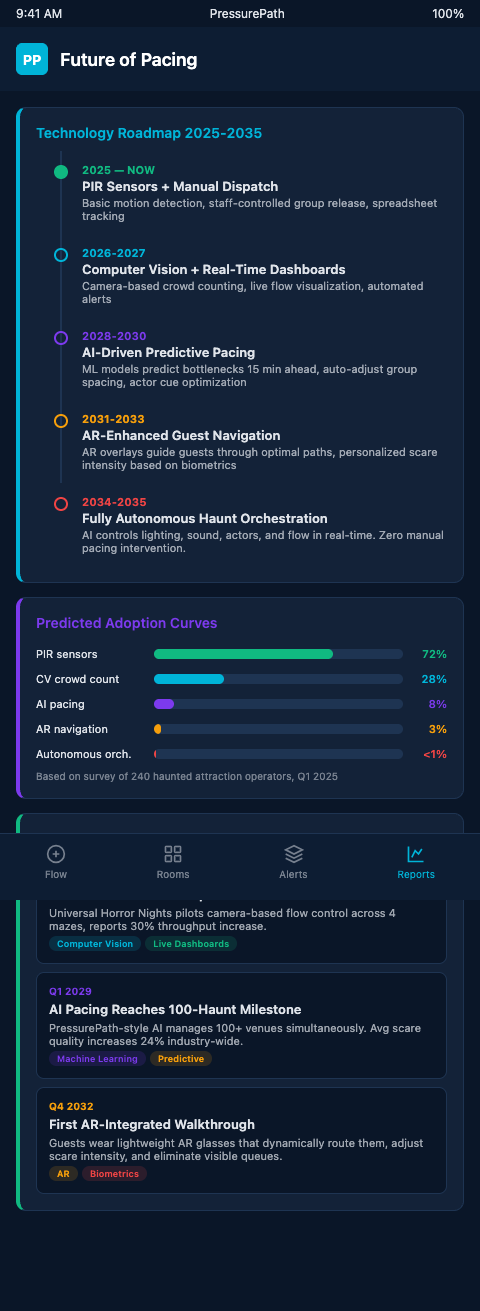
For context on how experimental theater productions are applying the earliest versions of these same technology layers in non-seasonal performance environments, future pacing tech in experimental theater documents where advanced pacing technology is proving out ahead of horror-specific deployment.
Advanced Tactics: Preparing for the Technology Transition
The operators who will extract maximum value from the next decade's pacing technology are those who build simulation-driven operations now, before the hardware arrives. The reason is data. PressurePath's simulation layer generates the historical baseline — recorded as modeled flow data — that machine learning prediction systems need to produce useful forecasts. An operator who runs three seasons of simulated flow modeling before deploying sensor hardware arrives with three years of training data rather than starting from zero.
The second preparation is standardization. Multi-decade pacing technology adoption will favor operations with documented spawn interval standards, actor reset window specifications, and corridor capacity baselines. Pacing simulators versus ticket scanners covers how current-generation simulation tools establish the operational baselines that the next generation's AI systems will read as their ground truth.
Top 11 Immersive Trends 2025 (Blooloop) identifies sensor integration, real-time flow management, and AI personalization as the defining investments of 2025 and beyond. For haunts, AI personalization will eventually mean adapting scare intensity and actor cue timing based on observed group response in previous chambers — a flow model that learns your guests as they move through the haunt and adjusts downstream scare delivery in real time.
The operators who build their flow-modeling discipline now — who know their spawn intervals, their chamber reset windows, their peak-night density ceilings — are the ones for whom that personalization layer will be a feature addition rather than a foreign technology.
The third preparation is investment staging. The three technology layers described in the solution section — predictive ticket release, corridor pressure regulation, and chamber pressure sensing — do not need to be deployed simultaneously. A phased approach that starts with the simulation-first baseline, then adds entry-point sensors in year two, then mid-corridor sensors in year three, spreads capital expenditure across seasons while building operational experience at each layer. Haunts that attempt full deployment in a single season regularly encounter calibration failures because their staff has not developed the operational habits that the technology requires: trusting the machine signal over manual judgment, logging deviations rather than overriding silently, and updating the flow model when the physical layout changes.
Calibration failure is the single most common cause of machine spawn timing underperformance. The cure is a staged deployment that matches technology complexity to operational readiness — which is exactly the staging that a simulation-first PressurePath build provides.
What the Industry's Early Adopters Are Learning Now
The haunts running the earliest versions of sensor-driven spawn timing are not the largest operations in the industry — they are mid-size attractions with technically inclined owners who moved on sensor deployment two to three years ahead of mainstream adoption. Their experience is producing a consistent set of lessons that will shape how the technology scales across the industry.
The first lesson: the simulation model is more important than the sensor hardware. Operators who deployed sensors without first establishing a PressurePath-style simulation baseline found that the sensor data was difficult to interpret because they had no reference curve to compare it against. Sensors tell you what is happening; the simulation tells you whether what is happening is within specification or outside it. Without the specification, sensor data is noise.
The second lesson: peak-night actor fatigue is the variable the technology has not yet solved. Sensors track group position and density accurately. They cannot track actor performance state. A spawn interval that is mechanically correct — group arrives at the scare chamber after the previous group exited — is not necessarily safe or effective if the actor is in hour four of a peak night and their reflexes and energy are depleted. The next generation of pacing technology needs an actor-state input, and the haunts working on this problem now are experimenting with simple proxy measures: heartrate wearables, shift-duration timers, and actor self-report systems that flag when a performer requests a rotation before their scheduled break.
Haunts that build simulation-first operations now will be positioned to integrate actor-state inputs into their spawn timing systems as those measurement tools mature — because they already have the flow model architecture that the actor-state data needs to plug into.
The Fear-State Personalization Horizon
The longest-horizon item on the pacing technology roadmap is fear-state personalization: adapting scare timing and intensity to each specific group's observed arousal state as they move through the haunt. The biological research foundation for this is already solid — Playing With Fear Field Study (PMC) validated that EEG measurement of fear states is feasible and that pacing precision controls fear experience quality. What is not yet feasible at seasonal scale is capturing that state data continuously for each group as they traverse the haunt.
The practical path toward personalization runs through voluntary pre-entry sensing: wristbands that capture heart rate and galvanic skin response, with guest consent, that feed anonymized arousal data to the spawn timing system. When the system detects that a group entering the Butcher Room shows low arousal — they are not scared yet, they are in curiosity state — it can signal the actor to deliver a slower-build approach rather than an immediate jump scare. When a group entering Clown Alley shows high arousal from a previous chamber encounter, the actor can amplify the strike timing for a compounding effect.
The actors who perform best at peak nights five years from now will be those who have trained with a simulation system that gives them feedback on group arousal state — building the intuition for reading a group's fear state visually before that data is available digitally.
Position Your Haunt for the Next Decade of Pacing Now
The haunted attraction operators who arrive at the 2028-2030 sensor deployment window with the most leverage will be the ones who built their flow modeling discipline three seasons earlier. The reason is not sentimental — it is operational. A PressurePath simulation baseline generated in October 2026 becomes the training data for the machine learning prediction system deployed in October 2029. An operator without that baseline arrives at sensor deployment with raw data and no reference curve, which produces 12-18 months of calibration noise before the system delivers meaningful recommendations. Three seasons of simulation data compresses that calibration period to 2-3 weeks.
The practical sequence is clear. Run the pre-season simulation this year. Log the deviations between model prediction and floor observation. Refine the model next year. By the third season, your flow model is calibrated to your specific haunt's behavior rather than industry averages, and you are operationally ready to layer sensor hardware onto a proven simulation baseline rather than starting from scratch. That is the competitive advantage of building early — not the technology, but the data and the operational habits that make the technology useful.
PressurePath gives haunted attraction designers the simulation foundation that next-generation pacing technology will build on. Start modeling your flow now, and arrive at the sensor hardware era with three seasons of calibrated data rather than starting fresh. Join the waitlist for haunted attraction designers and access the pacing roadmap module alongside your current-season simulation tools.